Search
155 items
-
Kati
Description of Kati, a game played by Santhal communities in Jharkhand, India -
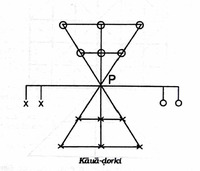
Kaua Dorki
This game has been recorded by Charu Chandra Das Gupta in 1983 at Kosam village situated in the district of Allahabad. The informant of the game was Bacchu Singhala who was an inhabitant of the village. Das Gupta in his short essay further mentions about the similarities of Kaua Dorki and Egara-guti, or Lau-Kata-Kati or even Nao-Gutiya. The board as shown in the image has a common characteristic with the other games mentioned, which is that the two triangles meet each other at the apex. But one unique aspect of this game is that there is an additional horizontal line, intersecting the central point marked P, to which two vertical lines are drawn on each side and on where two pieces in possession of each player are placed at the beginning of the game. -

Khutki Boia
This game was documented by Hem Chandra Das Gupta while he was working on some of his own geological field work. The informants as he stated were Pathan or Pashtun who lived in Mianwali district of Punjab. He explained in his essay that the games he documented from the region were played by everyone in the area including both children and elders, and the games were found at times etched on stone slabs in common spaces. Similar looking boards have been commonly found both in incised patterns in various sites across India inside temples and also in other places. Khutki Boia is a two-player game. Two rows of five circles are required, each row belonging to one player. According to Das Gupta Khutki Boia literally meant dug circles thus five holes are either dug on the ground or scooped out in slabs of stone i.e. etched or inscribed. At the beginning of the game five pieces are placed in each hole so that each player requires 25 pieces. The rules that are followed are generally like those already described in connection with Mawkar-katya and a few other similar games, the pieces being moved from left to right. -

Kolokpa
Kolokpa (ཀོ་ལོག་པ) is a game long played by Bhutanese, amongst cow herders to pass their time while their animals graze. Kolokpa refers to the dry round seed extracted from the pod of a wild creeping plant (African dream herb Entada rheedii); these are collected and used to play the game, thus giving it its name. It is an indigenous game passed on from generation to generation through its play practices and according to sources, the game is also played in the winter seasons as it is the end of fruitful tiring journey of the year of cultivation to the villagers and people do not have other activities on their fields. It is even played by lay monks (gomchen) to pass their free time in the intervals between festival rituals. This game can be played by any number of people (more than two) but it can only be played in even numbers like, two, four, six, eight and ten. There is also betting or gambling involved in the game. The Kolokpa game requires a number of dry round seeds, enough to constitute a stack. The number of stacked kolokpa seeds depends on the players; the larger the stack, the longer the game. Each player or team puts their stack of seeds on the ground in a straight line. The game begins by spinning a kolokpa seed on the ground, with the aim of hitting and disrupting the other team’s stack of seeds. The distance between the kolokpa seed and its target is usually between three and four meters. The spinning kolokpa must touch or hit as many of the opponent’s seeds as possible. Any of the opponent’s seeds that are disrupted or moved are taken by the shooter and added to his stack. The one who has the most seeds at the end is the winner. A Kolokpa seed can also be used in musical instrument today as a yangkali, which can produce amazing rhythm sounds by vigorously shaking the pod. Once dried, the seeds have a hard shell. Kolok-pa game does not differentiate between gender and age of the player, but teams are selected usually depending on the gender. According to 65 years old Meme Ugyen Guru, the game in the past can be played by burning bamboos and pinewoods for lighting the ground in the evenings. Mostly the betting is done for winning Bangchang, Ara (Local wine), pork and other food and drinks. The winner of the match is declared based on mutual understanding made within the players, and the bet is to be paid either after every game or out of three sets. -
Kowwa Dand
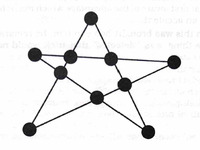
This is another game recorded by E. De. M. Humphries in Karwi, a district in Uttar Pradesh a kind of “Solitaire,” known as “Kowwa Dand.” As written by Humphries he had difficulty recording the rules of this game, as the man who showed him the diagram had forgotten them, and the only man in the village who knew the game at all, had not played it for years. -
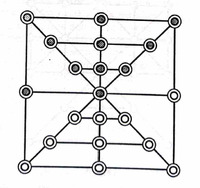
Kowwu Dunki - A Variant of Ahtarah Gutti ( Eighteen Pieces)
This game along with another variant was recorded by E. De. M. Humphries in Karwi, a district in Uttar Pradesh. He mentions that these variants have the same rules as another game recorded by him and mentioned in the same essay, known as Ahtarah Gutti ( Eighteen Pieces). The only information we get on these variants is the changes in the shapes of their boards and the second board shown in the second image was played in Bargarh when he recorded these. These variants are important to understand how a board can change the strageties of a game. One major difference is that due to the changes on the board, Kowwu Dunki is played on a board of 21 spaces, instead of 37 spaces which changes the play pattern. -
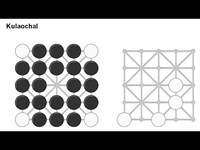
Kulaochal
This game has been documented by D.N Majumdar in Jharkhand. It is a popular game played by the Ho community. This game as he explains through the structure of the board or the game pieces is similar and is another variant of Bagh Chal. He also mentions this to be similar to shola guti or sixteen pieces. According to him the game is played by drawing the board on the ground. A quadrilateral diagram is drawn with chalk on the ground. The diagonal is intersected by three equidistant parallel, lines drawn within it perpendicularly and three horizontally. Two lines are then drawn diagonally so as to intersect each other at the centre of the diagram. Finally the middle points of each of the sides of the quadrilateral are joined by four straight lines. A guti or a piece of the game is represented with the name of ‘kulao’ being tigers and ‘meroms’ being goats. As per the rule of this game there should be four kulaos and twenty meroms placed on the board. The pieces could be used in the form of local stones, or seeds or similar materials. The gutis are placed at each of the twenty points of junction of the three horizontal lines with the three perpendicular lines and with the four sides of the quadrilateral. Two players sit face to face on two sides of the drawn board. -
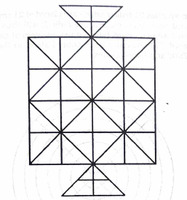
Lam Pusri or Sipahi Kat
This game was documented by Sunder Lal Hora at Kalijhora at present Kalimpong district. The informant of these games was a local man of the area who was of Nepali origin. Credit also has been given to Mr. F.D Raj of Kalimpong who helped confirm the rules and the descriptions of the documented games. Lam Pusri is played by two people on a board of 37 points, each player has 18 distinctive pieces which are arranged in such a way that the central cross point is left vacant. This game is similar in every respect to Ahtarah Gutti described by Humphries from Karwi in Uttar Pradesh and Atharagutiala teora described by Das-Gupta in his essay. The rules are also the same as stated by Hora. He also explains that according to his informants, Pusri means tail, and this term is used in the game reference to the triangular pieces at two ends of the diagrams which are likened to tail as they form outgrowths of the big central section of the board. The structure of the board also looks similar to Mughal Pathan documented in Bengal and other places in India.