Search
155 items
-
Mancala, Pataleshawar (8)
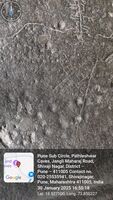
Pataleshwar cave complex are a small group of five excavations, developed into a cave temple dedicated to Pataleshwar, God of the underworld or Shiva. This cave complex is ruggedly excavated and also bears resemblance with the Elephanta caves of Mumbai. The cave has unfinished murals on the sides and on the backside. There is a Nandi pavilion at the entrance of the cave which is circular. The inside of the main cave contains a pillared hall with a pradakshinapatha the way to go around the shrine. One side of the cave remains unfinished. This and other boardgames were documented on the floor of the cave. This is a documented image of an eight hole mancala but all the houses or holes are not in a condition where it could be played at the moment. Some of the holes have worn away with time. Interestingly there lies a Chaupar board just beside this mancala. There are a total of eight mancala graffiti boards recorded from Pataleshwar. The game of Mancala is considered to be one of the oldest games of the world, while its place of origin and the timeline is debatable. The earliest textual reference as stated by scholars comes from Kitab al-Aghani, or Book of Songs which does not directly mention mancala but refers to a similar game. These rows of cupules have been excavated in ancient sites like Jordan and many others including megalithic sites in India but their link as to being Mancala is debatable. This game has many variants all across the world and is popular in Africa, Asia, and parts of Eastern Europe. In India, Mancala is known by many names and the rules and variants of the game keep changing based on its region and according to the communities who play them. The number of holes in mancala differ along with the number of rows as well. In some variants the board is hand-drawn on a surface as circles with chalk or even cut holes on the soil to play the game. It is played with local seeds, stones or anything which is easily available as pieces to place inside the pits. The number of pieces per pit also vary from four to even twelve in some variants. This game is popularly a two-player game but some variants also show three players or even one in some case. While there are abundant etched evidence of mancala spread all across Maharashtra, it has been stated by scholars and board game researchers that more recent memory of the existence of this game is absent from the region. Thus, the practice of playing the game or the regional variant belonging from this region is either lost or yet to be found. -
Mancala, Pataleshwar (3)
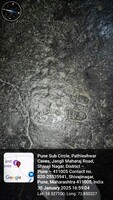
This is an etched or incised graffiti board of mancala documented from the cave complex of Pataleshwar. This particular board was found in the second row of the pillared halls of the temple. The board has two rows with eight holes or depressions. There is also an engraving of a small feet on the right side to it. Pataleshwar cave complex are a small group of five excavations, developed into a cave temple dedicated to Pataleshwar, God of the underworld or Shiva. This cave complex is ruggedly excavated and also bears resemblance with the Elephanta caves of Mumbai. The cave has unfinished murals on the sides and on the backside. There is a Nandi pavilion at the entrance of the cave which is circular. The inside of the main cave contains a pillared hall with a pradakshinapatha the way to go around the shrine. One side of the cave remains unfinished. This and other boardgames were documented on the floor of the cave. The game of Mancala is considered to be one of the oldest games of the world, while its place of origin and the timeline is debatable. The earliest textual reference as stated by scholars comes from Kitab al-Aghani, or Book of Songs which does not directly mention mancala but refers to a similar game. These rows of cupules have been excavated in ancient sites like Jordan and many others including megalithic sites in India but their link as to being Mancala is debatable. This game has many variants all across the world and is popular in Africa, Asia, and parts of Eastern Europe. In India, Mancala is known by many names and the rules and variants of the game keep changing based on its region and according to the communities who play them. The number of holes in mancala differ along with the number of rows as well. In some variants the board is hand-drawn on a surface as circles with chalk or even cut holes on the soil to play the game. It is played with local seeds, stones or anything which is easily available as pieces to place inside the pits. The number of pieces per pit also vary from four to even twelve in some variants. This game is popularly a two-player game but some variants also show three players or even one in some case. While there are abundant etched evidence of mancala spread all across Maharashtra, it has been stated by scholars and board game researchers that more recent memory of the existence of this game is absent from the region. Thus, the practice of playing the game or the regional variant belonging from this region is either lost or yet to be found. -
Mancala, Pataleshwar (4)
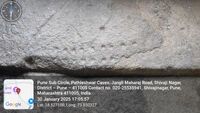
This is an etched or incised mancala board situated at the first row of pillars right side of the entrance facing the cave of Pataleshwar. It is an eighteen hole Mancala with nine holes on both sides. It is by far the biggest one recorded in that site. There are a total of eight mancala graffiti boards recorded from the temple cave of Pataleshwar. Pataleshwar cave complex are a small group of five excavations, developed into a cave temple dedicated to Pataleshwar, God of the underworld or Shiva. This cave complex is ruggedly excavated and also bears resemblance with the Elephanta caves of Mumbai. The cave has unfinished murals on the sides and on the backside. There is a Nandi pavilion at the entrance of the cave which is circular. The inside of the main cave contains a pillared hall with a pradakshinapatha the way to go around the shrine. One side of the cave remains unfinished. This and other boardgames were documented on the floor of the cave. The game of Mancala is considered to be one of the oldest games of the world, while its place of origin and the timeline is debatable. The earliest textual reference as stated by scholars comes from Kitab al-Aghani, or Book of Songs which does not directly mention mancala but refers to a similar game. These rows of cupules have been excavated in ancient sites like Jordan and many others including megalithic sites in India but their link as to being Mancala is debatable. This game has many variants all across the world and is popular in Africa, Asia, and parts of Eastern Europe. In India, Mancala is known by many names and the rules and variants of the game keep changing based on its region and according to the communities who play them. The number of holes in mancala differ along with the number of rows as well. In some variants the board is hand-drawn on a surface as circles with chalk or even cut holes on the soil to play the game. It is played with local seeds, stones or anything which is easily available as pieces to place inside the pits. The number of pieces per pit also vary from four to even twelve in some variants. This game is popularly a two-player game but some variants also show three players or even one in some case. While there are abundant etched evidence of mancala spread all across Maharashtra, it has been stated by scholars and board game researchers that more recent memory of the existence of this game is absent from the region. Thus, the practice of playing the game or the regional variant belonging from this region is either lost or yet to be found. -
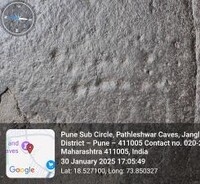
Mancala, Pataleshwar (5)
This etched or incised graffiti mancala board was recorded from the pillared halls of the cave complex. There are a total of eight mancalas recorded from the site. This board contains of six holes or depressions on both sides. This board was documented from the outer side of the pillared halls of the main temple cave of Pataleshwar. Pataleshwar cave complex are a small group of five excavations, developed into a cave temple dedicated to Pataleshwar, God of the underworld or Shiva. This cave complex is ruggedly excavated and also bears resemblance with the Elephanta caves of Mumbai. The cave has unfinished murals on the sides and on the backside. There is a Nandi pavilion at the entrance of the cave which is circular. The inside of the main cave contains a pillared hall with a pradakshinapatha the way to go around the shrine. One side of the cave remains unfinished. This and other boardgames were documented on the floor of the cave. The game of Mancala is considered to be one of the oldest games of the world, while its place of origin and the timeline is debatable. The earliest textual reference as stated by scholars comes from Kitab al-Aghani, or Book of Songs which does not directly mention mancala but refers to a similar game. These rows of cupules have been excavated in ancient sites like Jordan and many others including megalithic sites in India but their link as to being Mancala is debatable. This game has many variants all across the world and is popular in Africa, Asia, and parts of Eastern Europe. In India, Mancala is known by many names and the rules and variants of the game keep changing based on its region and according to the communities who play them. The number of holes in mancala differ along with the number of rows as well. In some variants the board is hand-drawn on a surface as circles with chalk or even cut holes on the soil to play the game. It is played with local seeds, stones or anything which is easily available as pieces to place inside the pits. The number of pieces per pit also vary from four to even twelve in some variants. This game is popularly a two-player game but some variants also show three players or even one in some case. While there are abundant etched evidence of mancala spread all across Maharashtra, it has been stated by scholars and board game researchers that more recent memory of the existence of this game is absent from the region. Thus, the practice of playing the game or the regional variant belonging from this region is either lost or yet to be found. -
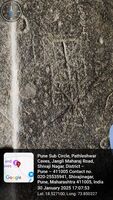
Mancala, Pataleshwar (7)
This board was documented from Pataleshwar in the second row, right side of the pillared halls from the entrace facing the shrine in the cave. It is an eight-hole mancala. This mancala was found just beside a baghchal board. Although no overlap, they lie close to each other. It could indicate that both were not engraved at the same time. The holes or houses of the mancala board is not very deep. There are a total of eight mancalas recorded from the site of Pataleshwar. Pataleshwar cave complex are a small group of five excavations, developed into a cave temple dedicated to Pataleshwar, God of the underworld or Shiva. This cave complex is ruggedly excavated and also bears resemblance with the Elephanta caves of Mumbai. The cave has unfinished murals on the sides and on the backside. There is a Nandi pavilion at the entrance of the cave which is circular. The inside of the main cave contains a pillared hall with a pradakshinapatha the way to go around the shrine. One side of the cave remains unfinished. While there are abundant etched evidence of mancala spread all across Maharashtra, it has been stated by scholars and board game researchers that more recent memory of the existence of this game is absent from the region. Thus, the practice of playing the game or the regional variant belonging from this region is either lost or yet to be found. The game of Mancala is considered to be one of the oldest games of the world, while its place of origin and the timeline is debatable. The earliest textual reference as stated by scholars comes from Kitab al-Aghani, or Book of Songs which does not directly mention mancala but refers to a similar game. These rows of cupules have been excavated in ancient sites like Jordan and many others including megalithic sites in India but their link as to being Mancala is debatable. This game has many variants all across the world and is popular in Africa, Asia, and parts of Eastern Europe. In India, Mancala is known by many names and the rules and variants of the game keep changing based on its region and according to the communities who play them. The number of holes in mancala differ along with the number of rows as well. In some variants the board is hand-drawn on a surface as circles with chalk or even cut holes on the soil to play the game. It is played with local seeds, stones or anything which is easily available as pieces to place inside the pits. The number of pieces per pit also vary from four to even twelve in some variants. This game is popularly a two-player game but some variants also show three players or even one in some case. -
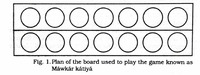
Mawkar Katiya
Mawkar Katiya is a form of Mancala found in North-Eastern India. In his research published by the Asiatic Society in 1923 , Hem Chandra Dasgupta locates the game in North-Eastern India, particularly in Shillong and Cherrapunji . -

Mawkynting/ Mawkhalai/ Mawsan/Mawdol (five stones)
Different places have different names for this type of game. Some call it mawkynting some call it mawkhalai some mawsan and sonic mawdot, however the game is the same. This game is very like the Korean stone game, also known as Gonggi (공기). -
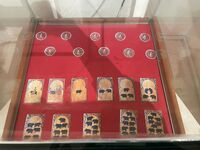
Mughal Ganjifa from Rajasthan
The card game Ganjifa probably arrived in India during the Mughal era as a popular pastime among the royal court. The game is mentioned in historical writings from that period, including the Baburnama and Humayunnama, memoirs of the first two Mughal emperors as well as the memoir of Gulbadan Begum, the sister of Humayun. Abul Fazl's Ain-i-Akbari, a detailed account of Emperor Akbar's reign names Ganjifa as one of his favorite games. Early Mughal Ganjifa sets were often circular and made from luxury materials like ivory or tortoise shell. These sets typically included 96 cards, divided into eight suits of 12 cards each. Every suit had a King and a Minister card, along with number cards from one to ten, all beautifully decorated with imperial imagery. The suits were categorized into two groups: the "powerful" suits (bishbar) and the "weak" suits (kambar). A 16th-century poet, Ahli Shirazi, recorded the names of these suits bas: gulam (servant), taj (crown), shamsher (sabre), and tanka (silver coin) in the bishbar cards, and barat (cheque or draft), qimash (material wealth), ashrafi (red or gold coin), and chang (a small harp) in the kambar cards. In the 16th century, Emperor Akbar introduced a unique version of Ganjifa with 12 suits. Each suit in this game represented a different aspect of his kingdom, from the military and finance to mythology and nature. The suits included a wide range of themes, such as divinities (sura), demons (asura), and serpents (ahi). For the next two centuries, Mughal-style Ganjifa remained popular in various regional courts across India. As the game spread, different regions developed their own unique variations and styles. The image here is from Rajasthan's Udaipur Palace and has been kindly shared by Professor Nirmala Menon. Some of the most well-known regional variations include the Dashavatara Ganjifa from Maharashtra and the Mysore Ganjifa.