Search
155 items
-
Mughal Pathan
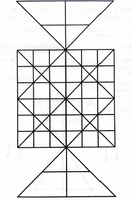
This game has been documented by Jatindra Mohan Datta in Belgharia, Kolkata near Dakshineshwar. According to Datta, the game is almost exclusive to the people who played this as it is found on a cemented floor of an old house. He also explains that this game is played like draughts. It is a two player game played by using 20 pieces. He also explains that a standard game of Mughal Pathan is also played with 16 pieces each and 19 pieces are used to play a variant of this game. Mughal-Pathan has also been described by B. Das Gupta in Quarterly Journal of Bangiya Sahitya Parisat, under the title of Sola-guti Mangal Pata, in which reference is made to 16 pieces used by each player as well as to the wars between Mughals and Pathans in Bengal. Mughal-Pathan has also been described by B. Das-Gupta in Quarterly Journal of Bangiya Sahitya Parisat, under the title of Sola-guti Mangal Pata, in which reference is made to 16 pieces used by each player as well as to the wars between Mughals and Pathans in Bengal. The board as seen in the diagram according to Datta, is used in playing several types of games, and he draws reference to the Bornean game of Rimoe described by Jacobson, the Ahtarah Guti of the United Provinces which is an 18-piece game described by Humphrey, Athara gutiala Teoraof the Central Provinces, also an 18-piece game described by H.C. Das Gupta, Lam Pusrior Sipahi Kat of the Teesta Valley an 18-piece game described by S.L. Hora and a new type of Bagh-Bandi or Tiger-play. -
![Photo of sixteen handed Pachisi / Pagade. [Credits: Souvik Mukherjee]](https://souvikmukherjeeresearch.com/omekas/files/medium/2e4f46ca8c24586c1c77477049edc5c246797050.jpg)
Multiple Pachisi Variants, Jaganmohan Palace Mysuru
There are several variants of Chaupar or Pachisi at the Jaganmohan Palace of Mysore (Mysuru). Some examples are the eight-handed Pachisi, the sixteen-handed Pachisi, and the four handed defensive Pachisi. These and many other games were made by the innovative creation of Maharaja Krishnaraja Wodeyar III(1799-1868), the twenty-second king of Mysore. The rules of these games were written by the king himself in his manuscripts partly in Kannada, and partly in Sanskrit according to R. Vasantha. The eight-hand Pachisi can be played with two, four, or even eight players. It has a total of one hundred and ninety-two squares or houses on the board. There are thirty-two pawns altogether, divided into eight sets of four, each set in a different color- yellow, green, red, or black. Among these, four sets are plain, while the remaining four sets are marked with vertical lines to distinguish them. This variant can be played with either two octagonal dice or four rectangular dice. Similarly the sixteen-handed Pachisi can be played by sixteen, eight, or four players. The board consists of three hundred and eighty four houses in total. There are sixty four pawns altogether, divided into four colors- yellow, green, red, and black, with four pawns in each set. Among these, one group of four sets is plain, while another group of four sets is distinguished by vertical lines. A third group of four sets is designed with yellow at the top and bottom and white in the middle, while the fourth group of four sets has the reverse pattern, with white at the top and bottom and yellow in the middle. This variant similarly also requires either two octagonal dice or four rectangular dice to play. The term Pachisi comes from 'Pachees' or twenty five and according to Vasantha, the king referred this game as 'Pagade Kayi Ata' which had been named after the pawn rather than the number twenty five and these variants were played with two or more stick dice and not cowries. The central 'home' of the pieces or the pawns were called, Mukti Sthala. -
Mysore Chhad Ganjifa
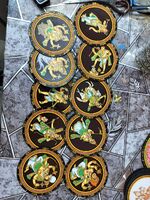
Mysore Chhad Dashavatar is a variation of ganjifa cards that comprises the ten suits representing ten avatars of Vishnu. These cards were patronised by Mummadi Krishnaraja Wodeyar III (1799 - 1868 ) and are handpainted in the style of Mysore paintings. -
Nao Guti
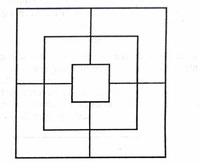
This game was documented by Hem Chandra Das Gupta while he was working on some of his own geological field work. The informants as he stated were Pathan or Pashtun who lived in Mianwali district of Punjab. He explained in his essay that the games he documented from the region were played by everyone in the area including both children and elders, and the games were found at times etched on stone slabs in common spaces. Similar looking boards have been commonly found both in incised patterns in various sites across India inside temples and also in other places. Nao Guti as the name suggests are played with nine pieces each and it is a two player game. Das Gupta draws comparison of this game with two other games that were documented in Eastern Bengal (now Bangladesh) in Bikrampur. They are known as bara-guti pait-pait, and tin-guti-pait-pait. The rules of the game are the same, but the diagrams used are different, though the difference between the patterns of the board used for nao-guti and baraguti-pait-pait is slightly different, that for the latter being only a little more elaborate and consistent with the increase in the number of pieces required for the game. This type of alquerque board is also commonly found in other countries besides India, for example Achi from Africa, Triodi from Greece and many more. While the variant differs along with the number of pieces used by per player in the game but the structure of the board has its similarities. -
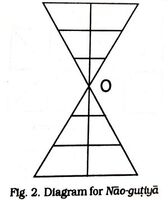
Nao- Gutiya
This game was also recorded by Charu Chandra Das Gupta. The information was given to him by a staff of the Nalanda Museum as well as from another inhabitant of Kumrahar, a village near Patna. The game is called Nao-Gutiya or nine pieces and it is a two player game. Das Gupta in his essay draws similarities of this game with another boardgamec called Egara-guti or eleven pieces. Thgis game also has similarities with Lau-Kata Kati which is played in several parts of India. -
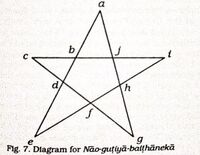
Nao- Gutiya- Baithaneka
This game has been documented by Charu Chandra Das Gupta and the informant was a staff of the Nalanda Museum in Bihar. He explains it to be a kind of 'solitaire' as only one man plays it. He mentions the rules of the game as given below. He also finds similarity of this game with another game mentioned by another scholar, S.L Hora called Lam Turki which was played in Darjeeling, West Bengal. He mentions there are similarities but they are still played differently. He also mentions in his essay that Humphries, had described a similar game named Kowwa Daud played in the (United Province?) which also had similarities with Nao- Gutiya- Baithaneka. Apart from similarities what sets this aside from the rest as the name itself is Nao- Gutiya- Baithaneka or placing of the nine pieces but further movement of the pieces remain unclear. -
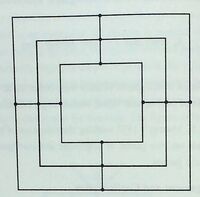
Nau Bhar
This board game can be reported as being played in the villages of the Mahendragarh district of Haryana, an area which is predominantly inhabited by the Ahir community. The game is invariably played by children and by the male members of any caste or community in the region. The game is locally called Nau bhar which means a game, played with nine pieces, such as pebbles or pieces of stone. Two individuals can play this game. The board is usually drawn with a piece of charcoal, brick or chalk on a floor. The two players sit facing each other in front of the board. A set of nine pebbles or stone pieces of one colour is used by each player. Either player can initiate the game, or the pieces are placed alternately on the dots marked on the drawn lines that make up the board. The players attempt to place their pieces in such a way that three pebbles of one colour form a row or straight line (bhar). Taking alternate turns, the players can move one step in any direction, vertically or horizontally along the lines, from marked dot to marked dot. At the same time the players also make attempts to restrict each other's movements by placing pieces in between those of their opponent. Each row (bhar) entitles a player to remove one of his opponent's pieces. The winner either blocks all the opponent's pieces so that they cannot be moved, or reduces his opponent's number so that he is unable to form a row of three. -

Nau Khant
The Nau khant is played in the rural areas of the Mahendragarh district of Haryana state as much as the two preceding games. A set of nine pieces (gutis) of one colour is used by each player. Only two members can play this game, hence pieces of two colours are used. The board, which consists of nineteen points in two triangles, is drawn on a floor with a piece of charcoal, brick or chalk. Either of the players can start the game. The placement of pieces is made in such a way that the opponent will not have the possibility of jumping over his rival's piece. Piece stationed on any point, can move in any direction along any marked line through that point to the next point on that line, which must be empty. If the adjacent point is occupied by the opponent's piece and the next point beyond it on the line is empty, then the player can make the piece leap over his opponent's to the vacant point beyond, and take the opponent's piece. Similar leaps can be made by either of the players. One of them can become the winner of the game by taking more leaps and thus capturing his opponent's pieces.