Search
155 items
-
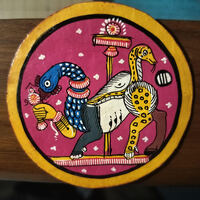
Navagunjara Ganjifa Card, Raghurajpur
Navagunjara ganjifa cards from Raghurajpur. Navagunjara is a legendary manifestation of Vishnu that has the head of a rooster, and stands on three feet, those of an elephant, tiger and deer or horse; the fourth limb is raised human arm carrying a lotus or a wheel. The beast has the neck of a peacock, the back or hump of a bull and the waist of a lion; the tail is a serpent . Navagunjara features in the Odia Mahabharat of Sarla Das. The Nila Chakra disc on top of the Puri Jagannath Temple has 8 Navagunjaras carved on it, and it’s sculpted on the northern side of the temple. -
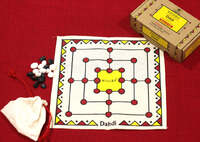
Nine Men's Morris
Believed to be one of the oldest games in history, Nine Men's Morris is an alignment and configuration game that is found widely around the world. "Morris" comes from the Latin word "merellus", which means the corruption of pieces. The earliest known etching of Nine Men's Morris was found in an Egyptian temple in Kurna, Egypt (c.a 1440 BC). Other boards have been discovered in Ceylon of Sri Lanka (c. AD 10) and in the Gokstad Viking ship (c. AD 900). Evidence of the board scratched in the ground in the United States. To the ancient Celts, the Morris square was sacred. The central square known as the Cauldron or Mill was a symbol of regeneration while the lines and squares coming out from the middle were symbols of the four directions. Shakespeare mentions the game in his A Midsummer's Nights Dream. In India, many graffiti boards are to be found in temples and Buddhist caves. -
Nine Men's Morris Kailash Temple, Ellora (2)
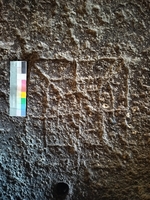
Believed to be one of the oldest games in history, Nine Men's Morris is an alignment and configuration game that is found widely around the world. "Morris" comes from the Latin word "merellus", which means the corruption of pieces. The earliest known etching of Nine Men's Morris was found in an Egyptian temple in Kurna, Egypt (c.a 1440 BC). Other boards have been discovered in Ceylon of Sri Lanka (c. AD 10) and in the Gokstad Viking ship (c. AD 900). Evidence of the board scratched in the ground in the United States. To the ancient Celts, the Morris square was sacred. The central square known as the Cauldron or Mill was a symbol of regeneration while the lines and squares coming out from the middle were symbols of the four directions. Shakespeare mentions the game in his A Midsummer's Nights Dream. In India, many graffiti boards are to be found in temples and Buddhist caves. This is one such example of a graffiti board found in Kailash temple Ellora. The construction of the Kailash temple roughly dates back to the reign of Krishna I (r.756 – 774 CE) of the Rashtrakuta dynasty according to the Vadodara copper plate inscription. This copper inscription records and mentions Krishna I as the patron of the Kailashnatha temple and also mentions a shiva temple at Elapura or Ellora present day. -
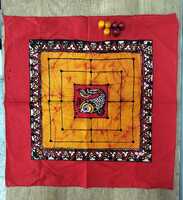
Nine Men's Morris, Handmade
Nine men's morris is a classic game of pure strategy. It has been described as "noughts and crosses for adults", as it shares the simpler game's aim for forming rows of three, but weaves that aim into a much more sophisticated game of wits. It is mentioned in Shakespeare's A Midsummer's Night's Dream where Titania says, 'The nine men's morris is filled up with mud' (Act 2 Scene 1: ll. 98-100). A similar game is also mentioned in Ovid's Ars Amatoria. The rows of three, called "mills", are not the main aim of the game, they are a means to an end. The board starts empty, and players place their pieces in turn; forming a row of three allows the removal of an enemy piece. When all pieces are placed, they slide from one position to another, still trying to form mills and capture enemy pieces. The aim of the game is to reduce the opponent to two pieces, rendering them unable to form any more mills. The game of nine mens morris is so ancient that we do not know its origin. From the stones of ancient Kurna in Egypt, to the stone- or bronze-age burial sites of Cr Bri Chualann, in County Wicklow in Ireland, the pattern for the board has been found in many ancient contexts. This particular board is made of cotton with a batik print on it which is popular in Bengal. This board is made by Ramsons Kreera Pratisthan. They are working towards the revival of traditional Indian Boardgames through manufacture of handmade boards, casting pieces and counters. They collaborate with artists and artisans all across India to make such boardgames and their material have a number of varieties such as, Navalgund Jamkhana, Silk embroidery, Batik print, Mysore silk zari weaving etc. Other than variants in types of cloth and handloom they also manufacture boardgames on Marble, Mysore wood, Brass Casting, Wood Polychrome and many as such. -
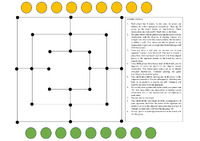
Nine Men's Morris: Downloadable Game
This is a downloadable resource of a Nine Men's Morris Game one can download and play referring to the rules and using the given pieces. -
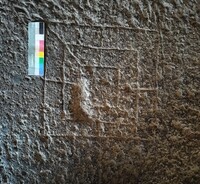
Nine Men's Morris/ Dahdi, Ellora
Nine Men's Morris is one of the oldest games of the world which has spread across the world. The earliest known etching of Nine Men's Morris was found in an Egyptian temple in Kurna, Egypt (c.a 1440 BC). Other boards have been discovered in Ceylon of Sri Lanka (c. AD 10) and in the Gokstad Viking ship (c. AD 900). The Board game here is located in the Kailash temple in Ellora. -
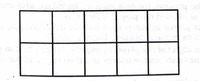
Pachgharwa (five spaces/homes)
This game has been recorded by E. De. M. Humphries in Karwi, a district in Uttar Pradesh. This game has many variants although the number of ghar(square/home) differs from region to region. At times variants are also played with holes dug in the ground. There are also variants where a wooden board of circular holes are used. The basic intention or play pattern remains similar with changes in strategies or terminologies used while playing the game. In this particular variant it is played on five squares respectively as shown in the image. It is a two-player game who take opposite sides of a board of ten spaces, arranged and is played by using five pieces in each square. -
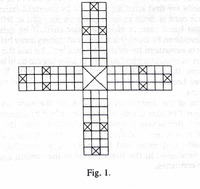
Pachisi
The information on Pachisi has been recorded by E. De. M. Humphries in Karwi, a district in Uttar Pradesh. He writes in his essay that in the common meeting space of the village lay this board as shown in the image on a stone bench. In 1904 he attempted to gather the rules of the game. Every arm of the cross is made into three rows consisting of eight squares. Among these, the fifth square from the end of each outer row and the center square of the bottom row are highlighted with a diagonal cross to show that a piece on either of these squares is protected from being captured. The game is played with four players, but can also be played with two or three participants, each having four “men” identified by their colours or pieces. Every player positions himself facing one arm of the cross, aiming to start at the center of the board and travel down the center and up the left-hand row of his respective arm, moving his four pieces around the board, eventually guiding them down the right-hand side and up the center row of his arm to land them in the triangular area at the center.