Search
155 items
-
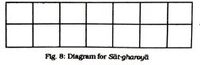
Sat- Gharoa
This game has been documented by Charu Chandra Das Gupta and the information initially was given by a staff of the Nalanda Museum in Bihar. Although Das Gupta could not understand the rules of this particular game himself, he still describes it as a two player game. He further draws similarities of Sat-Gharoa with another game played by the Khasis (Meghalaya) and also in Orissa and Madras. Although he does not mention the names of the similar game played in the other regions, there is a further note from the referenced text on this game by S.L Hora. He further mentions the rules of the game as described below. He also mentions that the duration of this game is long and it does not require a lot of skill to play. But, during the end of the game when the pieces are comparatively lesser, the skills are required to empty the holes or the depressions to win the game. -
Sekkor or Sekar
This game was documented by D. N. Majumdar as a game popular amongst the Mundas and Hos of Jharkhand. According to Majumdar Sekar means a top which is used to play the game. The game involves spinning the top using a string which is rounded and tied to the step of the top which is made to spin on its point by pressing it against the ground. This game is played on the ground and the players target the opposing team by topping the top on the ground. This game is also called the rain calling game and it is played by seven players in each team divided into teams of two. According to another source, mythological source suggests this game was first played between two men and Devils and eventually the early men won. This game is played in peak summer and is believed to bring rain and prevent drought. Made of Kusum wood, the Sekkor, is shaped like a big top with an oval plane cap. A string is wound closely to a pointed base that enables it to be toppled over by the opposing team. This can suggest that there might be variants of the game or the rules might change. -
Sher Bakar
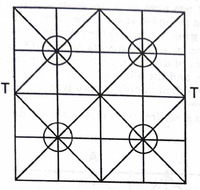
This game was documented by Hem Chandra Das Gupta while he was working on some of his own geological field work. The informants as he stated were Pathan or Pashtun who lived in Mianwali district of Punjab. He explained in his essay that the games he documented from the region were played by everyone in the area including both children and elders, and the games were found at times etched on stone slabs in common spaces. Similar looking boards have been commonly found both in incised patterns in various sites across India inside temples and also in other places. The game of Bagh Chal has multiple variants all across South Asia. It is a two player hunt game played on an alquerque game board. The kind of alquerque board varies along with the number of tigers and goats as well. Bagh chal is also the national game of Nepal and this game is played either on a board but also at times etched on surface or boards drawn on plain surfaces are used to play this game as for this one. -
Sher Bakr
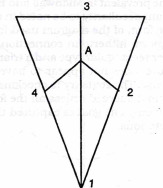
The game that is described in this note is a type of tiger-play prevalent in the district of Shahpur in the Punjab. It is known as Sher Bakr which means lion and goat. The informant of this game was an assistant surgeon of the charitable dispensary of Pail (Shahpur) at the time when Hem Chandra Das Gupta visited the area for his geological fieldwork. It is a two-player game, one being in charge of one piece, the tiger, and the other in charge of four pieces, the goats. At the beginning of the game the four goat pieces are to be kept at A and the tiger piece at the apex of the triangle, which is at the point marked 1. The player representing the goat pieces has to move one of his pieces first and then the usual rule is followed according to which a goat piece and the tiger piece can be moved only from one cross-point to another. But there are some unique points of this game which are worthy of special notice. In all the variants of Bagh Chal or Tigers and Goats recorded, the tiger piece may jump over a cross-point occupied by a goat piece provided the cross-point next to it and in the same straight line is vacant and capture the goat piece. According to the rules of the game as prevalent in Shahpur, the tiger piece may capture the goat piece in this way, while it may also, for the purpose of capturing a goat piece, jump round the angle A either from 2 to 4 or from 4 to 2. It may also be pointed out that there cannot be more than one goat piece on one cross-point though at the angle A there may be more goat pieces than one. If, however, the tiger piece succeeds in jumping over A and if at that time there are goat pieces more than one only one piece may be captured, recalling in this matter the rules of game recorded in Mianwali, Pakistan. Another important peculiarity to be noted in connection with this game is the form of the diagram used for playing it. All the diagrams known hitherto in connection with tiger-play are of a square or rectangular type and a triangular diagram. The pieces of the goats are stacked in one place during the beginning of the game which is also one major difference from other variants of tiger and goats. -
Shung Khama Chih Khi (Top Spinning)
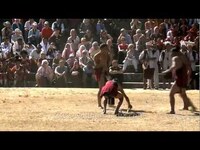
This game is played on the ground and according to sources, it is more popular amongst male players. It is competed amongst two groups. The top spins are made of wood and it is of round shape at both ends protruding with the middle portion wide. A cotton rope is tied to the top of the top spin for spinning it on the ground. By hitting the topspin of the opponent, if it could stop the opponent’s topspin from spinning, one is declared the winner. But in case, the attempt fails, it indicates defeat. In this way all participants are given chance. And the winner will go to second round and after that points are calculated and the team which gets maximum points is declared the winner. -
Sujjua
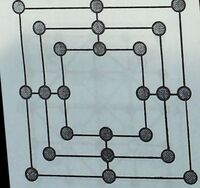
This game was documented by Humphries on his visit to Baldewa which was a ruined Chandel temple a few miles away from the Karvi railway station. He recorded this board etched on one of the vertical slabs on the wall of the inner shrine. According to his speculations, the game was etched on stone and this stone was part of the floor before the stone was used for the construction of the temple. This game is called Sujjua. He explains that this game was played on a board of twenty four spaces and it is a two player game. The objective of the game is to match three pieces which he terms as ‘men’ in one row before the opponent can do it. When the game commences the board is clear and the players move alternately, each commencing by placing one of his own men on the board in any vacant place. After the first move, the player may either place another "man" on the board, or may move a piece already on it one space at a time in any direction, provided that the space to which he wishes to move it is vacant. -

Taag dha Nor or Tagnor (Tiger and Cow)
Tagnor is a traditional Bhutanese board game, where a board with lines are filled with pellets representing cattle and two large tokens representation tigers. As the players makes a move, the tigers find opportunities to kill the cattle by jumping over the pellets. If the tigers cannot move as a result of shrewd moves from the cattle like, the cattle wins but if the tiger kills a specific number of cattle before they can cut down his movement, the tiger would end up winning. The game can be played with minimal preparation by drawing the board lines on any surface. In this the board is etched or incised on what looks like a park bench and is been played with local seeds by two players. In other cases there are also boards available made of cloth, wood and many other materials. This game is a variant of the played Bagh Chal which is popular in many parts of India and is also the national game of Nepal. -
Tablan
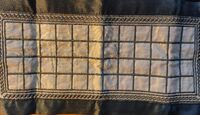
Tablan is a traditional Indian board game for two players, similar to Backgammon and Tâb, where the goal is to occupy more of your opponent's home squares than they do yours. [1, 2, 3, 4] Here's a more detailed breakdown: [1, 4, 5] Origin & History: Tablan is an ancient Hindustani game originating in India, particularly in some villages in Mysore, southwestern India. [1, 4, 5] It could have originated from the Roman games Duodecima Scripta . Tablan is a "running fight" game from Mysore in India. Two bands of twelve warriors fight their way to each other's stronghold. The game is a traditional one from India, of unknown antiquity. It is apparently related to a smaller, but more complex, game called tab, which was first described in the west in 1694. Whether tablan is the ancestor or descendant of tab is not currently known. According to R. C. Bell, tablan was still being played in the villages in Mysore, southwest India, in the second half of the twentieth century. It has been made known in the west partly by Bell's own books. (source: Cyningistan.com) It is apparently related to a smaller, but more complex, game called tab, which was first described in the west in 1694. Whether tablan is the ancestor or descendant of tab is not currently known.