Search
155 items
-
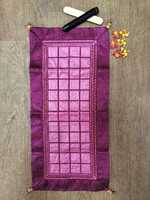
Tablan, Handmade
Tablan is a traditional Indian board game for two players, similar to Backgammon and Tâb, where the goal is to occupy more of your opponent's home squares than they do yours. [1, 2, 3, 4] Here's a more detailed breakdown: [1, 4, 5] Origin & History: Tablan is an ancient Hindustani game originating in India, particularly in some villages in Mysore, southwestern India. [1, 4, 5] It could have originated from the Roman games Duodecima Scripta . Tablan is a "running fight" game from Mysore in India. Two bands of twelve warriors fight their way to each other's stronghold. Can you get more of your warriors into enemy territory than your enemy can get into yours? The game is a traditional blend of luck and strategy still played relatively recently. History of Tablan There is a class of games known as running fight games, in which two players advance towards each other on a straight course according to the throw of dice or casting sticks. But instead of being a race, the winner of a running fight game is decided by the capture of pieces when the game ends. Tablan is a running fight game. Although the board is two-dimensional, it represents a single track which has been folded in on itself. The game is a traditional one from India, of unknown antiquity. It is apparently related to a smaller, but more complex, game called tab, which was first described in the west in 1694. Whether tablan is the ancestor or descendant of tab is not currently known. According to R. C. Bell, tablan was still being played in the villages in Mysore, southwest India, in the second half of the twentieth century. It has been made known in the west partly by Bell's own books. (source: Cyningistan.com) This particular board is made of Silk embroidery by Ramsons Kreera Kaushalya. They are working towards the rrevival of traditional Indian Boardgames. They manufacture handmade gameboards, casting pieces and counters. They collaborate with artists and artisans all across India to make these boardgames and their material have a number of varieties such as, Navalgund Jamkhana, Silk embroidery, Batik print, Mysore silk zari weaving etc. Other than variants in types of cloth and handloom they also manufacture boardgames on Marble, Mysore wood, Brass Casting, Wood Polychrome and many as such. -
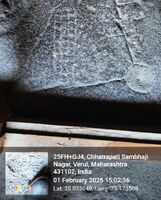
Tablan, Jagannatha Sabha, Ellora
This etched board of Tablan has been recorded from the Jain Cave complex of Ellora at the entrance of Cave number thirty three or Jagannatha Sabha. Etched games or games inscribed have been documented by scholars and board game researchers from many sites of India, both at religious and secular spaces. From sites like Lothal (Indus Valley) to game pieces found at Mohenjodaro, to reference of scholars at books like Sedentary Games and The Boardgame complied by the Anthropological Survey of India, etchings of game boards have been found on stone slabs of places where people gathered, in temple porches or floors of temples and stupa complex. This board has three rows and twelve squares on each row etched on the floor of the cave. The game of Tablan is said to have originated in Mysore or is popularly played in the southern part of India and along the coastal regions. It is a boardgame of two-players, and is considered a race game. It is usually played with four half-cylinder binary dice. The The Jagannatha Sabha is considered to be the second largest Jain Cave at Ellora dating back to the 9th century AD, according to the inscriptions on its pillars. This cave is popular for its intricate carvings and it is two storied. It consists of twelve pillars and elephant heads towards a porch, all carved from a single rock. The hall has two heavy square pillars in front, four in the middle area, and a pillared interior square principal hall with fluted shafts, all intricately carved with capitals, ridges and brackets. Inside the major idols are of Parshvanatha and Mahavira, the last two tirthankaras in Jainism. This board has been documented at the entrance of the cave facing the pillared prayer hall. This cave was popular to be a part of the Digambara Sect. -
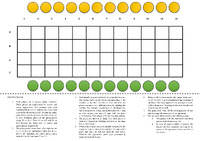
Tablan: Downloadable Game
This is a downloadable resource to help you learn Tablan -
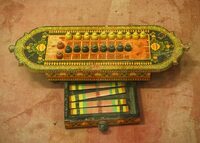
Tabul Phale
This is an 18th c. indigenous board game of Goa called Tabul Phale, from the collection of Bagore Ki Haveli Museum in Udaipur. Its nomenclature derives from the wooden plank/board called ‘Tabul’ and the dicing sticks called ‘phale’. It is a two player game, with 12 pegs or pieces each of two different colours aligned on opposite sides of the board. The 4 sticks are painted and rounded on one side, and plain on the other. The 12 x 4 squared board or ‘phale’ is vibrantly awash in colours of yellow, orange, and olive green, decorated with floral motifs on the side, known as ‘chitari’ art, named after the Chitari community, in Demani Village in Cuncolim, Goa that produces it today. They make all sorts of artefacts and toys using this art form such as advoli (traditional cutting board), paat (wooden stool), wooden vegetables and gunjifa cards. -
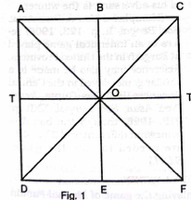
Tant Fant
This game was documented in an essay by Jantindra Mohan Datta. The games he described were played by locals of Howrah, Hooghly and 24-Parganas. According to Datta this and the other games in the essay are not indigenous in nature. The informant of these games belonged to Panihati. Datta also mentions that similar games were also common in other districts of Asansol, Burdwan, Midnapore, Ranaghat, Santipur, Khulna, and Barisal. The game of Tant Fant was played by drawing the structure or the diagram of the board on the floor with a piece of charcoal or brick. It is a two player game. At the beginning of the game each player places three distinctive pieces on the three cross-points (ABC or DEF) of their side of the square. In the first move, a piece is shifted to the central line TT. The game is won, when all the three pieces belonging to a player lie in a straight line anywhere (horizontally, vertically, or obliquely) with the exception of the starting line. This game happens to be similar to Bara Guti Pait Pait or Tin Guti Pait Pait in Vikrampore (Dhaka) but unfortunately his description is very meagre. In the game described above no piece of the adversary is to be removed from the board, but in the Vikrampore (Dhaka) game as soon as three pieces are arranged in a straight line, a piece of the opponent is removed from the board. In this way the winner of the game will be one who removes from the board all three pieces of his opponent without losing any one of his piece. -
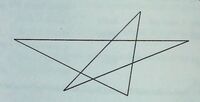
Tara
For this game the necessary equipment consists of a star-shaped board and nine pieces. Two or more players play Tara usually young boys, school going girls also play this game. The board is drawn on the floor with charcoal. -
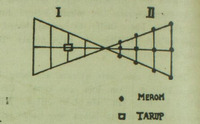
Tarup Ar Merom (leopards and goats)
This game was recorded in a text titled ‘Hoṛ Gidra Enec’ which documents seventy three different games played by the Santhals. The text is written in Roman and the language is Santhali so the exact rules of the game could not be translated. According to the Santhali dictionary, Tarup means leopard and merom means goats. The image of the game is given in the book which was digitised in The endangered archives programme by The British Library in the project titled 'Locating and digitising early Santali periodicals published between 1890 and 1975 in Eastern India (EAP1300)'. According to the diagram of the structure of the board it also finds similarities with other alquerque games like Lau Kata Kati. -
Terhuchu
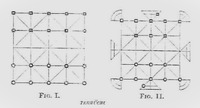
This board was first documented by John Henry Hutton during his extensive documentation of the culture of the people in Nagaland. He stated that this was one game that the Angami Nagas played and this board had similarities with other forms of Alquerque boards played all across the world. He stated that the name Terhuchu meant fighting-eating which would make sense as the game was intended to fight and eat their opponent’s pieces. The board he explained is of sixteen squares joint by diagonal lines and this game is not always played on a board but on flat surfaces where the diagram of the board is sketched temporarily or even at times incised on the ground or on stone slabs. He further explained that the pieces were usually also bits of stones, moved obliquely or straight along the lines, one going the distance of one square only at a time unless they are able to eat one of their opponents by jumping over them into an empty station beyond. It is a two-player game with each player having ten pieces on their side but at times the pieces to be played with could also be eight instead of ten. Another variant is played with nine pieces on each side. The number of pieces changes the rules and the strategy of the game. According to Hutton, some form of gambling with cowries are also practised by the Angamis, one rule being that no gambler may refuse to go on staking unless the whole sum which they brought with them to the game is exhausted. This game was further documented by Murray, who also mentions the variants of the pieces being used in the game. The Digital Ludemi Project also records this game and mentions that this game has similar rules with Perali Kotuma from Sri Lanka.