Search
155 items
-
Tibetan Game of Rebirth and Liberation (Sa lam rnam bzhag)
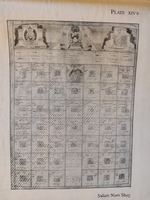
The Tibetan Game of Rebirth and Liberation is a variant of the Gyan Chaupar game, arguably. It is about the attainment of nirvana in either the Sutra way or the Tantra way. The game consists of a checkered board with each square being inscribed with scenarios from life and Buddhist philosophy. Each square leads to other squares depending on the throws of dice. The game itself is hypertextual and there are multiple outcomes possible from the throw of dice after the players reach any particular square on the game board. The following quotation from the Indian Museum's publication provides a detailed idea about the game: This is a fortune-telling thanka and as a sort of game, "the game of Rebirth", it is played with dice. Unlike other thankas this thanka is interesting fpr its subject matter, which neither depicts a deity nor a monk but a sort of religious game - a popular game of the Tibetan people. Though the subject is different the ultimate goal of the game as depicted in this painting, like other thankas is the same, i.e. nirvana or final liberation. Salam Nam Shag actually describes the path (marga) and the suc- cessive stages (bhumi) of spiritual progress for attaining nirvana. The game was invented by Sakyapandita, the great Sanskrit scholar and guru of the Sakya sect in the early 13th century A.D. The thanka shows seven horizontal and seven vertical rows representing seven squares in each row. These squares which symbolically represent the 'board' of the game and cosmic geography illustrate the paths to enlightenment and final libera- tion. At the top are shown the figures of Amitayus in Sukhāvatī heaven, Vajradhara in yab-yum in vajrahum kāramudra and Vajrayogini. In this thanka, devaloka, daityaloka, manuṣyaloka, nagaloka, paśuloka and naraka have been illustrated with representations of deities, arhats, śrāvakas, asuras, nagas, beasts and the sufferings in hell. The game is started from the human realm and with the cast of a dice one proceeds upward or down- ward either to devaloka or to the lower states of rebirth or naraka. The winner in the game of rebirth reaches the realm of Buddhahood and nirvāņa' (Chakravarti 2000, 28) -
Tikda
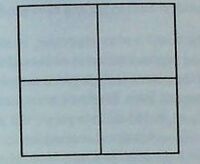
This game is played by people of various ages, but only by men. The equipment needed is a square board and two sets of three game pieces, one for each player. Small pebbles of different sizes and colours are used as pieces. The square board is drawn on the floor with the help of a piece of charcoal. Tikda is a blockade game. Players take alternate turns. The pieces are placed first in corners but not in a row. The players try to position their pieces in a row or sequences. Simultaneously each player erects a blockade in such a way that his opponent cannot place his pieces in a row. The player who becomes successful in placing his pieces in a row wins the set. One round consists of five sets. The winner of the maximum number of sets wins the round. This game is very popular among the younger boys, and is also useful for mental development. -
Tre Guti
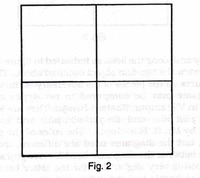
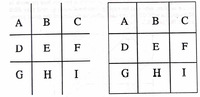
This game was documented by Hem Chandra Das Gupta while he was working on some of his own geological field work. The informants as he stated were Pathan or Pashtun who lived in Mianwali district of Punjab. He explained in his essay that the games he documented from the region were played by everyone in the area including both children and elders, and the games were found at times etched on stone slabs in common spaces. Tre Guti is also one of these games. Tre Guti is a capturing game played on a small board as the image shows. -
Tuk-Tak
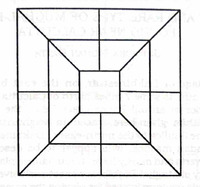
This game has been recorded by Jatindra Mohan Datta as a sedentary game played in Bengal. According to Datta, this game was usually played by children and young boys and girls of Bengal. The diagrams used for the game are shown in the image, but it may be noted that the one without the outer boundary line is also used. The board is on a slate with chalk or on the floor using charcoal and it is a two player game. -
Tule Paid
The game Tule Paid has been documented by Charu Chandra Das Gupta from Jowai, Meghalaya. The game as explained, is played by two players and twelve pieces for each player. The rule and diagram of this game is similar to a game called Bara-guti-pait-pait prevalent in Vikrampur in East Bengal (currently Bangladesh) This shows that a similar game is prevalent in Bengal and Assam under different names, as stated by Das Gupta. -
Unfinished Mancala, Ellora
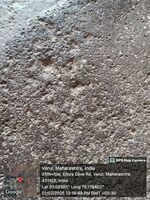
Etched games or games inscribed have been documented by scholars and board game researchers from many sites of India, both at religious and secular spaces. From sites like Lothal (Indus Valley) to game pieces found at Mohenjodaro, to reference of scholars at books like Sedentary Games and The Boardgame complied by the Anthropological Survey of India, etchings of game boards have been found on stone slabs of places where people gathered, in temple porches or floors of temples and stupa complex. This is an unfinished mancala board documented from Kailash Temple, Ellora. There are other examples of other unfinished engravings documented from this and other sites which could indicate the graffiti or etched boards were not always measured or engraved perfectly. This board could also have been a subject of destruction or erosion due to age and lack of preservation. The game of Mancala is considered to be one of the oldest games of the world, while its place of origin and the timeline is debatable. The earliest textual reference as stated by scholars comes from Kitab al-Aghani, or Book of Songs which does not directly mention mancala but refers to a similar game. These rows of cupules have been excavated in ancient sites like Jordan and many others including megalithic sites in India but their link as to being Mancala is debatable. This game has many variants all across the world and is popular in Africa, Asia, and parts of Eastern Europe. In India, Mancala is known by many names and the rules and variants of the game keep changing based on its region and according to the communities who play them. The number of holes in mancala differ along with the number of rows as well. In some variants the board is hand-drawn on a surface as circles with chalk or even cut holes on the soil to play the game. It is played with local seeds, stones or anything which is easily available as pieces to place inside the pits. The number of pieces per pit also vary from four to even twelve in some variants. This game is popularly a two-player game but some variants also show three players or even one in some case. While there are abundant etched evidence of mancala spread all across Maharashtra, it has been stated by scholars and board game researchers that more recent memory of the existence of this game is absent from the region. Thus, the practice of playing the game or the regional variant belonging from this region is either lost or yet to be found. The construction of the Kailash temple roughly dates back to the reign of Krishna I (756 – 774 CE) of the Rashtrakuta dynasty according to the Vadodara copper plate inscription. This copper inscription records and mentions Krishna I as the patron of the Kailashnatha temple and also mentions a shiva temple at Elapura or Ellora present day. This particular carving has been found beside a series of fire altars in the Kailash temple. -
Unidentified Board
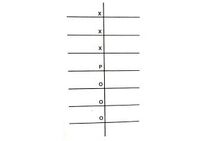
This game was documented from Mawrynghkneng in Meghalaya, about sixteen miles or twenty six kilometers away from Shillong. This game as described by Charu Chandra Das Gupta could be played both as a solitaire game as well more than one. The rules of the game as explained by das Gupta has been mentioned below. -
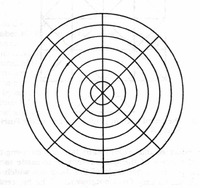
Unidentified Game (Variant of Gol Ekuish)
This game was documented by Sunder Lal Hora at Kalijhora at present Kalimpong district. The informant of these games was a local man of the area who was of Nepali origin. Credit also has been given to Mr. F.D Raj of Kalimpong who helped confirm the rules and the descriptions of the documented games. This particular game is untitled or unidentified as the informant could not obtain proper details about it except for the structure of the board. He also states that Mr. F.D. Raj could also not provide the rules of the game. The structure of the board is exactly similar to Gol-ekuish and if this was another variant the exact rules are unknown. But with the information available in his recorded essay Hora explains that the board consists of seven concentric circles divided by three diameters, thus there are 42 points in which the diameters meet the circles. Two players are required to play the game, one has a large number of ‘goats’ (unfortunately the number could not be understood) and the other plays with only one ‘tiger’. The usual rules of the tiger-play are observed, but the movement can be in all directions and not only along straight lines. In Gol-ekuish each player has 21 ballets which are placed at 21 cross points arranged along three consecutive radii. Thus even with a similar board two or more kinds of lay patterns are possible.