Search
155 items
-
Bara Gutiya
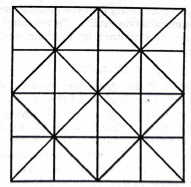
The game was documented by Charu Chandra Das Gupta from an inhabitant in Kumrahar, Bihar. In this game each player is played with 12 pieces and all cross-points are filled with pieces except the central one which is left vacant. The method of play is similar to that of Ram-tir and Bis-gutiya. It is stated by Das Gupta that this game is a more simplified variant of the two. -
Bara- Guti
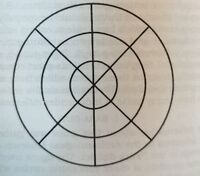
The game of Bara Guti was recorded from an interview with an individual who was an office staff of the Archaeological Museum of Nalanda and he belonged to Patna. This board or the diagram of the board contains three concentric circles divided into eight parts by a diameter of four which meets at a twenty-four cross point. It is a two player game. According to Charu Chandra Das Gupta, there are similarities between this game and Pretwa/ Pretoa which is prevalent in Chapra district of Bihar and another game called Gol-Ekuish which was popular in the central province of Bihar. The difference is that in Gol-Ekuish, The board is of seven circles which is divided into six parts by a diameter of three and in case of Pretwa/Pretoa, the board consists of three circles divided into six parts by a diameter of three. At times even pretwa is played by twelve pieces or bara-guti, just the difference being that there are four circles instead of three in case of Bara-Guti. -
Bheri Bakri
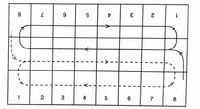
This game was documented at the region of Uttarkhand, which was once known as the British Garhwal by Hem Chandra Das Gupta during his geological fieldwork. The informants were inhabitants of the area. The game of bheri-bakri (sheep and goat) is a two person game played with 16 pieces equally divided between the players and 4 pieces of cowries as the dice. The 16 pieces represent the sheep and the goats white being the goats and the sheep is black. By means of the vertical and the horizontal lines the rectangular-diagram used for the play is divided into 24 compartments and of them 8 belong to each player as shown in the image. While the board looks similar to Tablan or Tabul Phale and the use of 4 cowries as dice might be similar, but there are other differences in the way both games are played. -
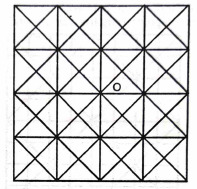
Bis Gutiya
This game was documented by Charu Chandra Das Gupta in Kumrahar, in Bihar. It is played by two players each having twenty pieces. The central point marked O is left vacant. The method of playing this game is exactly similar to that of the game called Ram-tir also documented in the essay. The main point of interest regarding this game is that in each of the sixteen small square courts there is a cross-point in the centre which is occupied by a piece. On each side there are such eight cross-points on which each player places eight of his twenty pieces. -
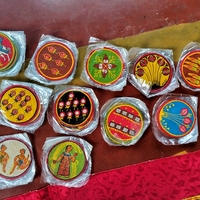
Bishnupur Naksh/Naqsh Cards
Naksh/ Naqsh is a variant of Ganjifa cards. It contains a total of forty eight cards. It comprises of four identical series pf 12 cards. Each has a mir on an elephant called sahib, the wazir on horseback called bibi and 10 numeral cards with designs derived from Mughal and Dashavatar Ganjifas. The suits are Saheb or riders on an elephant, Bibi or ghori or horsemen, Shankha or conch, Pahalwan or wrestlers, Pori or girl under tree, lotus bud, Dawal or swords, rectangular flowers, circular red flowers, red flowers on a stem, white round flowers and lotus flowers on stems. -
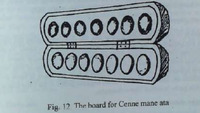
Cenne Mane
Cenne Mane is played all over Karnataka but it has different names and variants spreading across the region. According to Kulirani and Vijayendra and other scholars, Cenne Mane is itself a variant of the popular game of Mancala. The word chenne is a peculiar word in Tulu language. According to Verupakash et al. it is not used in regular conversation but it is associated with the names of the folk people as chenna, chenni, china, chennu, chennamma, chennappa, chinnappa etc. In Kannada the word chenne- means beautiful and attraction. India has had many alternate names and variations in rules and strategies of the game. It is often played on a wooden board with depressions. Other times in some regions it is also played by drawing or cutting holes on the ground either on stone or slabs or even temporarily on soil. This game is played for long hours by women more than men and Cenne Mane is also played during the Ashada-Shravan months. It is a two player game, although some variants also mention three players or even one. The intention of winning the game depends on collecting maximum number of seeds or stones or pieces. The pieces are placed in the holes. In case of Cenne Mane, there are four seeds per pit. The game begins in an anti-clockwise direction. This game does not end in one round. There is a case of debts and borrowing that is also followed in some variants. Cenne Mane is popularly known as Cenne Mane Ata. In the districts of nothern Karnataka it is also called Karu Baruva whereas in southern Karnataka it is known as Buleperga. There are other sub variants that are played like; Jodu Perga, Thara Thimbala, Hegge Thimbala, Mule Ata, Seenya Mukhya, Earns Ata, Arasa Ata and Sithata. -
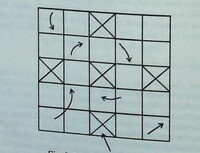
Chalar
This is played on a 5X5 board. Four women play at a time with four gaming pieces of four different colour {sari) made of broken bangles, and four cowries as dice. In the absence of cowries, broken pieces of earthenware can be used as dice by colouring the upper side in white. -
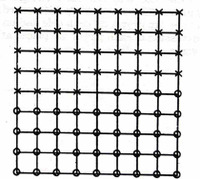
Challis Gutia
This game has been documented by Jatindra Mohan Datta in the streets of Ultadanga, Kolkata. The people who knew about the game were inhabitants from Jaunpur, Uttar Pradesh and they stated it used to be played in their village as well. It is a two player game. One player occupies the points marked with X’s with his 40 pieces —tiny bits of coal as their pieces; his opponent places his 40 pieces —tiny bits of potsherd at the points enclosed by O's. The pieces move one place at a time either vertically or horizontally, if it is vacant: and they capture the opponent's pieces by jumping over the same in a straight line to a vacant point opposite. Successive captures are allowed. The winner is to capture all the pieces of his opponent.