
Search
155 items
-
Chaupar, Bhaja
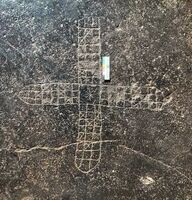
This is a chaupar grafitti board documented in Bhaja cave number 12 which is the chaitya griha of the bhaja cave complex. According to anthropologists K. Ravi and Jaya Sankar Rao and the classification of HJR Murray in his book, The History of Boardgames Other Than Chess, Chaupar is categorised as a Race Game. It is typically a four player game and the pieces belonging to each player is distict from the others. It is played with four pieces and a throwing of either cowrie shells or two oblong dice. There are various terminologies used for the safe squares, or the throws which differs from one region to the other. For example, in Haryana the central home which is a flower here is called 'charon ka ghar' (Bhattacharya, Finkel and Soni 2011). Interestingly, it can be played by a throw of six cowrie shells or even more depending on the variant. As this etched board is from Maharashtra, it is difficult to understand the exact throw of dice or cowries used or the rules made to play this game. There is currently a version of chaupar in Maharashtra called Saripat. Bhaja is one of the oldest rock cut cave complexes of the Hinayana period. The board is etched on the floor of the main chaitya griha on the left hand side facing the stupa. The limb facing the stupa is 42cm on both sides. The middle square or rectangle is 15cm facing the stupa. The width of the limb is 14cm on both sides approximately. On all limbs, there are 6 safe squares. Safe square on the 4th and 7th square is situated on both extremes while square number 3 and 6 is situated in the middle column. There is a floral pattern in the centre. Etched games or games inscribed have been documented by scholars and board game researchers from many sites of India, both at religious and secular spaces. From sites like Lothal (Indus Valley) to game pieces found at Mohenjodaro, to reference of scholars at books like Sedentary Games and The Boardgame complied by the Anthropological Survey of India, etchings of game boards have been found on stone slabs of places where people gathered, in temple porches or floors of temples and stupa complex. -
Chaupar, Handmade
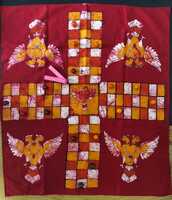
The first description of this game seems to have been written in the 16th century, when chaupar was a common gambling sport at the court of the Mughal emperor Akbar in Agra and Fatehpur Sikri. Abul Fazl describes how the game is played with sixteen pieces, three dice, and a “board” in the shape of a cross. The history of chaupar is linked to that of pachisi, not least because the boards are identical and that it is therefore impossible to see which of the two games an archaeological example belonged to. Also known as chausar or chaupad, this game has many similarities to the more well-known pachisi. A cross-shaped board hosts the pieces of four players, who play in two partnerships, each player having four pieces. The pieces begin at fixed positions around the board, racing around the board to finish at the centre. The game has also attracted much attention in the West and in colonial India. Thomas Hyde wrote about the game in his De Ludibus Orientalibus in 1694 followed by many other commentators and an 1851 painting of men playing chaupar by William Carpenter. Edward Falkener also published a detailed account of Pachisi in his Games Ancient and Oriental and How to Play Them in London in 1892 . There are multiple versions of chaupar and the rules and material vary. The Rajputs traditionally play the game during the entire night of a wedding, along with chanting, drinking tea and other beverages as well as smoking or chewing tobacco products. The Sodha Meghwals and the Rabaris faithfully follow the tradition of the Rajputs and play the game during marriage or any such festive occasion. The Rabari play the game on a board with seven khana (rooms) on each row, while the board of the Meghwal and the Rajput possesses eight squares on each row. The game is played with six cowries locally known as khairiya by the Rabari and with seven cowries both by the Rajput and the migrant Marvada group of the Meghwal of Sumrasar. It is also played by the Patwal families in Haryana and as Dosh Pochish among Sylheti communities. This Chaupar board is made of Batik print cotton cloth by Ramsons Kreera Pratisthan. They are working towards the revival of traditional Indian Boardgames. It also depicts the symbol of the Mysore royal family. Ramsons manufactures hand-made gameboards, casting pieces and counters. They collaborate with artists and artisans all across India to make these boardgames and their material have a number of varieties such as, Navalgund Jamkhana, Silk embroidery, Batik print, Mysore silk zari weaving etc. Other than variiants in types of cloth and handloom they also manufacture boardgames on Marble, Mysore wood, Brass Casting, Wood Polychrome and many as such. -
Chaupar, Pataleshwar (1)
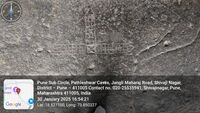
This etched or incised graffiti board of Chaupar is located right at the entrance of the cave temple of Pataleshwar. The chaupar board here has arms of 27 cms each with a floral design in the middle square or the central home square. Pataleshwar cave complex are a small group of five excavations, developed into a cave temple dedicated to Pataleshwar, God of the underworld or Shiva. This cave complex is ruggedly excavated and also bears resemblance with the Elephanta caves of Mumbai. The cave has unfinished murals on the sides and on the backside. There is a Nandi pavilion at the entrance of the cave which is circular. The inside of the main cave contains a pillared hall with a pradakshinapatha the way to go around the shrine. One side of the cave remains unfinished. This and other boardgames were documented on the floor of the cave. According to anthropologists K. Ravi and Jaya Sankar Rao and the classification of HJR Murray in his book, The History of Boardgames Other Than Chess, Chaupar is categorised as a race game. The first description of this game seems to have been written in the 16th century, when chaupar was a common gambling sport at the court of the Mughal emperor Akbar in Agra and Fatehpur Sikri. Abul Fazl describes how the game is played with sixteen pieces, three dice, and a “board” in the shape of a cross. It is typically a four-player game and the pieces belonging to each player is distinct from the others. It is played with four pieces and a throwing of either cowrie shells or two oblong dice. There are various terminologies used for the safe squares, or the throws which differs from one region to the other. For example, in Haryana the central home which is a flower here is called 'charon ka ghar'. Interestingly, it can be played by a throw of six cowrie shells or even more depending on the variant. As this etched board is from Maharashtra, it is difficult to understand the exact throw of dice or cowries used or the rules made to play this game. -

Chaupar, Pataleshwar (2)
According to anthropologists K. Ravi and Jaya Sankar Rao and the classification of HJR Murray in his book, The History of Boardgames Other Than Chess, Chaupar is categorised as a Race Game. The first description of this game seems to have been written in the 16th century, when chaupar was a common gambling sport at the court of the Mughal emperor Akbar in Agra and Fatehpur Sikri. Abul Fazl describes how the game is played with sixteen pieces, three dice, and a “board” in the shape of a cross. It is typically a four-player game and the pieces belonging to each player is distinct from the others. It is played with four pieces and a throwing of either cowrie shells or two oblong dice. There are various terminologies used for the safe squares, or the throws which differs from one region to the other. For example, in Haryana the central home which is a flower here is called 'charon ka ghar'. Interestingly, it can be played by a throw of six cowrie shells or even more depending on the variant. As this etched board is from Maharashtra, it is difficult to understand the exact throw of dice or cowries used or the rules made to play this game. There is currently a version of chaupar in Maharashtra called Saripat. This documented etched Chaupar board is relatively smaller than an usual playable board, suggesting it could have been an experimental one to draw a board or in the process of a trail an error of etching graffiti boards on the floor It might have been used for playing as well.Pataleshwar cave complex are a small group of five excavations, developed into a cave temple dedicated to Pataleshwar, God of the underworld or Shiva. This cave complex is ruggedly excavated and also bears resemblance with the Elephanta caves of Mumbai. The cave has unfinished murals on the sides and on the backside. There is a Nandi pavilion at the entrance of the cave which is circular. The inside of the main cave contains a pillared hall with a pradakshinapatha the way to go around the shrine. One side of the cave remains unfinished. This and other boardgames were documented on the floor of the cave. -
Chaupar, Pataleshwar (3)
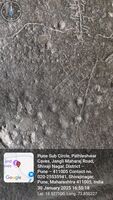
This is a documented image which showcases a small etched or incised Chaupar board on the floor along with another board of Mancala, almost overlapping. Speculation could suggest that they were either made one after another or in different times. This particular Chaupar board is relatively smaller than the other boards recorded in the cave temple of Pataleshwar. This could draw speculations that this board was made in an attempt to document what boards they played in the past or this could have been part of their trial and error process of etching boardgames on the ground without precise measurements. Pataleshwar cave complex are a small group of five excavations, developed into a cave temple dedicated to Pataleshwar, God of the underworld or Shiva. This cave complex is ruggedly excavated and also bears resemblance with the Elephanta caves of Mumbai. The cave has unfinished murals on the sides and on the backside. There is a Nandi pavilion at the entrance of the cave which is circular. The inside of the main cave contains a pillared hall with a pradakshinapatha the way to go around the shrine. One side of the cave remains unfinished. This and other boardgames were documented on the floor of the cave. According to anthropologists K. Ravi and Jaya Sankar Rao and the classification of HJR Murray in his book, The History of Boardgames Other Than Chess, Chaupar is categorised as a Race Game. The first description of this game seems to have been written in the 16th century, when chaupar was a common gambling sport at the court of the Mughal emperor Akbar in Agra and Fatehpur Sikri. Abul Fazl describes how the game is played with sixteen pieces, three dice, and a “board” in the shape of a cross. It is typically a four-player game and the pieces belonging to each player is distinct from the others. It is played with four pieces and a throwing of either cowrie shells or two oblong dice. There are various terminologies used for the safe squares, or the throws which differs from one region to the other. For example, in Haryana the central home which is a flower here is called 'charon ka ghar'. Interestingly, it can be played by a throw of six cowrie shells or even more depending on the variant. As this etched board is from Maharashtra, it is difficult to understand the exact throw of dice or cowries used or the rules made to play this game. -

Chaupar, Pataleshwar (Incomplete)
This is a documented image which showcase one arm of four found in a typical Chaupar board. Speculation could be that this was made in a trial and error process while games were being etched or excavated on the floors of the cave site. Or the measurement could have been incorrect leading to abandonment of this board mid-way. It could also have worn away with time and lack of preservation of etchings on the floor. Pataleshwar cave complex are a small group of five excavations, developed into a cave temple dedicated to Pataleshwar, God of the underworld or Shiva. This cave complex is ruggedly excavated and also bears resemblance with the Elephanta caves of Mumbai. The cave has unfinished murals on the sides and on the backside. There is a Nandi pavilion at the entrance of the cave which is circular. The inside of the main cave contains a pillared hall with a pradakshinapatha the way to go around the shrine. One side of the cave remains unfinished. This and other boardgames were documented on the floor of the cave. According to anthropologists K. Ravi and Jaya Sankar Rao and the classification of HJR Murray in his book, The History of Boardgames Other Than Chess, Chaupar is categorised as a Race Game. The first description of this game seems to have been written in the 16th century, when chaupar was a common gambling sport at the court of the Mughal emperor Akbar in Agra and Fatehpur Sikri. Abul Fazl describes how the game is played with sixteen pieces, three dice, and a “board” in the shape of a cross. It is typically a four-player game and the pieces belonging to each player is distinct from the others. It is played with four pieces and a throwing of either cowrie shells or two oblong dice. There are various terminologies used for the safe squares, or the throws which differs from one region to the other. For example, in Haryana the central home which is a flower here is called 'charon ka ghar'. Interestingly, it can be played by a throw of six cowrie shells or even more depending on the variant. As this etched board is from Maharashtra, it is difficult to understand the exact throw of dice or cowries used or the rules made to play this game. -
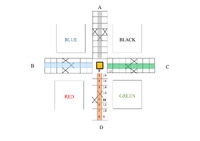
Chaupar: Downloadable Game
This is a downloadable resource of a Chaupar Game one can download and play referring to the rules and using the given pieces. -
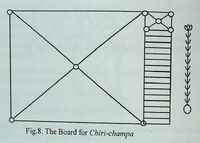
Chiri-champa or Siri-champa or Siri-gampa or Siri-jampa
Chiri or Siri, means 'stair' and here 'champa' is the term for a split tamarind seed used as a dice. The equipment consists of a square board, four split and two game pieces for each of the two players. Such games are played in peak summer months during the lean agricultural season or on a rainy day when farm activities are not possible, or when the maize crop is half grown. During this period there remains a minimum farm activity. The variant Siri-champa is played in lean agricultural seasons. Women of the area do play this game. It is a race game.