Search
155 items
-
Chonpa- A Variant of Pachisi
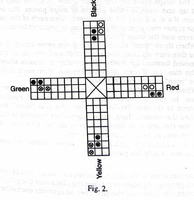
This variant of Pachisi has been recorded by by E. De. M. Humphries in Karwi, a district in Uttar Pradesh. It is known as Chonpa or Chaunsarh. According to Humphries, Another variant is known as “Chonpa” or “Chaunsarh.” It is a four player game, each having four “men,” coloured respectively black, yellow, green and red as shown in the image. The two former play in partnership against the two latter colours. The board is the same as a Pachisi board with the exception that the safe squares mentioned in the case of pachisi are either not marked at all or are disregarded, if the board is one made for both games. A single piece may, and a pair may not, be captured on any square to which a hostile piece may be moved. The moves are regulated by throwing three dice: not, as in the case of Pachisi, —cowries. These dice as documented were of bone or ivory and are about 2% inches long, marked on their long sides with the numbers (1), (2), (5) and (6). -
Chowka Bara : Downloadable Game
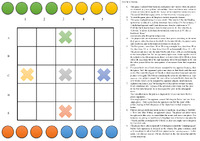
This is a downloadable resource of a Chowka Bara Game one can download and play referring to the rules and using the given pieces. -
Chowka Bara, Handmade
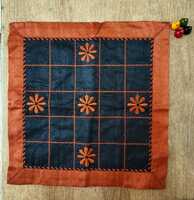
Chowka Bara, also known as Ashta Chamma, is a traditional Indian board game that dates back to ancient times. Although the exact place of origin and the period remains unknown, this boardgame has been popular in various places across India through generations. The game is played by two or four players using four cowrie shells and several tokens. The name “Chowka Bara” means “four eight,” which are the highest numbers a player can get from the cowrie shells. The game likely started in Andhra Pradesh, Telangana, or Karnataka. It is called 'Athha Pagdi' in Gujarat and 'Chiti' among the Baiga Community in Madhya Pradesh. In Karnataka, it is called “Chowkabara,” in Andhra Pradesh and Telangana, it is known as “Ashta Chamma,” and in Tamil Nadu, it is called “Daayam.” Each region has its own small changes to the rules, adding to the game’s rich variety. This game is known by various names in different languages and regions across India. t’s thought to be one of the cross-and-circle games, like Pachisi, Ashte Kashte, and Chaupar. The Chowka Bara board always has the same number of tiles across and down, but the tiles don’t have to be square. The number of tiles varies, allowing for bigger boards and longer games. There is always an odd number of tiles so there can be a central tile. Each player uses one less token than the number of tiles on one side of the board. The goal is to get all of one’s tokens to the central tile first. Variants: Among the Baiga Community in Madhya Pradesh, the game can be played by 2 3 or 4 players and each person is alloted 4 pices called khunti. 5 pieces of halved tamarind seeds are used as dice. The throw of the dice is called chiti. -
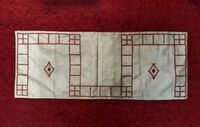
Daadu
Dadu is a game played by the Muslim Dawoodi Bohra community in Mumbai and Pune, India. Dadu is a 'Race Game' where two players race their respective pawns to complete the circuit. Each player gets 4 pawns of the same colour and keeps them in the place marked 'home'. The movement of pawns is controlled by the throw of 5 cowrie shells. -
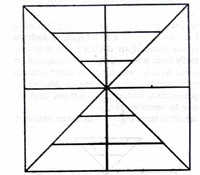
Dash Guti
This game was recorded by Hem Chandra Das Gupta and the information was collected during one of his field visits to Gosalpur in the district of Jubulpur, in present Madhya Pradesh -
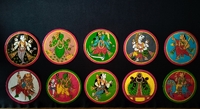
Dashavatar Cards
The Dashavatar cards of Bishnupur is a product of transculturation of locally made playing cards that came from the Mughal Ganjifa Cards. The Mughal Ganjifa Cards, possibly originated in Islamic Persia or Mameluke Turkey and they travelled to India and soon gained popularity and started having its own regional variants such as the Dashavatar cards which depict the ten incarnations of Lord Vishnu in a set of 120 cards. While the Mughal Ganjifa consisted of 8 suits with the Raja (king card) and the Mantri (vizier card) along with its number cards, this set had 10 suits belonging to each avatar namely, Matsya, Kurma, Varaha, Narasingha, Vaman, Parasuram, Ram, Balaram, Buddha/Jagannath, and lastly Kalki. The Dashavatar cards also had each avatar as a king and vizier card along with numeric cards of 1 to 10. While the transition of Mughal Ganjifa to its regional variants is still unknown, the makers of the Dashavatar cards in Bishnupur trace back their lineage to the Rajputs in Rajasthan. The artist, Shital Fouzdar belongs to the eighty ninth generation of artists making these hand painted playing cards. The Fouzdar family has been associated with the Malla Rajas of Bishnupur and are popular for making these cards. The image here shows only the 10 raja cards of the avatars. These cards are 8inches in diameter which is larger than the usual 6inches diameter of other regional variants of dashavatar cards such as in Orissa and Maharashtra. Another interesting feature of these cards lies in the differences in their artistic styles, the materials they use, their iconography and even the avatars that they paint. For example in Bishnupur (West Bengal) and Raghurajpur (Orissa) the ninth avatar is Jagannath whereas in other places such as Sawantwadi (Maharashtra) it is Krishna or even Buddha in some cases. The different variants of the game have their own rules: in some variants, the game starts in the daytime with the earlier avatar suits and at nighttime with the later avatars. When it rains, the game starts with the Matsya (fish) or Kurma (tortoise) suits as these are aquatic animals. In Bishnupur, the scenario is different and the Narasimha suit becomes the opening suit at twilight and the matsya suit opens the game in the daytime. The most powerful card as it is with the mughal ganjifa is the king followed by the mantri or the vizier. In case of dashavatar cards, there are two face cards such as the raja and mantri cards (king and vizier respectively) of the avatars and 10 numeric cards. In these cards, the number is depicted by the counting of symbols of the particular suit (number of fish in case of Matsya). In the first five suits the numeric card 1 is the highest after the raja and mantri card while 10 is the lowest. In case of the last 5 suits the numeric card of 10 becomes the highest while 1 becomes the lowest. -
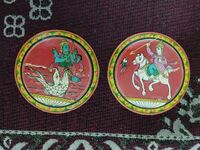
Dashavatar Cards, Sawantwadi
This image shows a variant of Dashavatar Ganjifa cards sourced from Sawantwadi of Maharashtra. During the 18th and 19th centuries, several regional schools of Ganjifa painting emerged in Sawantwadi. The revival of this craft began when H.H. Rajesaheb Shivramraje Bhonsle, during a visit to the Victoria and Albert Museum in London, noticed a label mentioning Sawantwadi Cards. He and his wife learned the art from the 80-year-old artist Pundalik Chitari, who at that time produced only two sets of Ganjifa per year. Motivated to preserve the tradition, they established Sawantwadi Lacquerwares to promote Ganjifa and lacquer art, with the goal of passing it on to younger generations. Ganjifa is a product of transculturation in Mughal India or earlier. Ganjifa cards possibly originated in Islamic Persia or Mameluke Turkey and as far as their travel to India is relevant with the earliest sources of Ganjifa cards being mentioned in the Mughal archives by Gulbadan Begum (1523 - 1603), the sister of Emperor Humayun (1508-1556) and later, at length by Abul Fazl (c.a. 1565), the celebrated biographer of the Emperor Akbar (1556-1605) who describes the Ganjifa set at length. The Mughal set consists of the king of Delhi (or the emperor himself) as well as officials from different parts of the administration and other neighbouring states. The Mughal Ganjifa spread to multiple parts of South Asia but has since disappeared from all but a few places in India. Ganjifa cards also developed into regional variants with the most popular being Dashavatar cards of the ten incarnations of Vishnu into a total card of 120 cards consisting of 10 suits. Each regional variant has their unique variant in play traditions or significance in their trump cards. In Sawantwadi, the ninth avatar is usually Buddha or Krishna whereas in Bengal and Odisha it is typically Jagannath. Hence the ten avatars of Vishnu: Matsya, Kurma, Varaha, Narasimha, Vamana, Parashurama, Rama, Krishna, Buddha, and Kalki consist of one king card, one vizier card and ten numeric cards consisting of one suit. The iconography of the cards also differs depending on the region and their artistic style which makes it significant to the local tradition of the area. The art style of painting the cards are influenced by the Ganjifa painting tradition of Andhra Pradesh. The dimension of the cards are much smaller than that of Bishnupur variant in Brngal or Mysore variant (chhad). The Sawantwadi Ganjifa is an ongoing culture of making cards with locally sourced artisans, supported by the royal family of Sawantwadi. Along with the making, the royal family is also involved in reviving the play traditions of the game. -
Dashavatar Ganjifa Card, Raghurajpur
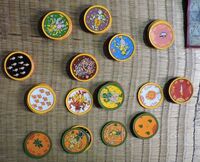
The Dashavatar Ganjifa cards of Raghurajpur Orissa are playing cards featuring the 10 avatars of Vishnu namely Matsya, Kurma, Varaha, Narasimha, Vamana, Parashuram, Rama, Balaram, Jagannath and Kalki. The total set contains 120 cards which includes 10 suits. Each suit contains one Raja or the king card, one Mantri or the vizier and ten number cards.