Search
155 items
-
Digor
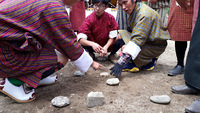
Digor (degor) is a traditional game played in Bhutan, which is often mistakenly described by foreign authors as a type of shot put. There are many elements that make it different from the shot put game (including the way of throwing). It is played with a pair of round flat stones, which are thrown in the direction of two wooden targets placed on the ground roughly 20 meters apart. It is a traditional target-based sport of Bhutan, which has some similarities to boules or petanque. This sport is traditionally played by village men all around Bhutan. The game is slightly different in various regions. Organized games between neighbouring villages are now rare. Today the game is played for social reasons, mostly at annual religious festivals. Sometimes it involves a bet that concerns the organization of the event, where the loser must engage in its preparation to a large extent, while the winner has fewer tasks to do. This type of betting takes place among local communities or among friends. -
Do Guti
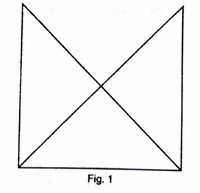
This game was documented by Hem Chandra Das Gupta while he was working on some of his own geological field work. The informants as he stated were Pathan or Pashtun who lived in Mianwali district of Punjab. He explained in his essay that the games he documented from the region were played by everyone in the area including both children and elders, and the games were found at times etched on stone slabs in common spaces. Do Guti is one of them. It is a two player game and as the name suggests Do Guti, means two pieces and it is played as such. Do Guti is a blockade game from Punjab in Pakistan. Graffiti on early monuments suggest this game could be medieval in date. -

Download and Play Ganjifa
Naqsh ruleset provided by Kaushal Gupta in the IPCS journal with some modern adaptations -
Düzalé
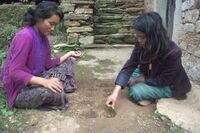
This is a mancala variant showing 4 holes facing each other and one hole at the end. -
Egara Guti
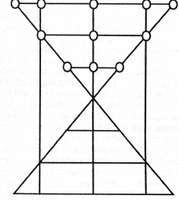
This game was documented by Hem Chandra Das Gupta from an informant at Bhandara in the Central Provinces. Two players are necessary for the game. There are 23 cross-points and of these 22 are filled up with pieces of two different descriptions, each player having 11 while the central cross-point is kept vacant at the beginning over and capturing the ballet of the adversary lying on the next cross-point if there be an un-occupied cross-point just beyond the latter and in the same line. Not Much information has been given by Das Gupta about the game. He mentioned that this game has resemblance with the game documented in Punjab called Bara Guti but having the central point as vacant. The structure of the board also has some similarities with other forms of alquerque boards like Lau Kata Kati or Kawwa Dorki. -
Gaya gaccha
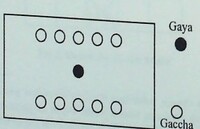
The name of this dexterity game for children is Gaya gaccha. The game piece 'ghuti' lying in the central place, or 'gaya,' must be struck by another ghuti to win the game as a whole. This signifies total loss to the opponent and marks the end of the game. A ghuti lying on its side is called gaccha, If a gaccha is hit, the said gaccha is won by that player, which indicates a partial loss to the opposition who must surrender that particular ghuti to the striker. These expressions are used verbally in the game. Normally, the players consist of five to ten in number but the minimum number of players is two. The number of ghuti depends on the number of players; in that there must be one more ghuti than the number of players, as there must be one in the central position as winning over the ghuti in the central position is the aim of all the players. The ghuti chosen for the game is kul or ber (black berry). It may also be of round marbles. There are no other special rules for the game. Normally fruits are chosen as ghunti by boys and girls because they like to taste them. The players can be of either sex, although boys are preferred. The age of the players is below fifteen years and there is no restriction of players in terms of economic and social status. It is normally played in leisure time or during grazing. It is played on the village road but preferably under the shadow of a tree. The layout of the board is simple and is drawn on using brick pieces. It may be square or rectangular in shape. -
Gol-Ekuish
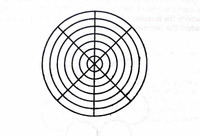
This game was recorded by Hem Chandra Das Gupta and the information was collected during one of his field visits to Gosalpur in the district of Jubulpur, in present Madhya Pradesh. As shown in the image seven concentric circles with three diameters are required for playing this game, the diameters meeting the circles at 42 points. It is a two player game, and each of them provides himself with 21 pieces which are placed at the 21 cross-points arranged along 3 consecutive radii. Charu Chandra Das Gupta in his essay where he documented the games from Bihar, he noted some similarities of Gol-Ekuish and Pretwa or Pretoa along with Bara Guti. According to him, the difference is that in Gol-Ekuish, The board is of seven circles which is divided into six parts by a diameter of three and in case of Pretwa/Pretoa, the board consists of three circles divided into six parts by a diameter of three. At times even pretwa is played by twelve pieces or bara-guti, just the difference being that there are four circles instead of three in case of Bara-Guti. -
Golok Dham
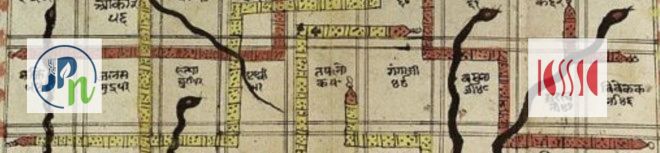
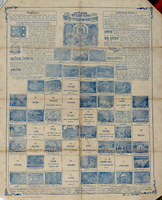
Golok Dham is a variant of Gyan Chaupar but instead of snakes and ladders, it portrays multiple place names and moral situations on a grid. The game seems similar to Western moral education games such as Mansions of Happiness but a greater similarity is observed with Sa lam nam bzhag, the Tibetan Game of Rebirth and Liberation. The game is clearly Vaishnavite and ends with the player reaching GolokDham or the abode of Vishnu. The game is a proto-hypertext because it often offers multiple moves from the same square based on the dice throws of the player. 'The board designed with arrays [was] printed first at the Tara Art Press, date of its initiation almost coincided with the time when in 1 870s and 1 880s, the religious and mythodological pictures were being produced by numerous small presses of Battala locality.3 A specific reference of this game is found in the conversation of Shree Ramakrishnadeb on 2nd October 1884. Ref. Shreema Kathita "Shree Shree Ramkrishna Kathamrita", Kalikata, 1339, Vol. IV, p. 179. The pictures used were stylistically next of kin of the kind of mythological pictures produced by those small presses throughout this period. As an instance the chromolithographie picture of Radha and Krishna, a production by the Kansaripara Art Studio may be cited.4 The picture given on the top of the golokdham game board (square no. 64) seems almost to be a replica of the aforesaid chromolithograph. The treatment of the mytho- pictures produced by the artists of Kansaripara or Chorebagan was cruder than the Calcutta Art Studio prints. ' (Bagchi 2005)