
Search
155 items
-
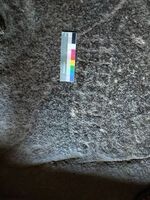
Graffiti Boardgame Tablan in Kailash Temple Ellora
Tablan is a traditional Indian board game for two players, similar to Backgammon and Tâb, where the goal is to occupy more of your opponent's home squares than they do yours. [1, 2, 3, 4] Here's a more detailed breakdown: [1, 4, 5] Origin & History: Tablan is an ancient Hindustani game originating in India, particularly in some villages in Mysore, southwestern India. [1, 4, 5] It could have originated from the Roman games Duodecima Scripta This gameboard has been found in Cave 16 of Ellora also known as the Kailash temple. -
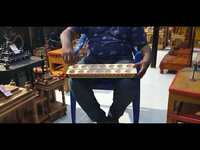
Gud Phale
Gud Phale or Ghuu'ddh Fha'le'h commonly known among the elders was a popularly played games. In Goa, India these games are made by the people of Chitari community and comes with colorful designs on them. The game is played with two players usually with the food grains in the groove (Ghuu'ddh). This is another possible variant of Mancala, Pallankuzhi, Vamana Guntulu, Morkor Katiya and many others played all across India. -

Gyalpo Tanor
The game is a string game of trickily moving the bamboo pieces hung on the string. It is played in the district of Tashigang in eastern Bhutan. String are attached to a bamboo pieces with two holes in the centre. Two loops are created with two bamboo pieces hung on it. The trick is to move the two bamboo pieces on the same loop. A king and a clever man is said to have had a contest to do the trick, keeping a horse as a bet. The intelligent man is said to have succeeded in trickily moving the bamboo pieces from one point to the other and won the horse. As the king lost the horse, the game is know as gyalpo tashor, or the king losing a horse. -
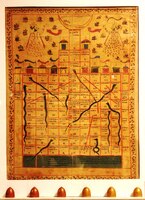
Gyan Chaupar board (Jain Version)
This 'is an example of the Jain version of the game. (Fig.1) It seems to follow the basic rules of the religious philosophy. Though unlike the nine snakes and five ladders seen in most Jain gyan chaupar boards, it has a distinctly coloured extra snake at the topmost box. It is a late-eighteenth century board painted on cloth in the usual 84-box style (9 x 9 plus three additional boxes at 1, 46, 66). The snake at the highest box on the left (76) is the mohani-karma—confusion and desire trying to catch hold of the jiva before it attains enlightenment.[5] This board follows the conventions of the Rajasthani school of painting, evident from the line work on the divine figures at the top, Devanagari inscriptions, floral creeper patterns and red–black colour contrast.' (Srivastava, Sahapedia.org) Gyan Chaupar or Gyan Bazi is the predecessor of Snakes and Ladders. The Jain version in the National Museum is shaped liked a Rajput fort but most of the boards are shaped like the Lokpurush, or the man who symbolises of the universe, with the three worlds (heaven, earth, and hell) mapped onto his body, illustrating the Jain understanding of the cosmos. -
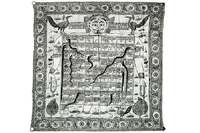
Gyan Chaupar board (Jain version), Lokapurush motif
Calico Museum, Ahmedabad, acc. no. 98422 (fig. 4). Executed by Pandit Tej Vijaya Ganin (?) and dated Phalgun V. S. I 890/I 8 34 A. D. A boldly painted and attractive board of the lokapurusa type, with a background of peacocks, stylised plants and trees, within a floral border in orange, ochre, pink and olive green. The gyan chaupar board used by the Jains of western India in the 18th and 19th centuries has 84 numbered squares, comprising a 9 x 9 square grid with three extra squares (I, 5 6, 66) at bottom left and at either side. Several additional squares (with separate numbering) generally appear above the main playing area, often enclosed within an architectural structure resembling a palace or temple (nos. II, I2, I5, I8). These squares are named Vijaya, Vaijayanta, Jayanta and Aparajita, with Sarvarthasiddha above them, and represent the vimanas of the Pancanuttara heaven, the highest of the heavenly regions according to Jain cosmology.15 Higher still is the crescent shape of Isatpragbhara (called Siddhasild or Muktiksetra on the boards themselves), the umbrella-shaped region at the topmost point of the universe, the abode of perfected souls who enjoy the eternal bliss of liberation.16 In the other principal variety of the Jain game, the playing area forms the body of the lokapurusa or Cosmic Man, whose head, arms and feet protrude from its sides (nos. IO, I4). The face of the lokapurusa and the crescent on his forehead again represent the Pancanuttara heaven and Tsatprdgbhdra.17 In keeping with the Jain passion for cosmological classification and theorising about the laws of karma, the nomenclature of the squares through which the player progresses is more systematic and detailed than in the Hindu forms of the game. There is some variation in nomenclature: whereas board no. IO, dated I834, uses long descriptive cap- tions for the squares, these are often abbreviated and simplified in later igth century boards. Some names, especially of spiritual vices, are shared with the Hindu game, e. g. krodha and the long snakes of tamas-ahankara (square 67 in nos. 13 and I 5) and rajas-ahan- kdra (leading from 75 to 2 in no. IO, much like the ahankara to maya snake in the 72-square Vaisnava board). The snakes in general represent the spiritual defilements which hinder the soul in its long upward journey from the various hells or the condition of the nigodas, the very lowest form of life, to the heavens and ultimate liberation. In no. I 5, for example, the snake squares include maithuna-saivyd (lust, 13); mithjydtva gunasthdna (17, "lack of insight", the lowest of the I4 gunasthdnas or stages of purification);18 lesyd nila (74, "blue lesya", the second darkest or most defiled of the "shades" of the soul); krsna lesya (75, "black lesya", the darkest of all); while the final snake (76) is mohanfya-karma, the residual karmas which cause the soul to become confused and desirous.19 In Jain doctrine, such karmic impediments must be dealt with by upasama ("suppression": ladder squares 7 and 44) or ksaya ("obliteration": ladder square 47). -

Haar'e
Haar'e or Haaran Gindun is a game played with Kaudi or cowrie shells by Kashmiri Pandits during the festival of Shivaratri. The title or the name of this game comes from the word Haar which means in Kashmiri, the money or a playing object. It is considered an old game although the period of its origin remains unknown. As the name suggest the main component of the game is the material, in this case the Kaudi or shells and the number of participants mentioned could range from two players to more. The rules of the game are followed on the day of Salaam (the following day after Shivratri) and Dalip Langoo who is the source informant of the game mentions that it used to be popularly played in Srinagar during his childhood. He also provides a detailed description of the game along with the terms used in Kashmiri. Haar is the Playing object, Chaakh is the measuring unit consists of four Haar’s, minimum of two Haars are required to start a game, Kunyi is the Combination of single Haar resulting the win, Pushraan Dabu means, to add a Haar on a particular number as decided, Juph Taaq is even and odd combinations: In this, odd numbers were to be won and even means to pass on the game to next the player adding a Haar to the rest of Haars on surface, Chaakan is the combination of Four results the win,Duchi means combination of Two results the win, Shartal means the betting, and Tichan means to strike with one Haar another one which is more popular amongst children. He mentions that there are various ways to play this game. -
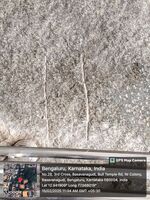
Incomplete Board, Bull Temple
This board or this etching of a board could be speculated as the outer lines of Tablan. This etched board was found and recorded from Bull temple at Bangalore. This Bull temple consists of the largest stone carving of Nandi, the vahana (vehicle) of Lord Shiva. This temple was built by Kempe Gowda who was the the founder of Bangalore. This temple also has legends around it of the villagers worshiping the bull and has been on of the important centers of worship for the local people. This graffiti board lies on the left side of the porch. The temple is built in Vijaynagara style with the Nandi idol in the centre and porches on both sides. These porches have graffiti boards etched on them. This is one such board. Tablan is a traditional Indian board game for two players, similar to Backgammon and Tâb, where the goal is to occupy more of your opponent's home squares than they do yours. [1, 2, 3, 4] Here's a more detailed breakdown: [1, 4, 5] Origin & History: Tablan is an ancient Hindustani game originating in India, particularly in some villages in Mysore, southwestern India. [1, 4, 5] It could have originated from the Roman games Duodecima Scripta . Tablan is a "running fight" game from Mysore in India. Two bands of twelve warriors fight their way to each other's stronghold. Can you get more of your warriors into enemy territory than your enemy can get into yours? The game is a traditional blend of luck and strategy still played relatively recently. History of Tablan There is a class of games known as running fight games, in which two players advance towards each other on a straight course according to the throw of dice or casting sticks. But instead of being a race, the winner of a running fight game is decided by the capture of pieces when the game ends. Tablan is a running fight game. Although the board is two-dimensional, it represents a single track which has been folded in on itself. The game is a traditional one from India, of unknown antiquity. It is apparently related to a smaller, but more complex, game called tab, which was first described in the west in 1694. Whether tablan is the ancestor or descendant of tab is not currently known. According to R. C. Bell, tablan was still being played in the villages in Mysore, southwest India, in the second half of the twentieth century. It has been made known in the west partly by Bell's own books. (source: Cyningistan.com) -
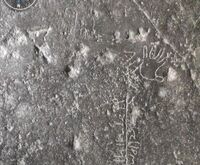
Incomplete Mancala, Pataleshwar (6)
Pataleshwar cave complex are a small group of five excavations, developed into a cave temple dedicated to Pataleshwar, God of the underworld or Shiva. This cave complex is ruggedly excavated and also bears resemblance with the Elephanta caves of Mumbai. The cave has unfinished murals on the sides and on the backside. There is a Nandi pavilion at the entrance of the cave which is circular. The inside of the main cave contains a pillared hall with a pradakshinapatha the way to go around the shrine. One side of the cave remains unfinished. This image showcases three holes of Mancala incised and what looks like attempts in curating rows of mancala to make a board on the floor. Another speculation could be that there was a board which eroded with time and lack of preservation of the rock floors. There are a total of eight mancalas recorded from Pataleshwar along with other boardgames. The game of Mancala is considered to be one of the oldest games of the world, while its place of origin and the timeline is debatable. The earliest textual reference as stated by scholars comes from Kitab al-Aghani, or Book of Songs which does not directly mention mancala but refers to a similar game. These rows of cupules have been excavated in ancient sites like Jordan and many others including megalithic sites in India but their link as to being Mancala is debatable. This game has many variants all across the world and is popular in Africa, Asia, and parts of Eastern Europe. In India, Mancala is known by many names and the rules and variants of the game keep changing based on its region and according to the communities who play them. The number of holes in mancala differ along with the number of rows as well. In some variants the board is hand-drawn on a surface as circles with chalk or even cut holes on the soil to play the game. It is played with local seeds, stones or anything which is easily available as pieces to place inside the pits. The number of pieces per pit also vary from four to even twelve in some variants. This game is popularly a two-player game but some variants also show three players or even one in some case. : While there are abundant etched evidence of mancala spread all across Maharashtra, it has been stated by scholars and board game researchers that more recent memory of the existence of this game is absent from the region. Thus, the practice of playing the game or the regional variant belonging from this region is either lost or yet to be found.