Boardgames
Item set
- Title (dcterms:title)
-
Boardgames
- Type (dcterms:type)
- boardgames, sedentary games, tabletop games
- Creator (dcterms:creator)
- Souvik Mukherjee, Adrija Mukherjee
- Description (dcterms:description)
-
This collection contains an archive of ganjifa cards from all over India
- Temporal Coverage (dcterms:temporal)
- Ancient India to modern times
- Coverage (dcterms:coverage)
- All over India
Items
1 item
-
Chaupar, Pataleshwar (1)
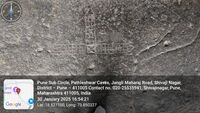
This etched or incised graffiti board of Chaupar is located right at the entrance of the cave temple of Pataleshwar. The chaupar board here has arms of 27 cms each with a floral design in the middle square or the central home square. Pataleshwar cave complex are a small group of five excavations, developed into a cave temple dedicated to Pataleshwar, God of the underworld or Shiva. This cave complex is ruggedly excavated and also bears resemblance with the Elephanta caves of Mumbai. The cave has unfinished murals on the sides and on the backside. There is a Nandi pavilion at the entrance of the cave which is circular. The inside of the main cave contains a pillared hall with a pradakshinapatha the way to go around the shrine. One side of the cave remains unfinished. This and other boardgames were documented on the floor of the cave. According to anthropologists K. Ravi and Jaya Sankar Rao and the classification of HJR Murray in his book, The History of Boardgames Other Than Chess, Chaupar is categorised as a race game. The first description of this game seems to have been written in the 16th century, when chaupar was a common gambling sport at the court of the Mughal emperor Akbar in Agra and Fatehpur Sikri. Abul Fazl describes how the game is played with sixteen pieces, three dice, and a “board” in the shape of a cross. It is typically a four-player game and the pieces belonging to each player is distinct from the others. It is played with four pieces and a throwing of either cowrie shells or two oblong dice. There are various terminologies used for the safe squares, or the throws which differs from one region to the other. For example, in Haryana the central home which is a flower here is called 'charon ka ghar'. Interestingly, it can be played by a throw of six cowrie shells or even more depending on the variant. As this etched board is from Maharashtra, it is difficult to understand the exact throw of dice or cowries used or the rules made to play this game.