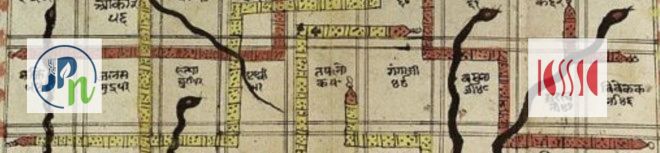
Chaupar, Pataleshwar (3)
Item
- Title (dcterms:title)
- Chaupar, Pataleshwar (3)
- Description (dcterms:description)
-
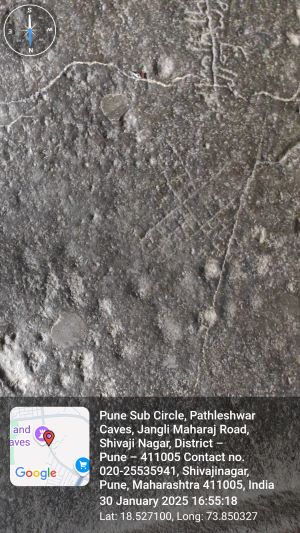
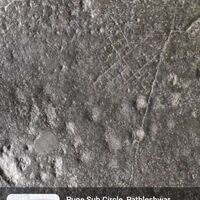
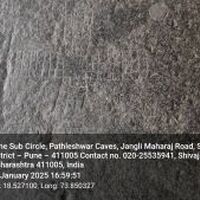
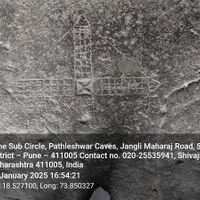
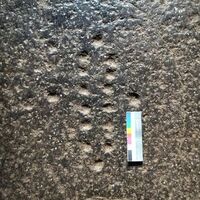
This is a documented image which showcases a small etched or incised Chaupar board on the floor along with another board of Mancala, almost overlapping. Speculation could suggest that they were either made one after another or in different times. This particular Chaupar board is relatively smaller than the other boards recorded in the cave temple of Pataleshwar. This could draw speculations that this board was made in an attempt to document what boards they played in the past or this could have been part of their trial and error process of etching boardgames on the ground without precise measurements.
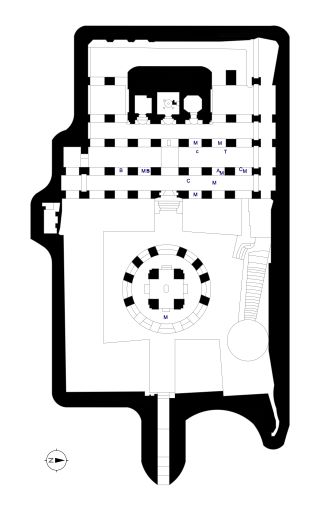
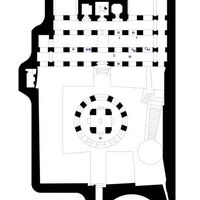
Pataleshwar cave complex are a small group of five excavations, developed into a cave temple dedicated to Pataleshwar, God of the underworld or Shiva. This cave complex is ruggedly excavated and also bears resemblance with the Elephanta caves of Mumbai. The cave has unfinished murals on the sides and on the backside. There is a Nandi pavilion at the entrance of the cave which is circular. The inside of the main cave contains a pillared hall with a pradakshinapatha the way to go around the shrine. One side of the cave remains unfinished. This and other boardgames were documented on the floor of the cave.
According to anthropologists K. Ravi and Jaya Sankar Rao and the classification of HJR Murray in his book, The History of Boardgames Other Than Chess, Chaupar is categorised as a Race Game. The first description of this game seems to have been written in the 16th century, when chaupar was a common gambling sport at the court of the Mughal emperor Akbar in Agra and Fatehpur Sikri. Abul Fazl describes how the game is played with sixteen pieces, three dice, and a “board” in the shape of a cross. It is typically a four-player game and the pieces belonging to each player is distinct from the others. It is played with four pieces and a throwing of either cowrie shells or two oblong dice. There are various terminologies used for the safe squares, or the throws which differs from one region to the other. For example, in Haryana the central home which is a flower here is called 'charon ka ghar'. Interestingly, it can be played by a throw of six cowrie shells or even more depending on the variant. As this etched board is from Maharashtra, it is difficult to understand the exact throw of dice or cowries used or the rules made to play this game. - Alternative Title (dcterms:alternative)
- Chausar, Pachisi, Pagaday, Chonpa
- Rules (dcterms:instructionalMethod)
-
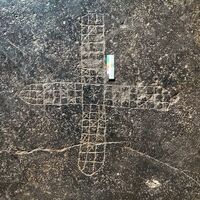
Four 3x8 rectangles arranged in a cross with a large empty square in the center. Two teams of two players, or by two players playing with two sets of pieces. The pieces move along the outer track of the board according to the throw of three four-sided dice with values of 1, 2, 5 and 6. The values of each die must be played individually, except in certain cases. Each player has four pieces, which begin on the sixth and seventh space of the central row and the seventh and eight space in the right hand row of the arm of the board belonging to the player. If a piece lands on a space occupied by an opponent, the opponent's piece is sent back to the starting position. If two of a player's pieces are on the same space, they cannot be sent to the beginning. In addition, when three pieces are on the same spaces, if triple sixes are thrown the pieces may move twelve spaces together. The same rule applies for threes and twos, moving six and four, respectively. After completing a circuit of the board, the pieces then move into the central row of squares in the arm where the player began. The player must then move off all of their pieces by an exact roll. If a player has removed all of their pieces from the board and their partner is still playing, the player rolls on what would be their turn and the partner moves according to these rolls in addition to their own turn. The player or team to remove all of their pieces from the board first wins.
- Chaupar Rules
- Contributor (dcterms:contributor)
- Souvik Mukherjee and Adrija Mukherjee
- Rights (dcterms:rights)
- Creative Commons
- Format (dcterms:format)
- Graffiti Boardgame
- Medium (dcterms:medium)
- Graffiti board etched on basalt rock floor
- References (dcterms:references)
-
Bhattacharya, Ranjit Kumar, Irving L. Finkel, and Lok Nath Soni. The Indian Board Game Survey. Anthropological Survey of India, Government of India and British Museum, London, 2011.
Murray, H. J. R. (Harold James Ruthven). A History of Board-Games Other than Chess. With Internet Archive. Hacker Art Books, 1978. - Chaupar- Digitalo Ludemi Project
- Chaupar- Cyningstan
- Chaupar and Pachisi- Penn Museum
- Temporal Coverage (dcterms:temporal)
- The Pataleshwar caves were built during the Rashtrakuta dynasty at 8th century CE.
- Spatial Coverage (dcterms:spatial)
- Pataleshwar Cave, Jangli Maharaj Road, Pune
- Variants (dcterms:isVersionOf)
-
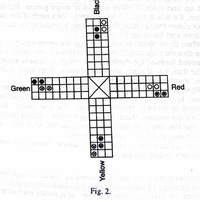 Chonpa- A Variant of Pachisi
-
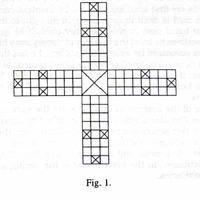 Pachisi
-
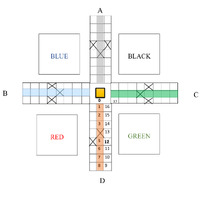 Chaupar: Downloadable Game
-
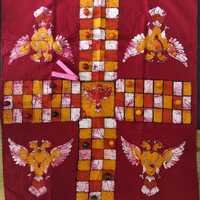 Chaupar, Handmade
-
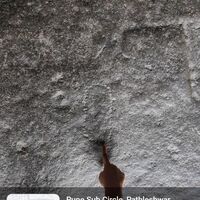 Chaupar, Pataleshwar (Incomplete)
-
 Chaupar, Pataleshwar (3)
-
 Chaupar, Pataleshwar (2)
-
 Chaupar, Pataleshwar (1)
-
 Chaupar, Bhaja
- Entered by (dcterms:accrualMethod)
- Adrija Mukherjee
- Notes (foaf:status)
-
As the provenance of these etched boards are unknown, the exact variant and the rule of the game is difficult to trace. There is currently a version of chaupar in Maharashtra called Saripat.
- Tags (dcterms:conformsTo)
- Chaupar
- Pachisi
- Pataleshwar
- Etched games
- Stone
- Maharashtra
- Dice
- Four-player
Linked resources
| Title | Class |
|---|---|
 Cenne Mane Cenne Mane |
Text |
| Chaupar, Bhaja |
Physical Object |
| Chaupar, Handmade |
Physical Object |
| Chaupar, Pataleshwar (1) |
Physical Object |
| Chaupar, Pataleshwar (2) |
Physical Object |
| Chaupar, Pataleshwar (3) |
Physical Object |
| Chaupar, Pataleshwar (Incomplete) |
Physical Object |
| Chonpa- A Variant of Pachisi |
Text |
 Mancala, Karla (1) Mancala, Karla (1) |
Physical Object |
![Photo of sixteen handed Pachisi / Pagade. [Credits: Souvik Mukherjee]](https://souvikmukherjeeresearch.com/omekas/files/square/2e4f46ca8c24586c1c77477049edc5c246797050.jpg) Multiple Pachisi Variants, Jaganmohan Palace Mysuru Multiple Pachisi Variants, Jaganmohan Palace Mysuru |
Physical Object |
| Pachisi |
Text |
 Sat- Gharoa Sat- Gharoa |
Text |