Baghchal, Pataleshwar (2)
Item
- Title (dcterms:title)
- Baghchal, Pataleshwar (2)
- Description (dcterms:description)
-
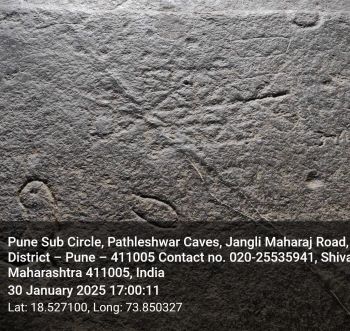
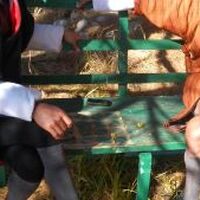
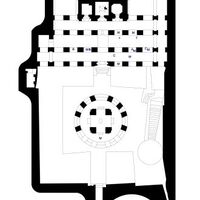
This etched or incised Bagh Chal board was recorded from the main cave complex on the second row of the pillared halls on the left side from the entrance facing the cave. Bagh Chal or Tigers and Goats is an ancient hunt game that has been popular in many regions of the world. The board of Bagh Chal is part of the alquerque family which traces its history to the Moors of Spain in their Libro de Los juegos (book of games) commissioned by Alfonso X in the 13th century. Although the rules were first found there, the history of alquerque goes further back to Egypt and to a name mentioned in the Kitab-al-Aghani (book of songs) as Kirkat or Al-Kirkat. Besides reference in literature similar game boards have been found both in practice amongst players in various communities as well as in archaeological sites. Bagh Chal has many variants, and is known by different names all over India, Nepal, Bhutan and other countries of South Asia. The structure of the board, the number of pieces and the variants in the rules may vary from place to place but the intention of winning remains the same. It is a two-player game where one individual represents the tiger and the other represents the goats. The number of tigers vary from one to even five in some games while the number of goats can be twenty or less or more depending on the structure of the board and the rules popular to the region.
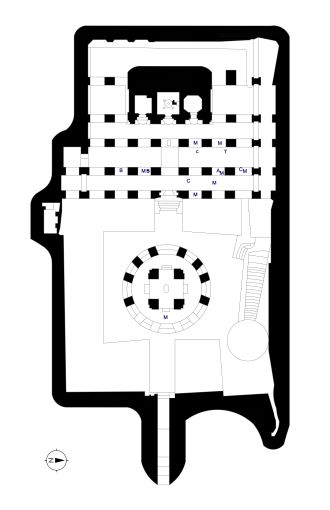
Pataleshwar cave complex are a small group of five excavations, developed into a cave temple dedicated to Pataleshwar, God of the underworld or Shiva. This cave complex is ruggedly excavated and also bears resemblance with the Elephanta caves of Mumbai. The cave has unfinished murals on the sides and on the backside. There is a Nandi pavilion at the entrance of the cave which is circular. The inside of the main cave contains a pillared hall with a pradakshinapatha the way to go around the shrine. One side of the cave remains unfinished. This and other boardgames were documented on the floor of the cave. - Alternative Title (dcterms:alternative)
- Bagh Bandi, Tigers and Goats, Baghchakkar, Chakrachhal, Sher Bakr, Bagh Batti, Sher Bakar, Kaooa, Bam Blang Beh Khla, Bagha Guti, Tagnor, Adu Puli Attam, Puli Meka, Ada Huli, Terhuchu, Kulaochal, Puli Judham
- Rules (dcterms:instructionalMethod)
-
Rules for four tigers and twenty goats :-
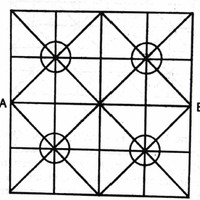
1. The game begins with four tigers on the board, one in each corner, as shown in the diagram.
2. The twenty goats are kept in hand by the player who has taken their side.
3. The goat player takes the first turn.
4. If the goat player has goats in hand, he must use his turn to place one on any empty point on the board.
5. If the goat player has placed all the goats, then he must instead use his turn to move one of the goats from its current position, along a marked line in any direction, to an adjacent empty point.
6. The tiger player in his turn may move a tiger from its current position, along a marked line in any direction, to an adjacent empty point.
7. Only one piece may occupy a point at any one time; stacking of pieces is not allowed.
8. A tiger may sometimes capture, or eat, a goat, instead of moving as described in rule 6.
9. To eat a goat, the tiger player must jump with one of his tigers along a marked line, over an adjacent goat, to an empty point beyond. The goat is then removed from the board and takes no further part in play.
10. The tiger may not change direction in the middle of its jump. A goat is only in danger of being eaten if on one side it has a tiger, and on the other an empty space.
11. Only one goat may be eaten in any one turn. Multiple jumps are not allowed.
12. The tiger player wins when his tigers have eaten five goats.
13. The goat player wins if the tigers are trapped and the tiger player has no legal move. - Contributor (dcterms:contributor)
- Souvik Mukherjee and Adrija Mukherjee
- Rights (dcterms:rights)
- Creative Commons
- Format (dcterms:format)
- Graffiti Boardgame
- Medium (dcterms:medium)
- Graffiti board game engraved/excavated on basalt rock floor.
- References (dcterms:references)
- Bagh Chal- Digital Ludemi Project
- Bagh Chal- Boards and Pieces
- Bagh Chal- Cyningstan
- Temporal Coverage (dcterms:temporal)
- The Pataleshwar caves were built during the Rashtrakuta dynasty at 8th century CE
- Spatial Coverage (dcterms:spatial)
- Pataleshwar Cave, Jangli Maharaj Road, Pune
- Variants (dcterms:isVersionOf)
-
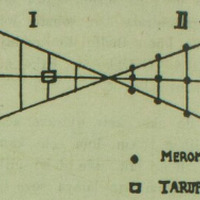 Tarup Ar Merom (leopards and goats)
-
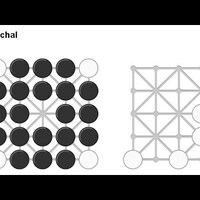 Kulaochal
-
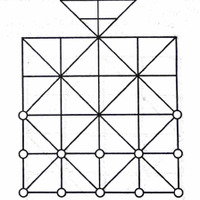 Bagh Chal (variant),Odisha
-
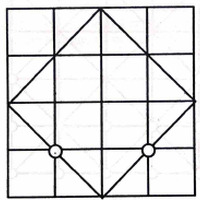 Bagha Chheli ( Odisha)
-
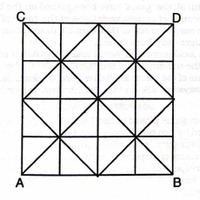 Baghchakkar or Chakrachal
-
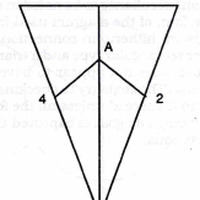 Sher Bakr
-
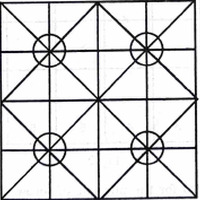 Bagh Batti
-
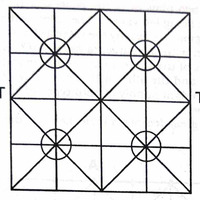 Sher Bakar
-
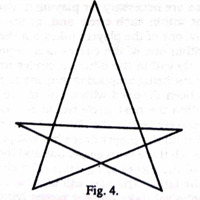 Kaooa
Kaooa
-
 Taag dha Nor or Tagnor (Tiger and Cow)
-
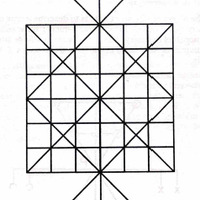
 Bagh Chal, Kamakhya
-
 Mughal Pathan
-
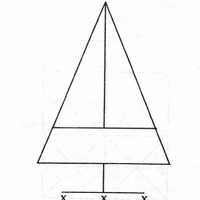 Bam Blang Beh Khla
-
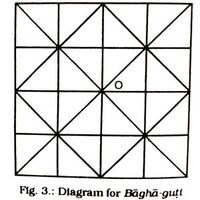 Bagha Guti
-
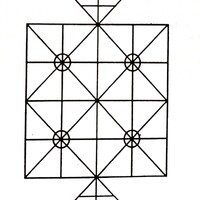 Bagh Bandi
-
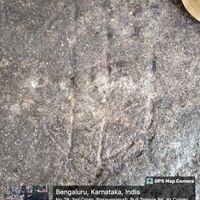 Bagh Chal, Bull Temple (4)
-
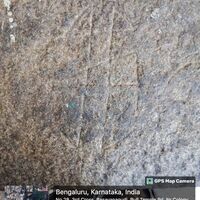 Baghchal, Bull Temple (3)
-
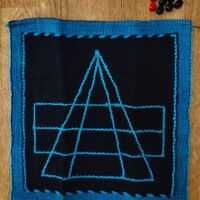 Baghchal, Handmade
-
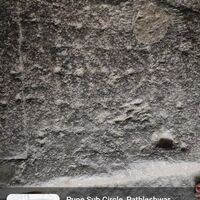 Bagh Chal, Pataleshwar (3)
-
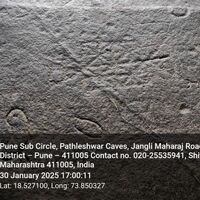 Baghchal, Pataleshwar (2)
-
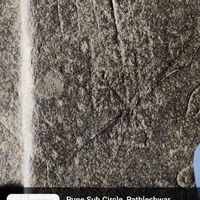 Baghchal, Pataleshwar (1)
-
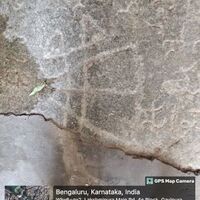 Bagh Chal, Bull Temple (2)
-
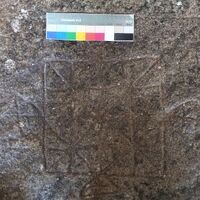 Bagh Chal, Bull Temple (1)
-
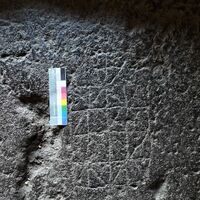 Bagh Chal, Ellora
-
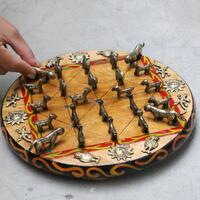 Bagh Chal
-
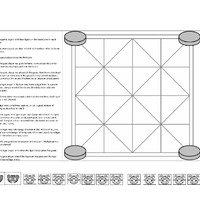 Bagh Chal: Downloadable Game
- Entered by (dcterms:accrualMethod)
- Adrija Mukherjee
- Notes (foaf:status)
- As the provenance of these etched boards are unknown, the exact number of pieces for both tigers and goats and the exact rule variant is difficult to trace.
- Tags (dcterms:conformsTo)
- Pataleshwar
- etched
- Cave
- Tigers and Goat
- Maharashtra
- Two-player
- Alquerque
- Capture
- Hunt
- Shape: Square with 2 triangles
Linked resources
| Title | Class |
|---|---|
| Bagh Bandi |
Text |
| Bagh Chal, Bull Temple (1) |
Physical Object |
| Bagh Chal, Bull Temple (2) |
Physical Object |
| Bagh Chal, Ellora |
Physical Object |
| Bagha Chheli ( Odisha) |
Text |
| Bagha Guti |
Text |
| Baghchal, Bull Temple (3) |
Physical Object |
| Baghchal, Handmade |
Physical Object |
| Baghchal, Pataleshwar (1) |
Physical Object |
| Baghchal, Pataleshwar (2) |
Physical Object |
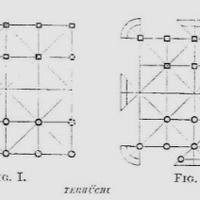 Terhuchu Terhuchu |
Text |