Mysore Chhad Ganjifa
Item
- Title (dcterms:title)
- Mysore Chhad Ganjifa
- Description (dcterms:description)
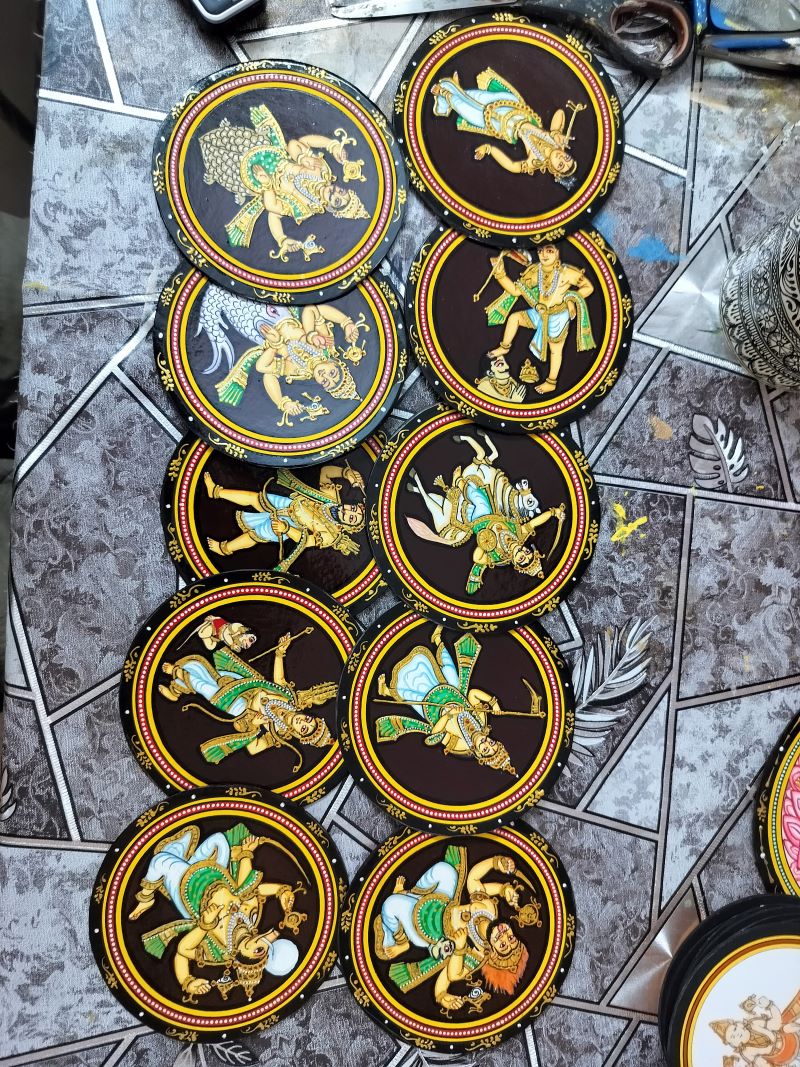
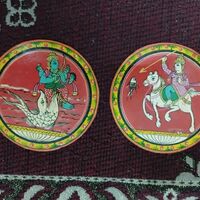
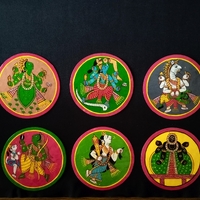
- Mysore Chhad Dashavatar is a variation of ganjifa cards that comprises the ten suits representing ten avatars of Vishnu. These cards were patronised by Mummadi Krishnaraja Wodeyar III (1799 - 1868 ) and are handpainted in the style of Mysore paintings.
- Rules (dcterms:instructionalMethod)
-
These cards are no longer played in Mysore. We were unable to obtain the rules as the cards are mainly produced as art objects. Nevertheless, the rules of dashavatar cards may also be applicable.
Dashavatar rules Bishnupur:-
lthough the iconography varies of Dashavatar cards from the Mughal Ganjifa cards, the rules of the game remain similar. Like the Mughal Ganjifa cards, the first five avatars Matsya, Kurma, Varaha, Narasingha and Vaman are more powerful suits than the last five avatar suits namely Ram, Parasuram, Balaram, Jagannath and Kalki.
The main cards are the Raja (king card) and the Mantri (vizier card) followed by numeric cards of 1 to 10. In the first 5 avatars the the numbers are counted from 10 to 1 and in the last 5 it is counted from 1 to 10.
Total cards are 120 which are distributed amongst 5 players seated in a circle while the cards are distributed. The game begins from the right-hand side of the player who distributes the cards. 4 cards are distributed at a time to each player. Each player should have 24 cards at the end of the distribution.
The point for winning the game is also 24.
The game begins with the player who has the starter card or the trump card. The rule of the starter card varies from region to region and also differs during daytime, night time or during monsoons. Like in Bishnupur, if the game is played in the morning the starter card is Ram, in the evening it is Narasingha, and at night it is Matsya. At dawn the starter card changes to Jagannath and during monsoons it changes to Kurma. During the game, if the player passes the card onto another it is called ‘seroya’ or ‘serowa’. If one player passes his turn onto the player on their left side, the value of that pass is a two pointer for that player.
The game is said to be difficult. It is a 24-point game played by 5 people. In the beginning of the game the players decide how many hands they want to play also called 'par' or 'chillik'. If any player plays and wins 5 hands the total score is 25(5X5), 24 has to be deducted from their hand which remains 1 so that 1 point is added as a winning point. Similarly, if a player wins 7 hands, the total score is 35 and 24 is deducted from it leaving 11. Those who win less than 5 hands get negative points. The player who gets the largest number of points at the end of the agreed number of turns.
In another variant from a source, it states that that the total hand should be 24 and every hand gives the player 5 points while losing every hand deducts that 5 points from the total. In the end whoever has the highest number of points wins the game. - Creator (dcterms:creator)
- Chandrika Padmanabhan
- Source (dcterms:source)
- Gautam Sen Memorial Boardgames Museum
- Date Created (dcterms:created)
- 15 February 2025
- Contributor (dcterms:contributor)
- Adrija Mukherjee
- Rights (dcterms:rights)
- Creative Commons
- Format (dcterms:format)
- Playing Cards
- References (dcterms:references)
-
Leyden, Rudolf Von. 1982. Ganjifa: Playing Cards of India. London: Victoria & Albert Museum.
Lochan, Pramila. 2019. Splendours of Ganjifa Art. Edited by R.H. Kulkarni, Pramila Lochan, H.A. Anil Kumar, and Tejendra Singh Baoni. Mysore: Karnataka Chitrakala Parishath.
- Medium (dcterms:medium)
- Mount board, handpainted with artificial colours, reverse side varnish. 6 inches diameter
- Temporal Coverage (dcterms:temporal)
- Early nineteenth century to present
- Provenance (dcterms:provenance)
- Gautam Sen Memorial Boardgames Museum
- Spatial Coverage (dcterms:spatial)
- Bangalore; Mysore., Karnataka, India
- Variants (dcterms:isVersionOf)
-
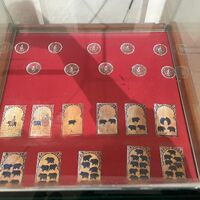 Mughal Ganjifa from Rajasthan
-
 Interview with Chandrika Padmanabhan, Mysore ganjifa artist
-
 Dashavatar Cards, Sawantwadi
-
 Download and Play Ganjifa
-
 Interview with Shraddha Bhonsle (Sawantwadi royal family)
-
 Interview with Dr Arunima Pati 20250217
-
 Dashavatar Cards
-
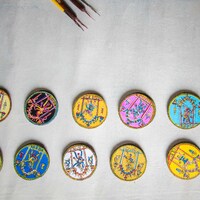 Ramayana Ganjapa from Sonepur
-
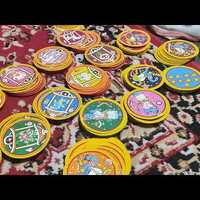
 Playing Sawantwadi Ganjifa
-
 Interview with Ganjapa [Ganjifa] artist Banamali Mahapatra
-
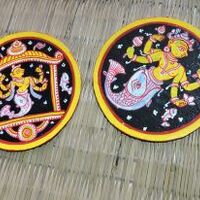 Raja (King) and Mantri (Vizier) card
-
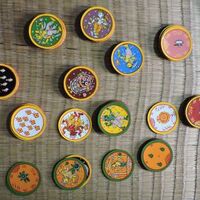 Dashavatar Ganjifa Card, Raghurajpur
-
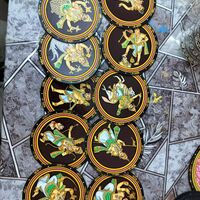 Mysore Chhad Ganjifa
-
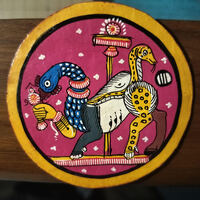 Navagunjara Ganjifa Card, Raghurajpur
-
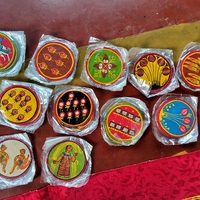 Bishnupur Naksh/Naqsh Cards
Linked resources
| Title | Class |
|---|---|
| Bishnupur Naksh/Naqsh Cards |
Physical Object |
| Dashavatar Cards |
Physical Object |
| Dashavatar Cards, Sawantwadi |
Physical Object |
| Mughal Ganjifa from Rajasthan |
Text |
| Mysore Chhad Ganjifa |
Physical Object |
| Navagunjara Ganjifa Card, Raghurajpur |
Physical Object |