Chaupar, Handmade
Item
- Title (dcterms:title)
- Chaupar, Handmade
- Description (dcterms:description)
-
The first description of this game seems to have been written in the 16th century, when chaupar was a common gambling sport at the court of the Mughal emperor Akbar in Agra and Fatehpur Sikri. Abul Fazl describes how the game is played with sixteen pieces, three dice, and a “board” in the shape of a cross.
The history of chaupar is linked to that of pachisi, not least because the boards are identical and that it is therefore impossible to see which of the two games an archaeological example belonged to.
Also known as chausar or chaupad, this game has many similarities to the more well-known pachisi. A cross-shaped board hosts the pieces of four players, who play in two partnerships, each player having four pieces. The pieces begin at fixed positions around the board, racing around the board to finish at the centre. The game has also attracted much attention in the West and in colonial India. Thomas Hyde wrote about the game in his De Ludibus Orientalibus in 1694 followed by many other commentators and an 1851 painting of men playing chaupar by William Carpenter. Edward Falkener also published a detailed account of Pachisi in his Games Ancient and Oriental and How to Play Them in London in 1892 .
There are multiple versions of chaupar and the rules and material vary. The Rajputs traditionally play the game during the entire night of a wedding, along with chanting, drinking tea and other beverages as well as smoking or chewing tobacco products. The Sodha Meghwals and the Rabaris faithfully follow the tradition of the Rajputs and play the game during marriage or any such festive occasion. The Rabari play the game on a board with seven khana (rooms) on each row, while the board of the Meghwal and the Rajput possesses eight squares on each row. The game is played with six cowries locally known as khairiya by the Rabari and with seven cowries both by the Rajput and the migrant Marvada group of the Meghwal of Sumrasar. It is also played by the Patwal families in Haryana and as Dosh Pochish among Sylheti communities.
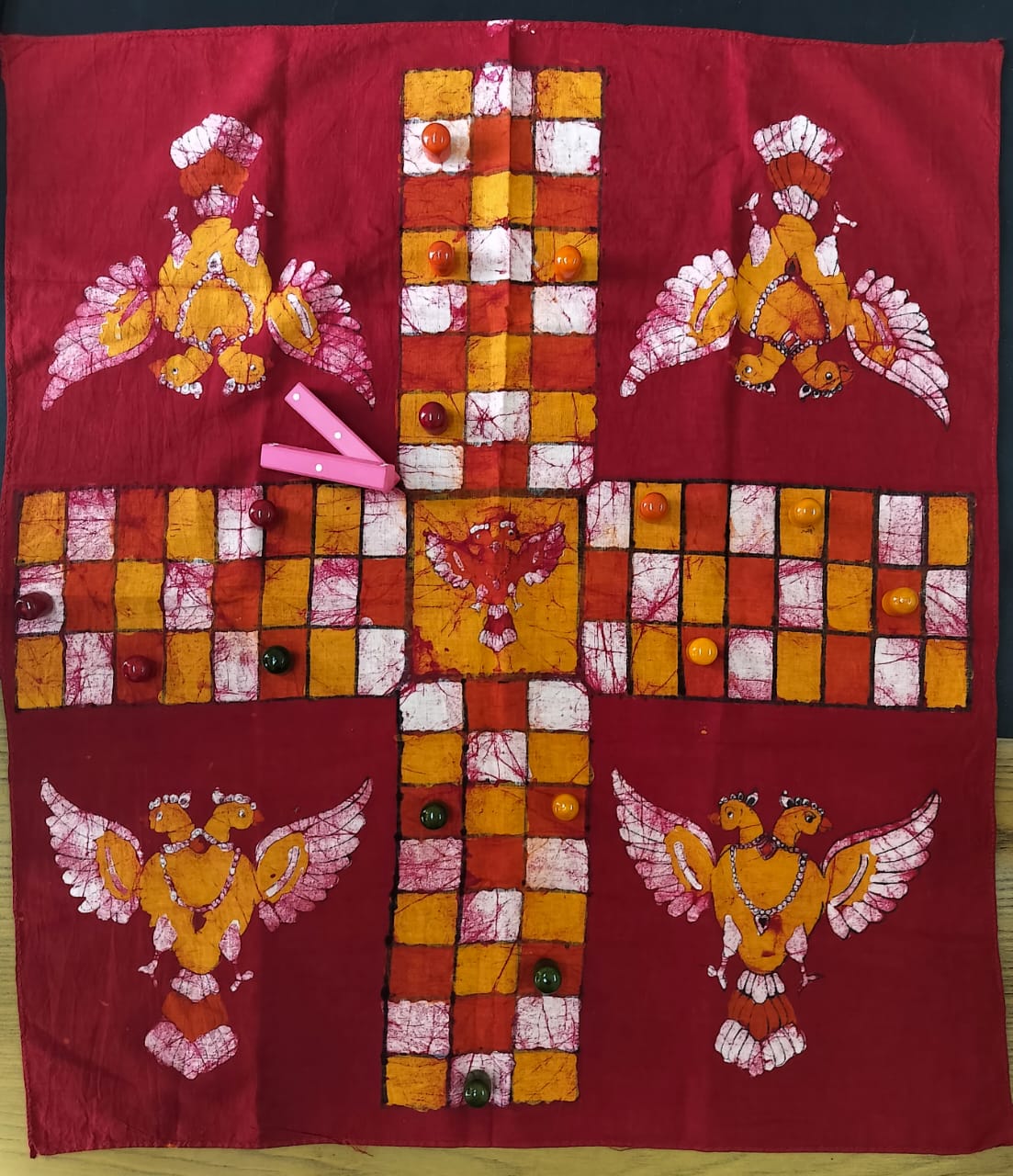
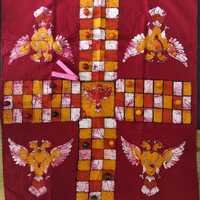
This Chaupar board is made of Batik print cotton cloth by Ramsons Kreera Pratisthan. They are working towards the revival of traditional Indian Boardgames. It also depicts the symbol of the Mysore royal family.
Ramsons manufactures hand-made gameboards, casting pieces and counters. They collaborate with artists and artisans all across India to make these boardgames and their material have a number of varieties such as, Navalgund Jamkhana, Silk embroidery, Batik print, Mysore silk zari weaving etc. Other than variiants in types of cloth and handloom they also manufacture boardgames on Marble, Mysore wood, Brass Casting, Wood Polychrome and many as such. - Alternative Title (dcterms:alternative)
- Chausar, Pachisi, Pagaday (Karnataka), Chopat (Rajasthan)
- Rules (dcterms:instructionalMethod)
-
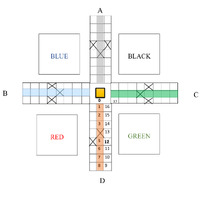
How to play Chaupar
The game is played by four players on a cross-shaped board, each player having four pieces. Black and yellow play in partnership against red and green. Three four-sided dice control the moves of the pieces, the numbers on the dice being 1, 2, 5 and 6.
At the start of the game, each player's piece start at the 6th, 7th, 9th and 10th positions of their course, as shown in the diagram.
Players each roll the dice, the highest throwing player moving first. Play continues clockwise around the board.
The pieces having begun their journey already, no specific throw is needed to move a piece from its starting place.
A player on his turn starts by throwing the dice. He then moves up to three pieces. The throws may all be used on one piece, which moves by the total number of squares, or split between two or among three pieces.
The pieces are moved along the course shown in the diagram. The cross-cut markings on some of the squares have no relevance to the game.
The movement of the pieces (as seen for the south player)
All of the throw must be used if there are moves possible. It is not allowed to pass a turn in chaupar.
A piece landing on a square occupied by an opponent captures the opponent's piece and sends it back to the central square to begin its journey again.
A piece landing on another of its own colour may double up. On subsequent turns, the pair may move together as if they were a single piece. A third or fourth piece may be added to the group in the same way.
A group of two or more pieces may not be captured by an enemy singleton. It may only be captured by a group equal in number or larger than itself.
A piece returns the the central square by an exact throw only.
When all four pieces of a player have returned to the central square, he continues to throw during his turn; his throws are used by his opponent.
When both players of a partnership have arrived at the central square, then the game is over and they are victorious. - Creator (dcterms:creator)
- Ramsons Kreera Pratisthan
- Source (dcterms:source)
- Centre for Studies in Social Sciences, Calcutta
- Contributor (dcterms:contributor)
- Souvik Mukherjee and Adrija Mukherjee
- Rights (dcterms:rights)
- Creative Commons
- Format (dcterms:format)
- Boardgame on Cloth
- Medium (dcterms:medium)
- Boardgame made of cotton cloth with a Batik print
- References (dcterms:references)
- Chaupar- Cyningstan
- Chaupar- Digital Ludemi Project
- Chaupar and Pachisi- Penn Museum
- Spatial Coverage (dcterms:spatial)
- This board is made in Mysore, Karnataka
- Variants (dcterms:isVersionOf)
-
 Chonpa- A Variant of Pachisi
-
 Pachisi
-
 Chaupar: Downloadable Game
-
 Chaupar, Handmade
-
 Chaupar, Pataleshwar (Incomplete)
-
 Mancala, Pataleshawar (8)
-
 Chaupar, Pataleshwar (3)
-
 Chaupar, Pataleshwar (2)
-
 Chaupar, Pataleshwar (1)
- Entered by (dcterms:accrualMethod)
- Adrija Mukherjee
- Media
- Chaupar.jpg
Linked resources
| Title | Class |
|---|---|
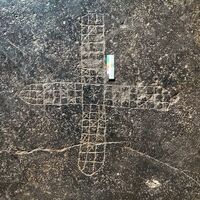 Chaupar, Bhaja Chaupar, Bhaja |
Physical Object |
| Chaupar, Handmade |
Physical Object |
| Chaupar, Pataleshwar (1) |
Physical Object |
| Chaupar, Pataleshwar (2) |
Physical Object |
| Chaupar, Pataleshwar (3) |
Physical Object |
| Chaupar, Pataleshwar (Incomplete) |
Physical Object |
| Chonpa- A Variant of Pachisi |
Text |
![Photo of sixteen handed Pachisi / Pagade. [Credits: Souvik Mukherjee]](https://souvikmukherjeeresearch.com/omekas/files/square/2e4f46ca8c24586c1c77477049edc5c246797050.jpg) Multiple Pachisi Variants, Jaganmohan Palace Mysuru Multiple Pachisi Variants, Jaganmohan Palace Mysuru |
Physical Object |
| Pachisi |
Text |