Bagh Bandi
Item
- Title (dcterms:title)
- Bagh Bandi
- Description (dcterms:description)
-
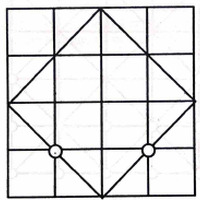
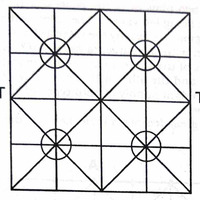
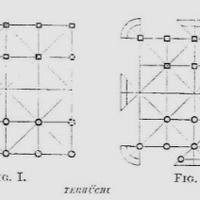
This game has been recorded by Jatindra Mohan Datta In Basirhat in the 1930s. The name of the informant was Santosh Kumar Ray who explained that he used to play this game in his childhood. According to Jatindra Mohan Datta, the board or the diagram of the game shown here has similarities with the Mughal-Pathan game.
Bagh Bandi or Bagh Chal is played on a board by two players. Often, one players plays with four tigers, while the other has twenty goats. The tigers need to jump over and eat five goats whereas the goat needs to corner all the tigers to win. The game is the national game of Nepal and exists in multiple variations all over South Asia.
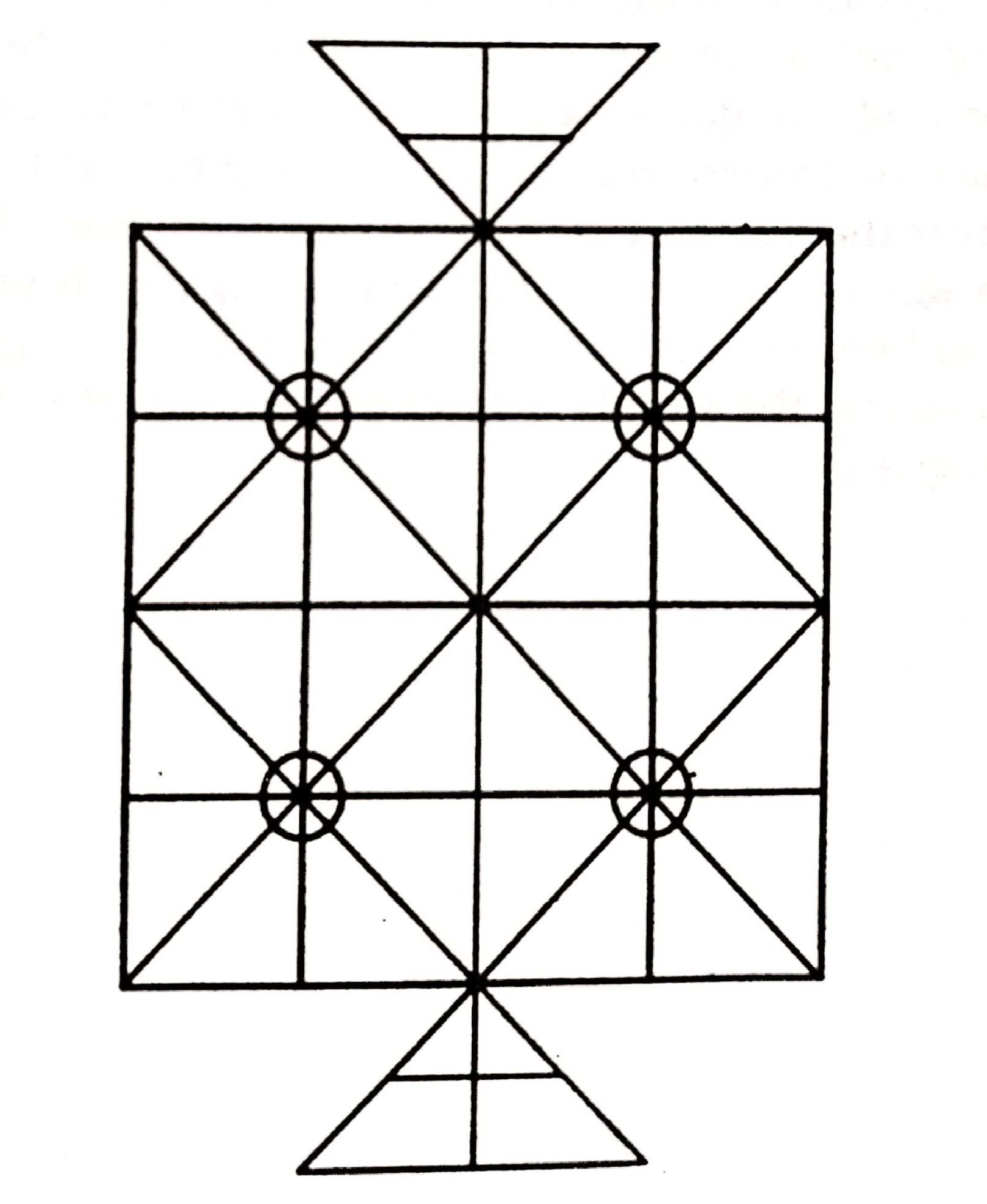
In the variation reported by Datta, this game is played with two tigers and thirty-two goats. the goats are placed in a group of eight at points enclosed by circles in the diagram at the beginning of the game. The two tigers are placed or can be placed anywhere on the board. It is then followed by the usual rules of Bagh Chal or Bagh Bandi. In this form, two or more captures are allowed one after the other but not by jumping forward and then backward over the goats. - Alternative Title (dcterms:alternative)
- Bagh Bandi, Tigers and Goats, Baghchakkar, Chakrachhal, Sher Bakr, Bagh Batti, Sher Bakar, Kaooa, Bam Blang Beh Khla, Bagha Guti, Tagnor, Adu Puli Attam, Puli Meka, Ada Huli, Terhuchu, Kulaochal
- Rules (dcterms:instructionalMethod)
-
5x5 intersecting lines, with diagonals drawn in the four quadrants of the board. Two triangles, their apices intersecting the main board at opposite midpoints. The bast of the triangle is bisected by a line drawn from the apex, and this line is bisected and intersects with the other two sides of the triangle. One player plays as two tigers, which can be placed anywhere on the board, and the other player plays as 32 goats, which begin on the four central points of the quadrants of the square board, eight per stack. Players alternate turns moving a piece to an empty adjacent spot along the lines. The goats move one at a time from their stacks, and cannot be restacked once they have been moved. The tiger may capture a goat by hopping over it to an empty spot immediately on the opposite side of an adjacent goat. Multiple captures in one turn are allowed, but a tiger cannot hop over a stack of goats and hop over it again in the opposite direction. When tigers hop over a stack of goats, only one goat is captured. The goats win by blocking the tigers from being able to move; the tigers win by capturing all the goats.
- Creator (dcterms:creator)
- Jatindra Mohan Datta
- Source (dcterms:source)
- 'A New Type of Bagh- Bandi or Tiger- Play Prevalent at Basirhat In Lower Bengal' by Jatindra Mohan Datta in Sedentary Games of India eds. Nirbed Ray and Amitabha Ghosh
- Contributor (dcterms:contributor)
- Jatindra Mohan Datta
- Rights (dcterms:rights)
- Creative Commons
- Format (dcterms:format)
- Boardgames
- Medium (dcterms:medium)
- Boardgames on Text
- References (dcterms:references)
- 'A New Type of Bagh- Bandi or Tiger- Play Prevalent at Basirhat In Lower Bengal' by Jatindra Mohan Datta in Sedentary Games of India
- Bagh Bandi by Digital Ludemi Project
- Spatial Coverage (dcterms:spatial)
- Basirhat, West Bengal
- Variants (dcterms:isVersionOf)
-
 Bagh Chal, Bull Temple (4)
-
 Baghchal, Handmade
-
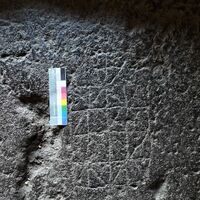 Bagh Chal, Ellora
-
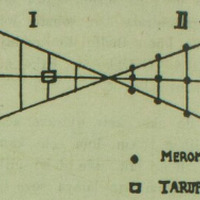 Tarup Ar Merom (leopards and goats)
-
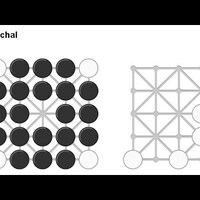 Kulaochal
-
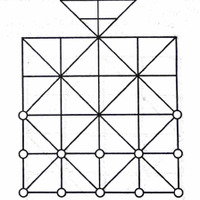 Bagh Chal (variant),Odisha
-
 Bagha Chheli ( Odisha)
-
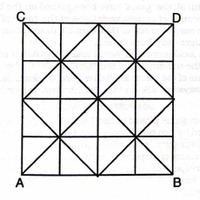 Baghchakkar or Chakrachal
-
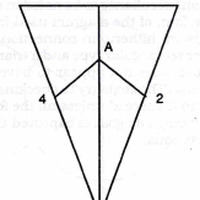 Sher Bakr
-
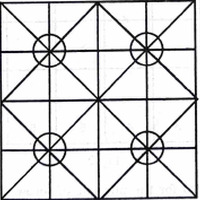 Bagh Batti
-
 Sher Bakar
-
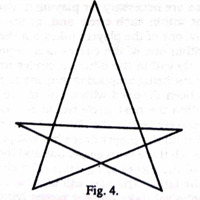 Kaooa
Kaooa
-
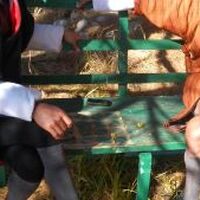 Taag dha Nor or Tagnor (Tiger and Cow)
-
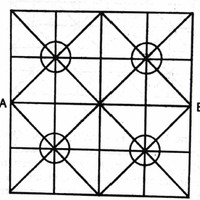 Bagh Chal, Kamakhya
-
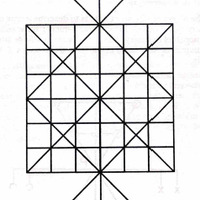 Mughal Pathan
-
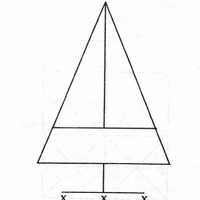 Bam Blang Beh Khla
-
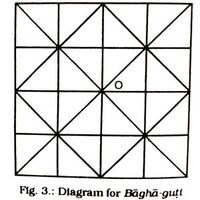 Bagha Guti
-
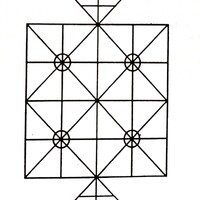 Bagh Bandi
-
Bagh Chal, Bull Temple (4)
-
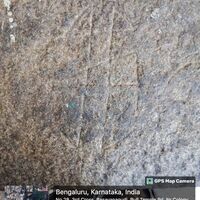 Baghchal, Bull Temple (3)
-
Baghchal, Handmade
-
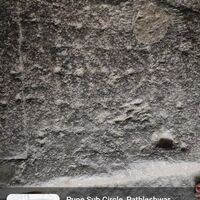 Bagh Chal, Pataleshwar (3)
-
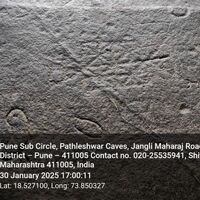 Baghchal, Pataleshwar (2)
- Entered by (dcterms:accrualMethod)
- Adrija Mukherjee
- Tags (dcterms:conformsTo)
- Bagh Chal
- Tigers and Goats
- Alquerque
- Sedentary Games
- Games of Bengal
- Two-player
- Capture
- Hunt
- Shape: Square with 2 triangles
Linked resources
| Title | Class |
|---|---|
| Bagh Bandi |
Text |
| Bagh Batti |
Text |
| Bagh Chal (variant),Odisha |
Text |
| Bagh Chal, Bull Temple (4) |
Physical Object |
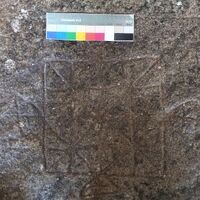 Bagh Chal, Bull Temple (1) Bagh Chal, Bull Temple (1) |
Physical Object |
 Bagh Chal, Bull Temple (2) Bagh Chal, Bull Temple (2) |
Physical Object |
| Bagh Chal, Ellora |
Physical Object |
| Bagh Chal, Kamakhya |
Text |
| Bagh Chal, Pataleshwar (3) |
Physical Object |
| Bagha Chheli ( Odisha) |
Text |
| Bagha Guti |
Text |
| Baghchal, Bull Temple (3) |
Physical Object |
| Baghchal, Handmade |
Physical Object |
 Baghchal, Pataleshwar (1) Baghchal, Pataleshwar (1) |
Physical Object |
| Baghchal, Pataleshwar (2) |
Physical Object |
| Bam Blang Beh Khla |
Text |
| Kaooa |
Text |
| Kulaochal |
Text |
 Lam Pusri or Sipahi Kat Lam Pusri or Sipahi Kat |
Text |
| Mughal Pathan |
Text |
 Pam Pait Pam Pait |
Text |
| Sher Bakar |
Text |
| Sher Bakr |
Text |
| Taag dha Nor or Tagnor (Tiger and Cow) |
Image |
 Terhuchu Terhuchu |
Text |