Taag dha Nor or Tagnor (Tiger and Cow)
Item
- Title (dcterms:title)
- Taag dha Nor or Tagnor (Tiger and Cow)
- Description (dcterms:description)
-
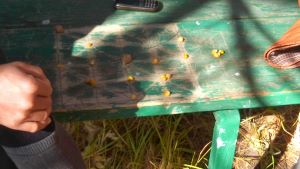
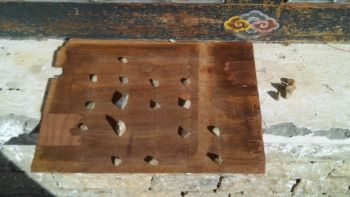
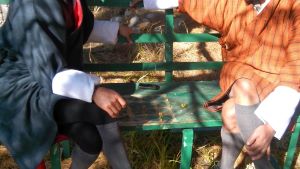
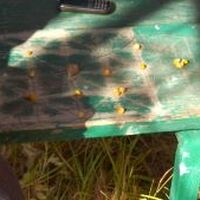
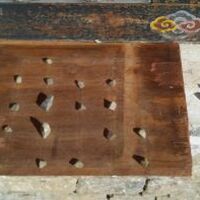
Tagnor is a traditional Bhutanese board game, where a board with lines are filled with pellets representing cattle and two large tokens representation tigers. As the players makes a move, the tigers find opportunities to kill the cattle by jumping over the pellets. If the tigers cannot move as a result of shrewd moves from the cattle like, the cattle wins but if the tiger kills a specific number of cattle before they can cut down his movement, the tiger would end up winning. The game can be played with minimal preparation by drawing the board lines on any surface. In this the board is etched or incised on what looks like a park bench and is been played with local seeds by two players. In other cases there are also boards available made of cloth, wood and many other materials.
This game is a variant of the played Bagh Chal which is popular in many parts of India and is also the national game of Nepal.
- Alternative Title (dcterms:alternative)
-
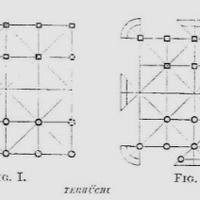
Bagh Bandi, Tigers and Goats, Baghchakkar, Chakrachhal, Sher Bakr, Bagh Batti, Sher Bakar, Kaooa, Bam Blang Beh Khla, Bagha Guti, Tagnor, Adu Puli Attam, Puli Meka, Ada Huli, Terhuchu, Kulaochal, Puli Judham
- Rules (dcterms:instructionalMethod)
-
The rules of the game differ with the number of tigers and cows or cattle in this case and even the shape of the board or patterns played on the surface but the usual intention of winning the game remains the same. It is played by two players.
The general rules probably correspond with Bagh Chal:-
One has two tigers which are represented by large pebbles, while the other has twenty cows (seeds). Henceforth they will be called the tiger player and the cow player.
1. The game begins with the tigers on the board and the cows are also placed one by one.
2. The twenty cows are kept in hand by the player who has taken their side.
3. The cow player takes the first turn.
4. If the cow player has goats in hand, he must use his turn to place one on any empty point on the board.
5. If the cow player has placed all the cows, then he must instead use his turn to move one of the cows from its current position, along a marked line in any direction, to an adjacent empty point.
6. The tiger player in his turn may move a tiger from its current position, along a marked line in any direction, to an adjacent empty point.
7. Only one piece may occupy a point at any one time; stacking of pieces is not allowed.
8. A tiger may sometimes capture, or eat, a cow, instead of moving as described in rule 6.
9. To eat a cow, the tiger player must jump with one of his tigers along a marked line, over an adjacent cow, to an empty point beyond. The cow is then removed from the board and takes no further part in play.
10. The tiger may not change direction in the middle of its jump. A cow is only in danger of being eaten if on one side it has a tiger, and on the other an empty space.
11. The cow player wins if the tigers are trapped and the tiger player has no legal move.
12. The tigers wins once it captures a specific number of cows (numbers may vary). - Creator (dcterms:creator)
- Souvik Mukherjee
- Contributor (dcterms:contributor)
- Souvik Mukherjee
- Rights (dcterms:rights)
- Creative Commons
- Format (dcterms:format)
- Boardgames
- Medium (dcterms:medium)
- Etched boardgame on a surface
- References (dcterms:references)
- Mandala Library- Tagnor
- Spatial Coverage (dcterms:spatial)
- Bhutan
- Variants (dcterms:isVersionOf)
-
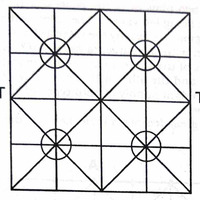 Sher Bakar
-
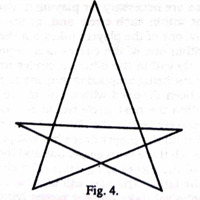 Kaooa
Kaooa
-
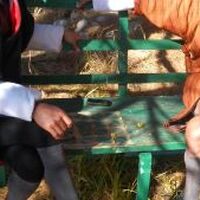 Taag dha Nor or Tagnor (Tiger and Cow)
-
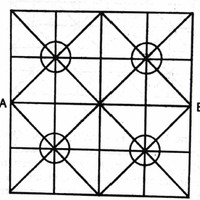 Bagh Chal, Kamakhya
-
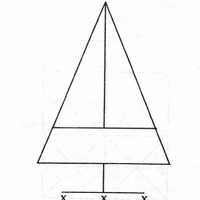 Bam Blang Beh Khla
-
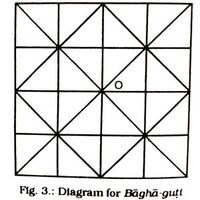 Bagha Guti
-
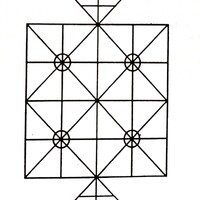 Bagh Bandi
-
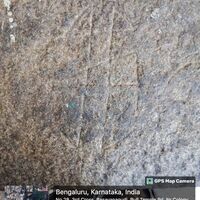
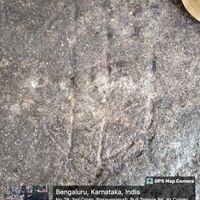 Bagh Chal, Bull Temple (4)
-
 Baghchal, Bull Temple (3)
-
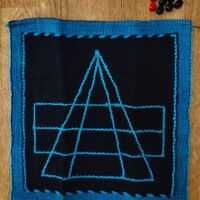 Baghchal, Handmade
- Entered by (dcterms:accrualMethod)
- Adrija Mukherjee
- Tags (dcterms:conformsTo)
- Games of Bhutan
- Tigers and Goats
- Bagh Chal
- Etched games
- Two-player
- Hunt
- Capture
- Shape: Square
Linked resources
| Title | Class |
|---|---|
| Bagh Bandi |
Text |
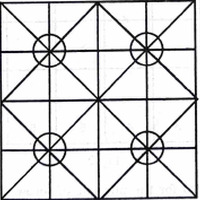 Bagh Batti Bagh Batti |
Text |
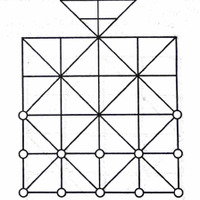 Bagh Chal (variant),Odisha Bagh Chal (variant),Odisha |
Text |
| Bagh Chal, Bull Temple (4) |
Physical Object |
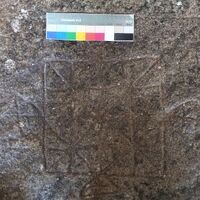 Bagh Chal, Bull Temple (1) Bagh Chal, Bull Temple (1) |
Physical Object |
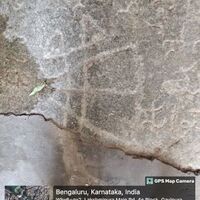 Bagh Chal, Bull Temple (2) Bagh Chal, Bull Temple (2) |
Physical Object |
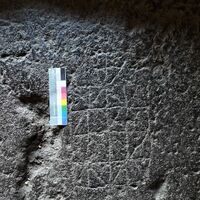 Bagh Chal, Ellora Bagh Chal, Ellora |
Physical Object |
| Bagh Chal, Kamakhya |
Text |
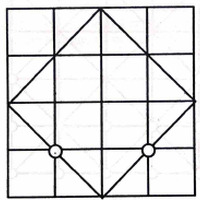 Bagha Chheli ( Odisha) Bagha Chheli ( Odisha) |
Text |
| Bagha Guti |
Text |
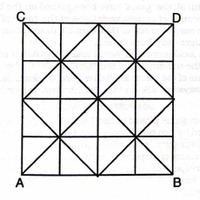 Baghchakkar or Chakrachal Baghchakkar or Chakrachal |
Text |
| Baghchal, Bull Temple (3) |
Physical Object |
| Baghchal, Handmade |
Physical Object |
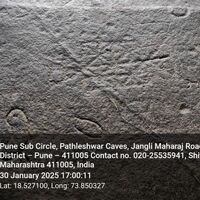 Baghchal, Pataleshwar (2) Baghchal, Pataleshwar (2) |
Physical Object |
| Bam Blang Beh Khla |
Text |
| Kaooa |
Text |
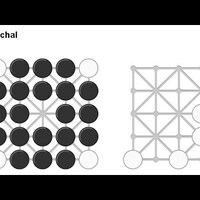 Kulaochal Kulaochal |
Text |
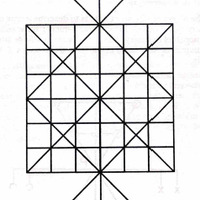 Mughal Pathan Mughal Pathan |
Text |
| Sher Bakar |
Text |
 Sher Bakr Sher Bakr |
Text |
| Taag dha Nor or Tagnor (Tiger and Cow) |
Image |
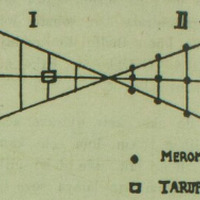 Tarup Ar Merom (leopards and goats) Tarup Ar Merom (leopards and goats) |
Text |
 Terhuchu Terhuchu |
Text |