Dashavatar Cards
Item
- Title (dcterms:title)
- Dashavatar Cards
- Description (dcterms:description)
-
The Dashavatar cards of Bishnupur is a product of transculturation of locally made playing cards that came from the Mughal Ganjifa Cards. The Mughal Ganjifa Cards, possibly originated in Islamic Persia or Mameluke Turkey and they travelled to India and soon gained popularity and started having its own regional variants such as the Dashavatar cards which depict the ten incarnations of Lord Vishnu in a set of 120 cards. While the Mughal Ganjifa consisted of 8 suits with the Raja (king card) and the Mantri (vizier card) along with its number cards, this set had 10 suits belonging to each avatar namely, Matsya, Kurma, Varaha, Narasingha, Vaman, Parasuram, Ram, Balaram, Buddha/Jagannath, and lastly Kalki. The Dashavatar cards also had each avatar as a king and vizier card along with numeric cards of 1 to 10.
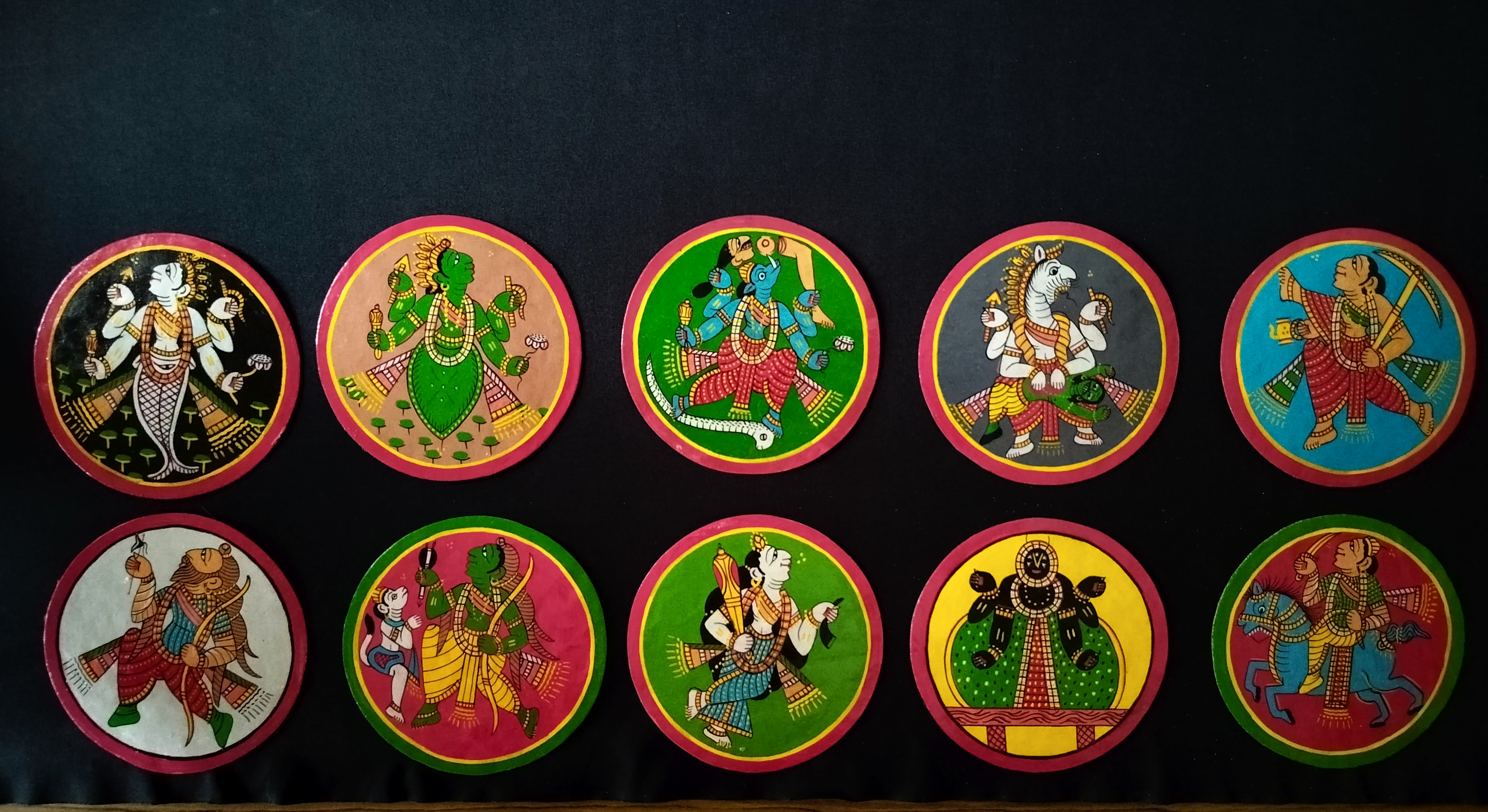
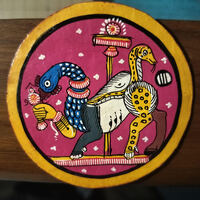
While the transition of Mughal Ganjifa to its regional variants is still unknown, the makers of the Dashavatar cards in Bishnupur trace back their lineage to the Rajputs in Rajasthan. The artist, Shital Fouzdar belongs to the eighty ninth generation of artists making these hand painted playing cards. The Fouzdar family has been associated with the Malla Rajas of Bishnupur and are popular for making these cards. The image here shows only the 10 raja cards of the avatars. These cards are 8inches in diameter which is larger than the usual 6inches diameter of other regional variants of dashavatar cards such as in Orissa and Maharashtra. Another interesting feature of these cards lies in the differences in their artistic styles, the materials they use, their iconography and even the avatars that they paint. For example in Bishnupur (West Bengal) and Raghurajpur (Orissa) the ninth avatar is Jagannath whereas in other places such as Sawantwadi (Maharashtra) it is Krishna or even Buddha in some cases.
The different variants of the game have their own rules: in some variants, the game starts in the daytime with the earlier avatar suits and at nighttime with the later avatars. When it rains, the game starts with the Matsya (fish) or Kurma (tortoise) suits as these are aquatic animals. In Bishnupur, the scenario is different and the Narasimha suit becomes the opening suit at twilight and the matsya suit opens the game in the daytime. The most powerful card as it is with the mughal ganjifa is the king followed by the mantri or the vizier. In case of dashavatar cards, there are two face cards such as the raja and mantri cards (king and vizier respectively) of the avatars and 10 numeric cards. In these cards, the number is depicted by the counting of symbols of the particular suit (number of fish in case of Matsya). In the first five suits the numeric card 1 is the highest after the raja and mantri card while 10 is the lowest. In case of the last 5 suits the numeric card of 10 becomes the highest while 1 becomes the lowest. - Alternative Title (dcterms:alternative)
- Ganjifa cards
- Rules (dcterms:instructionalMethod)
-
Although the iconography varies of Dashavatar cards from the Mughal Ganjifa cards, the rules of the game remain similar. Like the Mughal Ganjifa cards, the first five avatars Matsya, Kurma, Varaha, Narasingha and Vaman are more powerful suits than the last five avatar suits namely Ram, Parasuram, Balaram, Jagannath and Kalki.
The main cards are the Raja (king card) and the Mantri (vizier card) followed by numeric cards of 1 to 10. In the first 5 avatars the the numbers are counted from 10 to 1 and in the last 5 it is counted from 1 to 10.
Total cards are 120 which are distributed amongst 5 players seated in a circle while the cards are distributed. The game begins from the right-hand side of the player who distributes the cards. 4 cards are distributed at a time to each player. Each player should have 24 cards at the end of the distribution.
The point for winning the game is also 24.
The game begins with the player who has the starter card or the trump card. The rule of the starter card varies from region to region and also differs during daytime, night time or during monsoons. Like in Bishnupur, if the game is played in the morning the starter card is Ram, in the evening it is Narasingha, and at night it is Matsya. At dawn the starter card changes to Jagannath and during monsoons it changes to Kurma. During the game, if the player passes the card onto another it is called ‘seroya’ or ‘serowa’. If one player passes his turn onto the player on their left side, the value of that pass is a two pointer for that player.
The game is said to be difficult. It is a 24-point game played by 5 people. In the beginning of the game the players decide how many hands they want to play also called 'par' or 'chillik'. If any player plays and wins 5 hands the total score is 25(5X5), 24 has to be deducted from their hand which remains 1 so that 1 point is added as a winning point. Similarly, if a player wins 7 hands, the total score is 35 and 24 is deducted from it leaving 11. Those who win less than 5 hands get negative points. The player who gets the largest number of points at the end of the agreed number of turns.
In another variant from a source, it states that that the total hand should be 24 and every hand gives the player 5 points while losing every hand deducts that 5 points from the total. In the end whoever has the highest number of points wins the game. - Creator (dcterms:creator)
- Shital Fouzdar
- Source (dcterms:source)
- Shital Fouzdar
- Contributor (dcterms:contributor)
- Souvik Mukherjee and Adrija Mukherjee
- Rights (dcterms:rights)
- Creative Commons
- Format (dcterms:format)
- Playing Cards
- References (dcterms:references)
-
Hopewell, Jeff. 2010. Ganjifa - The Traditional Playing Cards of India. IPCS Papers. London: International Playing-Card Society.
Kar,Pradip. Bishnupurer Dashavatar Tash. Terracotta. Kolkata.
Lochan, Pramila. 2019. Splendours of Ganjifa Art. Edited by R.H. Kulkarni, Pramila
Leyden, Rudolf Von. 1982. Ganjifa: Playing Cards of India. London: Victoria & Albert Museum.
Ramamitra, Singha Mahapatra. 2021. Mallabhumer Dashabatar Tas. Suprokash Anchalcharcha Granthamala. Kolkata
- Medium (dcterms:medium)
- Playing Cards on Cotton Cloth
- Spatial Coverage (dcterms:spatial)
- Bishnupur, West Bengal
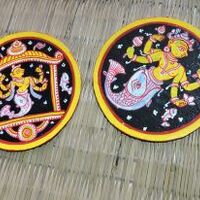
- Media
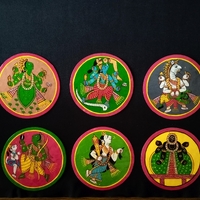 Dashavatar cards
Linked resources
| Title | Class |
|---|---|
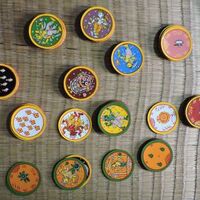 Dashavatar Ganjifa Card, Raghurajpur Dashavatar Ganjifa Card, Raghurajpur |
Physical Object |
 Interview with Ganjapa [Ganjifa] artist Banamali Mahapatra Interview with Ganjapa [Ganjifa] artist Banamali Mahapatra |
Interview |
| Title | Class |
|---|---|
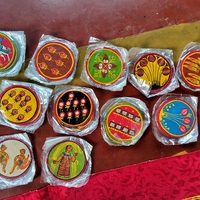 Bishnupur Naksh/Naqsh Cards Bishnupur Naksh/Naqsh Cards |
Physical Object |
| Dashavatar Cards |
Physical Object |
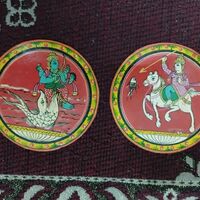 Dashavatar Cards, Sawantwadi Dashavatar Cards, Sawantwadi |
Physical Object |
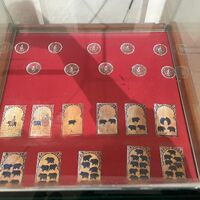 Mughal Ganjifa from Rajasthan Mughal Ganjifa from Rajasthan |
Text |
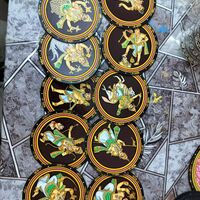 Mysore Chhad Ganjifa Mysore Chhad Ganjifa |
Physical Object |
 Navagunjara Ganjifa Card, Raghurajpur Navagunjara Ganjifa Card, Raghurajpur |
Physical Object |