Golok Dham
Item
- Title (dcterms:title)
- Golok Dham
- Description (dcterms:description)
-
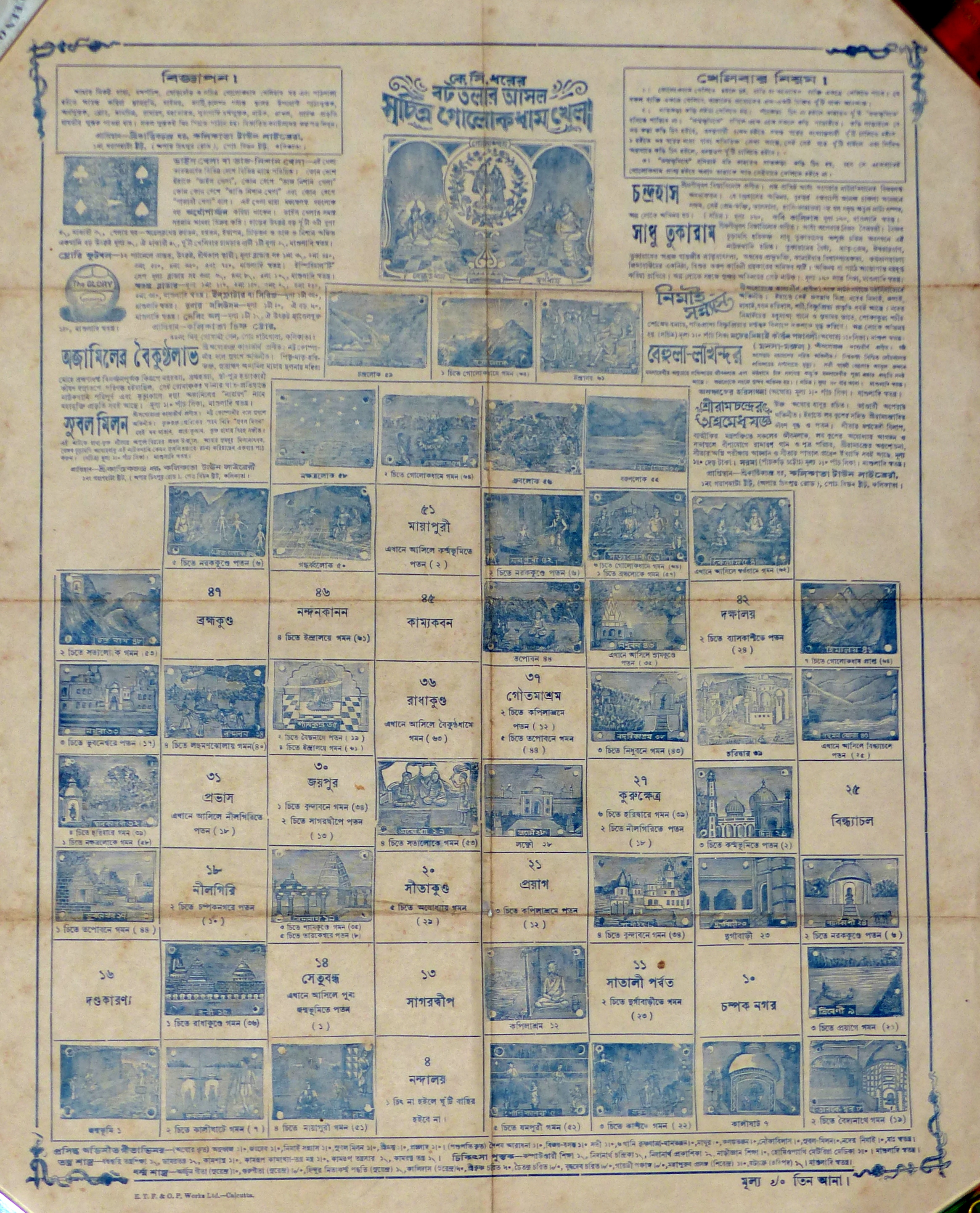
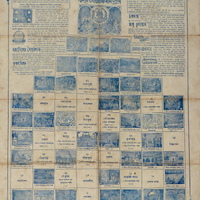
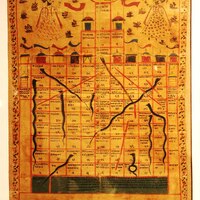
Golok Dham is a variant of Gyan Chaupar but instead of snakes and ladders, it portrays multiple place names and moral situations on a grid. The game seems similar to Western moral education games such as Mansions of Happiness but a greater similarity is observed with Sa lam nam bzhag, the Tibetan Game of Rebirth and Liberation. The game is clearly Vaishnavite and ends with the player reaching GolokDham or the abode of Vishnu. The game is a proto-hypertext because it often offers multiple moves from the same square based on the dice throws of the player.
'The board designed with arrays [was] printed first at the Tara Art Press, date of its initiation almost coincided with the time when in 1 870s and 1 880s, the religious and mythodological pictures were being produced by numerous small presses of Battala locality.3 A specific reference of this game is found in the conversation of Shree Ramakrishnadeb on 2nd October 1884. Ref. Shreema Kathita "Shree Shree Ramkrishna Kathamrita", Kalikata, 1339, Vol. IV, p. 179. The pictures used were stylistically next of kin of the kind of mythological pictures produced by those small presses throughout this period. As an instance the chromolithographie picture of Radha and Krishna, a production by the Kansaripara Art Studio may be cited.4 The picture given on the top of the golokdham game board (square no. 64) seems almost to be a replica of the aforesaid chromolithograph. The treatment of the mytho- pictures produced by the artists of Kansaripara or Chorebagan was cruder than the Calcutta Art Studio prints. ' (Bagchi 2005) - Alternative Title (dcterms:alternative)
- shochitro golok dham; golok dham khela
- Rules (dcterms:instructionalMethod)
-
1. Golokdham is played by two, four or multiple players (playing as a groups).
2. It is played with seven cowrie shells. If five shells do not show their concave sides, the player will not be 'born' in the game world. Once the players reaches the 'birth' square, they can proceed to other squares as per the dice throw and the instructions on the board.
3. If someone throws a 7 while on the birth square, then (s)he reaches GolokDham (square 64) directly
[Note: the rules are written on the top right corner of the board and have been translated here] - Creator (dcterms:creator)
- Kartik Chandra Dhar
- Source (dcterms:source)
- Tarar Chhayay Museum; Apurba Kumar Panda
- Contributor (dcterms:contributor)
- Apurba Kumar Panda
- Rights (dcterms:rights)
- Apurba Kumar Panda
- Format (dcterms:format)
- boardgame
- Medium (dcterms:medium)
- Paper, lithograph
- References (dcterms:references)
-
Bagchi, Anita. 2005. “Golokdham Khela: Its History and Social Perspective.” Proceedings of the Indian History Congress 66:736–46.
- Temporal Coverage (dcterms:temporal)
- 1870s to 1950s
- Spatial Coverage (dcterms:spatial)
-
Bengal, Assam;
Made in 1 Chitpur Road (Garanhata Street) - Variants (dcterms:isVersionOf)
-
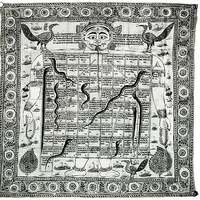 Gyan Chaupar board (Jain version), Lokapurush motif
-
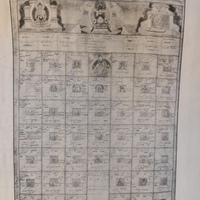 Tibetan Game of Rebirth and Liberation (Sa lam rnam bzhag)
- Date (dcterms:date)
- 30 March 2025
- Entered by (dcterms:accrualMethod)
- Souvik Mukherjee
- Approximate time period (dcterms:valid)
- 1870
- Media
 GolokDham Khela
Linked resources
| Title | Class |
|---|---|
 Gyan Chaupar board (Jain Version) Gyan Chaupar board (Jain Version) |
Physical Object |
| Gyan Chaupar board (Jain version), Lokapurush motif |
Physical Object |
| Tibetan Game of Rebirth and Liberation (Sa lam rnam bzhag) |
Image |