Bheri Bakri
Item
- Title (dcterms:title)
- Bheri Bakri
- Description (dcterms:description)
-
This game was documented at the region of Uttarkhand, which was once known as the British Garhwal by Hem Chandra Das Gupta during his geological fieldwork. The informants were inhabitants of the area.
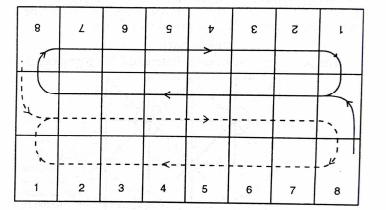
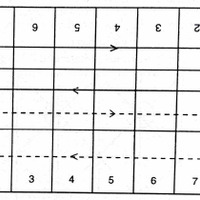
The game of bheri-bakri (sheep and goat) is a two person game played with 16 pieces equally divided between the players and 4 pieces of cowries as the dice. The 16 pieces represent the sheep and the goats white being the goats and the sheep is black. By means of the vertical and the horizontal lines the rectangular-diagram used for the play is divided into 24 compartments and of them 8 belong to each player as shown in the image. While the board looks similar to Tablan or Tabul Phale and the use of 4 cowries as dice might be similar, but there are other differences in the way both games are played.
- Alternative Title (dcterms:alternative)
- Tabla, Tabul Fale,
- Rules (dcterms:instructionalMethod)
-
The pieces are arranged in the order as indicated in the diagram and their movement is regulated by the result of the throw of the cowries, the result being described as pod, do, tin or car— which is, the number of points gained—according as the number of cowries which show their mouths up after each throw is one, two, three, or four.
When no cowrie shows its mouth up after a throw, the player gets no point to his credit. After the players have arranged their pieces in the way as stated, they begin to throw the cowries and when a player gets a pod to his credit, he is able to move the piece lying in the compartment marked 8 to the next one lying in the middle row which is the neutral row.
A player who has a pod to his credit is entitled to have a second throw of the cowries.
One player can play only with one piece at a time ie., the piece occupying the compartment No. 8 has to be brought out first and must be captured by the other player before the former player can bring out the piece occupying the 7th compartment of his own row.
After a piece has been moved from its original compartment to that in the neutral row, a player (say A) can move it from one compartment to another, the number of movements being regulated by the number of points gained, if he has 3 points in his favour, his piece will occupy the third compartment unless it is already occupied by a piece of his opponent (say B) in which case the latter piece will be captured by A whose piece will now occupy the compartment thus made vacant.
For all points of one, i.e., pod, the requirements of the pieces lying within the player's own row of compartments must be satisfied first and before all the pieces have been shifted from one compartment to another, the piece which is out of the player's row of compartments may not be moved for a throw that gives to the player credit for one point only, i.e., pod.
No piece may be moved from its original compartment unless the player to whom the compartment belongs has got a pod to his credit. Thus if the piece No. 8 belonging to a player be captured and if the piece No. 7 has not been previously shifted by him owing to his not having secured already a pod necessary for the purpose, it (the piece No. 7) shall be moved only when he succeeds in getting a pod to his credit and the other throws in the interval, carrying other values, are of no avail to him.
A player's piece, when out of his own row of compartments, has to be moved from right to left in the neutral row and from left to right in that of his adversary. It can never be made to enter the player's own row but must be moved only in the other two rows spirally in the directions as mentioned above and also indicated in the diagram. The pieces of the player are to be moved gradually from a lower number to a higher one and to the neutral zone only from the compartment marked 8.
Whoever of the two players succeeds in capturing all the pieces belonging to his adversary is the winner.
- Creator (dcterms:creator)
- Hem Chandra Das Gupta
- Source (dcterms:source)
- ‘Two Types of Sedentary Games Prevalent in British Garhwal’ by Hem Chandra Das Gupta in Sedentary Games of India eds. Nirbed Ray and Amitabha Ghosh
- Contributor (dcterms:contributor)
- Hem Chandra Das Gupta
- Rights (dcterms:rights)
- Creative Commons
- Format (dcterms:format)
- Boardgames
- Medium (dcterms:medium)
- Boardgames on Text
- References (dcterms:references)
- Bheri Bakri - Digital Ludemi Project
- ‘Two Types of Sedentary Games Prevalent in British Garhwal’ by Hem Chandra Das Gupta in Sedentary Games of India
- Spatial Coverage (dcterms:spatial)
- Uttarkhand
- Variants (dcterms:isVersionOf)
-
 Gud Phale
-
 Tabul Phale
-
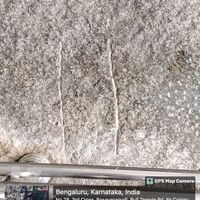 Incomplete Board, Bull Temple
-
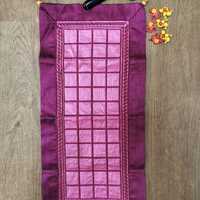 Tablan, Handmade
-
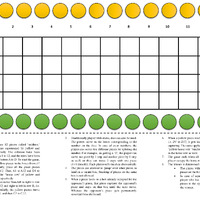 Tablan: Downloadable Game
-
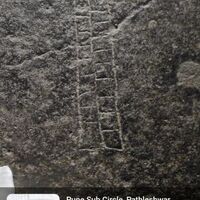 Tablan, Pataleshwar
-
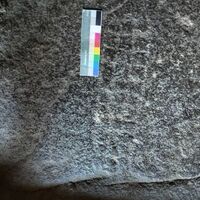 Graffiti Boardgame Tablan in Kailash Temple Ellora
-
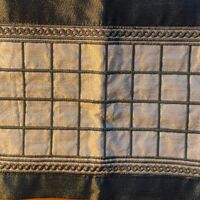 Tablan
- Entered by (dcterms:accrualMethod)
- Adrija Mukherjee
- Notes (foaf:status)
- This essay was written before the independence period of India when the region of Uttarkhand was a province called the Garhwal region. Although still popularly known as Garhwal Himalays, Uttarkhand is mentioned in the description owing to current location of the state.
Linked resources
| Title | Class |
|---|---|
| Incomplete Board, Bull Temple |
Physical Object |
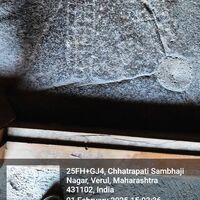 Tablan, Jagannatha Sabha, Ellora Tablan, Jagannatha Sabha, Ellora |
Physical Object |
| Tabul Phale |
Text |