Tant Fant
Item
- Title (dcterms:title)
- Tant Fant
- Description (dcterms:description)
-
This game was documented in an essay by Jantindra Mohan Datta. The games he described were played by locals of Howrah, Hooghly and 24-Parganas. According to Datta this and the other games in the essay are not indigenous in nature. The informant of these games belonged to Panihati. Datta also mentions that similar games were also common in other districts of Asansol, Burdwan, Midnapore, Ranaghat, Santipur, Khulna, and Barisal.
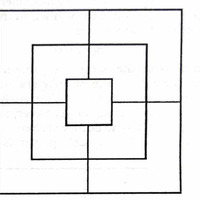
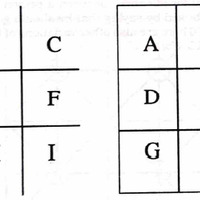
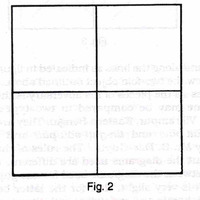
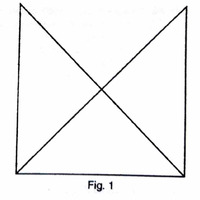
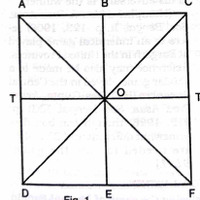
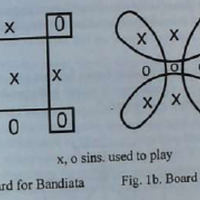
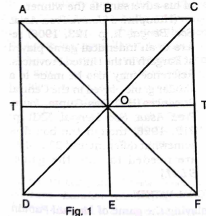
The game of Tant Fant was played by drawing the structure or the diagram of the board on the floor with a piece of charcoal or brick. It is a two player game. At the beginning of the game each player places three distinctive pieces on the three cross-points (ABC or DEF) of their side of the square. In the first move, a piece is shifted to the central line TT. The game is won, when all the three pieces belonging to a player lie in a straight line anywhere (horizontally, vertically, or obliquely) with the exception of the starting line. This game happens to be similar to Bara Guti Pait Pait or Tin Guti Pait Pait in Vikrampore (Dhaka) but unfortunately his description is very meagre. In the game described above no piece of the adversary is to be removed from the board, but in the Vikrampore (Dhaka) game as soon as three pieces are arranged in a straight line, a piece of the opponent is removed from the board. In this way the winner of the game will be one who removes from the board all three pieces of his opponent without losing any one of his piece. - Alternative Title (dcterms:alternative)
- Bara Guti
- Rules (dcterms:instructionalMethod)
-
3x3 intersecting lines with diagonals. Play occurs on the intersections of the lines. Players each have three pieces, initially placed on the sides closest to the player. Players move the pieces to an adjacent unoccupied intersection along the lines. The goal is to make three in a row which cannot be in the starting position. An alternate version requires the three in a row to be diagonal.
- Creator (dcterms:creator)
- Jatindra Mohan Datta
- Source (dcterms:source)
- ‘A Few Types Of Sedentary Games Of Lower Bengal’ by Jatindra Mohan Datta in Sedentary Games of India eds. Nirbed Ray and Amitabha Ghosh
- Contributor (dcterms:contributor)
- Jatindra Mohan Datta
- Rights (dcterms:rights)
- Creative Commons
- Format (dcterms:format)
- Boardgames
- Medium (dcterms:medium)
- Boardgames on Text
- References (dcterms:references)
- ‘A Few Types Of Sedentary Games Of Lower Bengal’ by Jatindra Mohan Datta in Sedentary Games of India
- Tant Fant - Digital Ludemi Project
- Spatial Coverage (dcterms:spatial)
- West Bengal
- Entered by (dcterms:accrualMethod)
- Adrija Mukherjee
- Notes (foaf:status)
- This essay was written before the Independence period of India. Thus some of the districts mentioned such as Vikrampore, Khulna and Barishal are situated in Bangladesh.