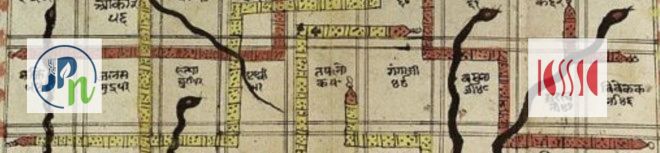
Multiple Pachisi Variants, Jaganmohan Palace Mysuru
Item
![Photo of sixteen handed Pachisi / Pagade. [Credits: Souvik Mukherjee]](https://souvikmukherjeeresearch.com/omekas/files/original/2e4f46ca8c24586c1c77477049edc5c246797050.jpg)
- Title (dcterms:title)
- Multiple Pachisi Variants, Jaganmohan Palace Mysuru
- Description (dcterms:description)
-
There are several variants of Chaupar or Pachisi at the Jaganmohan Palace of Mysore (Mysuru). Some examples are the eight-handed Pachisi, the sixteen-handed Pachisi, and the four handed defensive Pachisi. These and many other games were made by the innovative creation of Maharaja Krishnaraja Wodeyar III(1799-1868), the twenty-second king of Mysore. The rules of these games were written by the king himself in his manuscripts partly in Kannada, and partly in Sanskrit according to R. Vasantha.
The eight-hand Pachisi can be played with two, four, or even eight players. It has a total of one hundred and ninety-two squares or houses on the board. There are thirty-two pawns altogether, divided into eight sets of four, each set in a different color- yellow, green, red, or black. Among these, four sets are plain, while the remaining four sets are marked with vertical lines to distinguish them. This variant can be played with either two octagonal dice or four rectangular dice.
Similarly the sixteen-handed Pachisi can be played by sixteen, eight, or four players. The board consists of three hundred and eighty four houses in total. There are sixty four pawns altogether, divided into four colors- yellow, green, red, and black, with four pawns in each set. Among these, one group of four sets is plain, while another group of four sets is distinguished by vertical lines. A third group of four sets is designed with yellow at the top and bottom and white in the middle, while the fourth group of four sets has the reverse pattern, with white at the top and bottom and yellow in the middle. This variant similarly also requires either two octagonal dice or four rectangular dice to play.
The term Pachisi comes from 'Pachees' or twenty five and according to Vasantha, the king referred this game as 'Pagade Kayi Ata' which had been named after the pawn rather than the number twenty five and these variants were played with two or more stick dice and not cowries. The central 'home' of the pieces or the pawns were called, Mukti Sthala.
- Alternative Title (dcterms:alternative)
- Pacheesi, Chaupar, Chausar, Pagade
- Rules (dcterms:instructionalMethod)
-
The rules of the four hand cruciform Pachisi:-
To start the game, place the 4 pieces on your respective mark. Refer to rectangle home row to start the game. The pieces will move in an anti-clockwise direction along the board through the columns. The main objective of the player is to make their 4 pieces reach the central square before the opponents. This game was traditionally played using 6 seashells. But you can use a dice for playing this game as well. The players take alternate turns to play this game. The pieces move according to the number which comes on the dice/seashells. The player who gets the highest number on their dice or seashells compared to the opponents starts the game by moving their piece. The player gets an additional turn if they get a ‘6’ on their dice. If you are playing with seashells, then you will get extra turns on getting ‘6’, ‘10’ and ‘25’. However, if you get the same number consecutively three times while getting your additional turn, then your entire turn gets cancelled. If you are using dice, then your turn will stand cancelled if you get ‘6’ consecutively three times. The same applies to ‘6’, ‘10’ and ‘25’ on the seashells. (For example, your turn does not get cancelled if you get a 6 and then a 10 and again a 6, the turn will only get cancelled if you get either ‘6’, ‘10’ or ‘25’ consecutively). If a piece lands on a block already occupied by the opponent’s piece, then that piece ‘hits’ the opponent’s piece and stays on that block until the next move. The piece which gets ‘hit’ lands on the zero mark and starts the journey over again. You shall get an extra turn after ‘hitting’ an opponent’s piece. There is no limit to the number of times you ‘hit’ your opponent’s piece and get extra turns consecutively. You can make a ‘pair’ by placing two of your pieces on the same block simultaneously. A single piece cannot ‘hit’ the opponent’s pair, but a ‘pair’ by the player can ‘hit’ the opponent’s pair. In this case, both the pieces from the ‘pair’ of the opponent land back on the ‘0’ mark. The pairs can move half the number of steps as compared to the number you get on the dice/seashells (for instance, your pair can only move 1 step if you get 2). You can break the pair on a block which has a ‘cross’ symbol and move the pieces individually from the consequent turn. The crosses on the board indicate ‘safe squares’; players cannot ‘hit’ each other’s pieces on these ‘safe squares’. A player’s piece cannot occupy these safe places along with the piece of their opponent simultaneously. If you land in a condition in which you get the number which allows you to only move your piece to the ‘safe block’ occupied by the opponent. In such a case, you shall skip your turn. In case you do not wish to move your piece according to the number you get, then you can skip your turn and allow your piece to stay in the same block. A player with their designated ‘home-row’ can enter the coloured columns and eventually reach the central square. Only designated pieces can enter their designated coloured column of the rectangle. For example only blue, green and red pieces can enter the blue, green and red coloured columns respectively. The pieces which reach the central square are removed from the board as they have finished their journey.
On reaching block ‘8’after circling the whole board, the player gets two choices. Either they can enter the respective coloured columns and finish the journey of their respective piece,or they can move along the 9th block, then the 10th and continue with the entire journey over again. The player who is able to make all 4 of their pieces reach their home before their opponents is declared as the winner. The game continues until only one player is left to land all their pieces on the home. In this game, you also get players who are declared as the first runner-up and the second runner-up. - Rights (dcterms:rights)
- Creative Commons
- Format (dcterms:format)
- Boardgames
- Medium (dcterms:medium)
- Cloth
- References (dcterms:references)
- Rangachar, Vasantha, Maharaja's Games and Puzzles. Kelkheim, Foerderkreis Schach-Geschichtsforschung, 2006.
- A Maharaja's Passion- R.G Singh
- Chaupar and Pachisi- Penn Museum
- Pachisi- Cyningstan
- Temporal Coverage (dcterms:temporal)
- 1799-1868
- Spatial Coverage (dcterms:spatial)
- Jaganmohan Palace, Mysore
- Variants (dcterms:isVersionOf)
-
![Photo of sixteen handed Pachisi / Pagade. [Credits: Souvik Mukherjee]](https://souvikmukherjeeresearch.com/omekas/files/square/2e4f46ca8c24586c1c77477049edc5c246797050.jpg) Multiple Pachisi Variants, Jaganmohan Palace Mysuru
Multiple Pachisi Variants, Jaganmohan Palace Mysuru
-
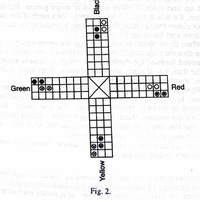 Chonpa- A Variant of Pachisi
-
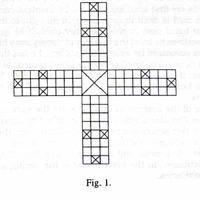 Pachisi
-
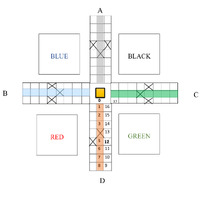 Chaupar: Downloadable Game
-
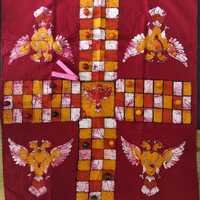 Chaupar, Handmade
-
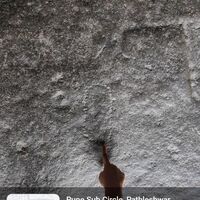 Chaupar, Pataleshwar (Incomplete)
-
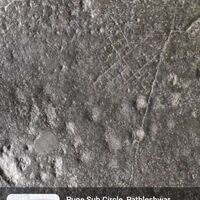 Chaupar, Pataleshwar (3)
-
 Chaupar, Pataleshwar (2)
-
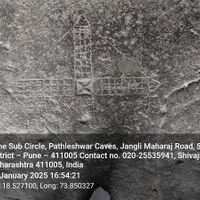 Chaupar, Pataleshwar (1)
-
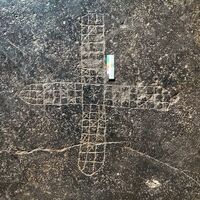 Chaupar, Bhaja
- Entered by (dcterms:accrualMethod)
- Adrija Mukherjee
- Tags (dcterms:conformsTo)
- Chaupar
- Pachisi
- Dice
- Karnataka
- Four-player
- Race Game
- eight-hand Pachisi
- sixteen-hand pachisi
- Maharaja
- Kannada
- Sanskrit
- Media
- 16 hand pachisi.jpg
Linked resources
| Title | Class |
|---|---|
| Multiple Pachisi Variants, Jaganmohan Palace Mysuru |
Physical Object |