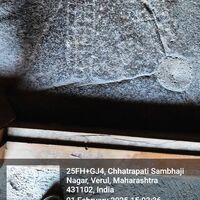
Tablan, Jagannatha Sabha, Ellora
Item
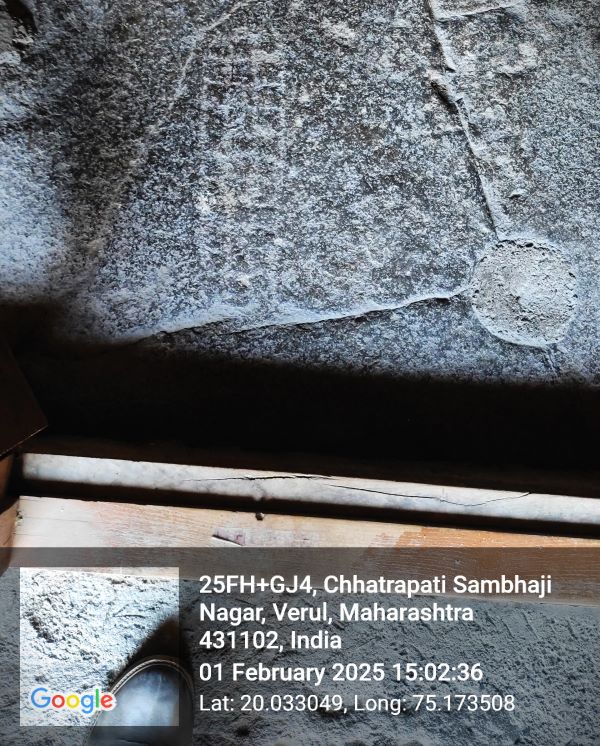
- Title (dcterms:title)
- Tablan, Jagannatha Sabha, Ellora
- Description (dcterms:description)
-
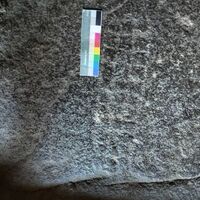
This etched board of Tablan has been recorded from the Jain Cave complex of Ellora at the entrance of Cave number thirty three or Jagannatha Sabha. Etched games or games inscribed have been documented by scholars and board game researchers from many sites of India, both at religious and secular spaces. From sites like Lothal (Indus Valley) to game pieces found at Mohenjodaro, to reference of scholars at books like Sedentary Games and The Boardgame complied by the Anthropological Survey of India, etchings of game boards have been found on stone slabs of places where people gathered, in temple porches or floors of temples and stupa complex.
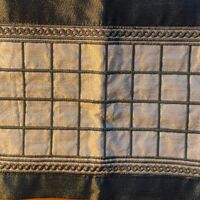
This board has three rows and twelve squares on each row etched on the floor of the cave.
The game of Tablan is said to have originated in Mysore or is popularly played in the southern part of India and along the coastal regions. It is a boardgame of two-players, and is considered a race game. It is usually played with four half-cylinder binary dice.
The The Jagannatha Sabha is considered to be the second largest Jain Cave at Ellora dating back to the 9th century AD, according to the inscriptions on its pillars. This cave is popular for its intricate carvings and it is two storied. It consists of twelve pillars and elephant heads towards a porch, all carved from a single rock. The hall has two heavy square pillars in front, four in the middle area, and a pillared interior square principal hall with fluted shafts, all intricately carved with capitals, ridges and brackets. Inside the major idols are of Parshvanatha and Mahavira, the last two tirthankaras in Jainism. This board has been documented at the entrance of the cave facing the pillared prayer hall. This cave was popular to be a part of the Digambara Sect. - Alternative Title (dcterms:alternative)
- Tablaa, Tabul Phale, Taablan
- Rules (dcterms:instructionalMethod)
-
Each player commences with twelve counters arranged as above. Alternate turns entail a throw of the dice to determine how far to move one of your own counters.
A throw of one plain side up is required for any counter to start movement. Although a throw of one plain side up allows the starting counter to move ahead two steps, it may also be used to move two counters ahead one step each. Likewise, the equivalent steps from a throw of four or zero plain sides up may also be split in half for two different counters. For example, a player that has cast zero plain sides up may move one counter forward six steps and another counter forward six steps. On a player's turn, they cast the dice, move the equivalent steps and then cast the dice again and move the equivalent steps and so on until they throw two or three flat sides up which do not grant movement. Then the turn is over and the dice are passed to the next player. Any legal move that can be made must be taken.
With the opening position shown above, white counters begin moving left to right, black counters begin right to left and all continue in boustrophedon movement throughout the board. Therefore, counters are moving parallel to one another rather than contrary or head to head.
When a counter lands upon an opposing counter by exact throw, the counter that previously occupied the cell is captured by replacement and removed from the board for the rest of the game.
When a counter lands on any square on the enemy’s back row it is immobilized and does not move again during the game. Also, it can no longer be captured. There is no stacking or doubling up of counters. - How to Play Tablan
- Contributor (dcterms:contributor)
- Souvik Mukherjee and Adrija Mukherjee
- Rights (dcterms:rights)
- Creative Commons
- Format (dcterms:format)
- Graffiti gameboard
- Medium (dcterms:medium)
- Boardgame etched on basalt rock floor
- References (dcterms:references)
- Tablan- Boards and Pieces
- Tablan- Digital Ludemi Project
- Tablan- The Bead Project
- Jain Caves at Ellora- Incredible Jainism
- Ellora Caves- Archaeological Survey of India
- Temporal Coverage (dcterms:temporal)
- The Jagannatha Sabha was excavated around 9th century AD.
- Spatial Coverage (dcterms:spatial)
- Ellora, Maharashtra
- Variants (dcterms:isVersionOf)
-
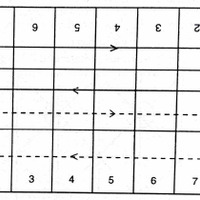 Bheri Bakri
-
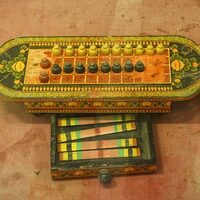 Tabul Phale
-
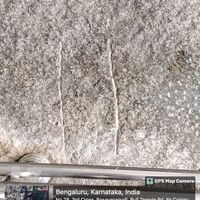 Incomplete Board, Bull Temple
-
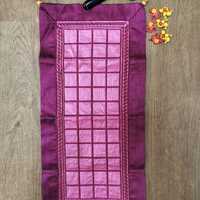 Tablan, Handmade
-
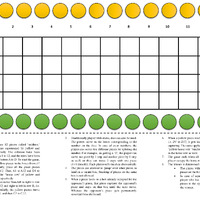 Tablan: Downloadable Game
-
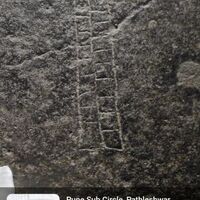 Tablan, Pataleshwar
-
 Graffiti Boardgame Tablan in Kailash Temple Ellora
-
 Tablan
- Entered by (dcterms:accrualMethod)
- Adrija Mukherjee
- Notes (foaf:status)
- As the provenance of these etched boards are unknown, the exact variant and the rule of the game is difficult to trace.
- Tags (dcterms:conformsTo)
- Etched games
- Stone
- Tablan
- Race Game
- Dice
- Two-player
- Ellora
- Maharashtra
- Jain Cave