Mughal Ganjifa from Rajasthan
Item
- Title (dcterms:title)
- Mughal Ganjifa from Rajasthan
- Description (dcterms:description)
-
The card game Ganjifa probably arrived in India during the Mughal era as a popular pastime among the royal court. The game is mentioned in historical writings from that period, including the Baburnama and Humayunnama, memoirs of the first two Mughal emperors as well as the memoir of Gulbadan Begum, the sister of Humayun. Abul Fazl's Ain-i-Akbari, a detailed account of Emperor Akbar's reign names Ganjifa as one of his favorite games.
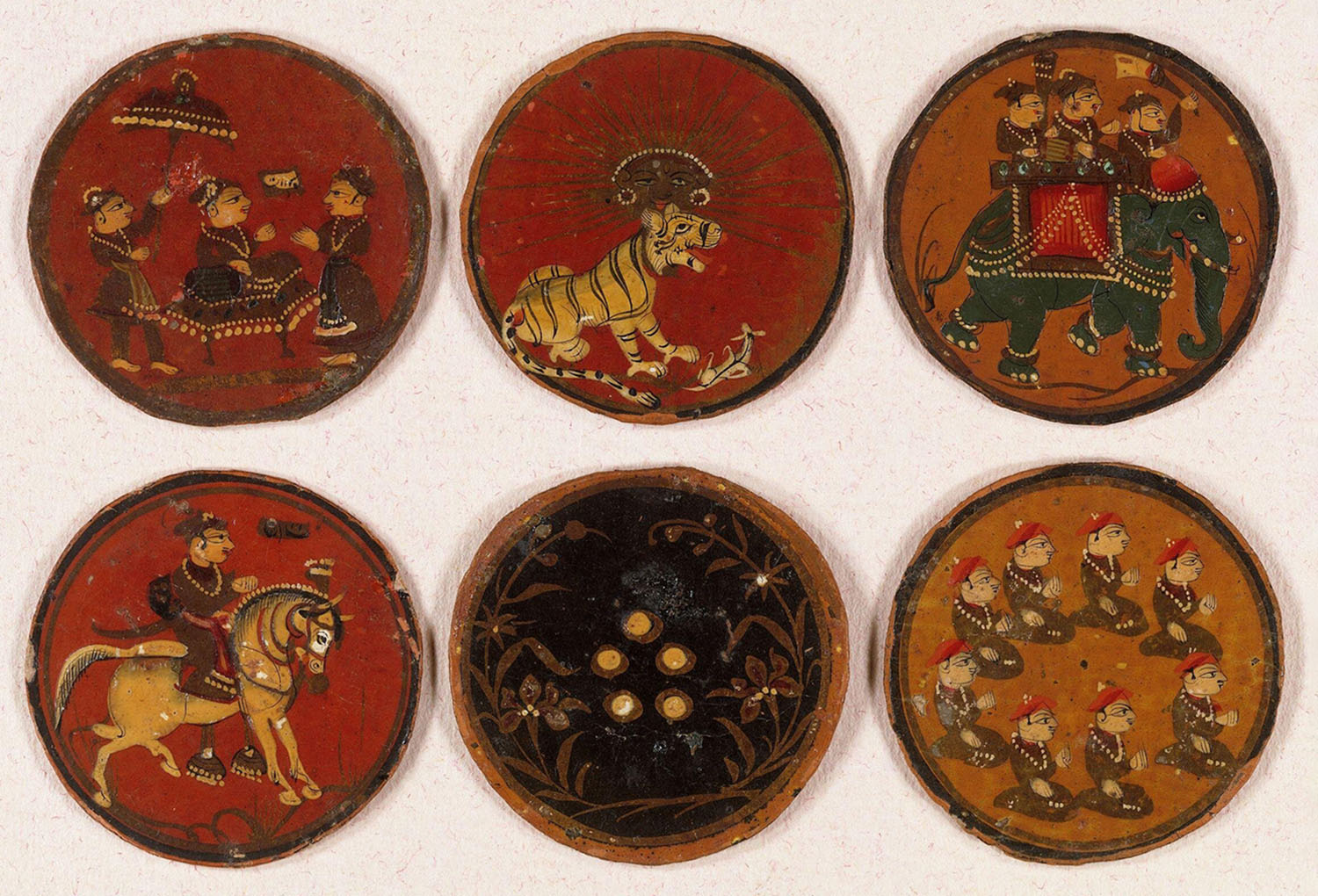
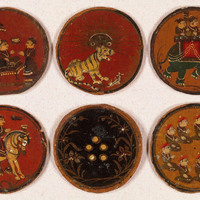
Early Mughal Ganjifa sets were often circular and made from luxury materials like ivory or tortoise shell. These sets typically included 96 cards, divided into eight suits of 12 cards each. Every suit had a King and a Minister card, along with number cards from one to ten, all beautifully decorated with imperial imagery. The suits were categorized into two groups: the "powerful" suits (bishbar) and the "weak" suits (kambar). A 16th-century poet, Ahli Shirazi, recorded the names of these suits bas: gulam (servant), taj (crown), shamsher (sabre), and tanka (silver coin) in the bishbar cards, and barat (cheque or draft), qimash (material wealth), ashrafi (red or gold coin), and chang (a small harp) in the kambar cards.
In the 16th century, Emperor Akbar introduced a unique version of Ganjifa with 12 suits. Each suit in this game represented a different aspect of his kingdom, from the military and finance to mythology and nature. The suits included a wide range of themes, such as divinities (sura), demons (asura), and serpents (ahi).
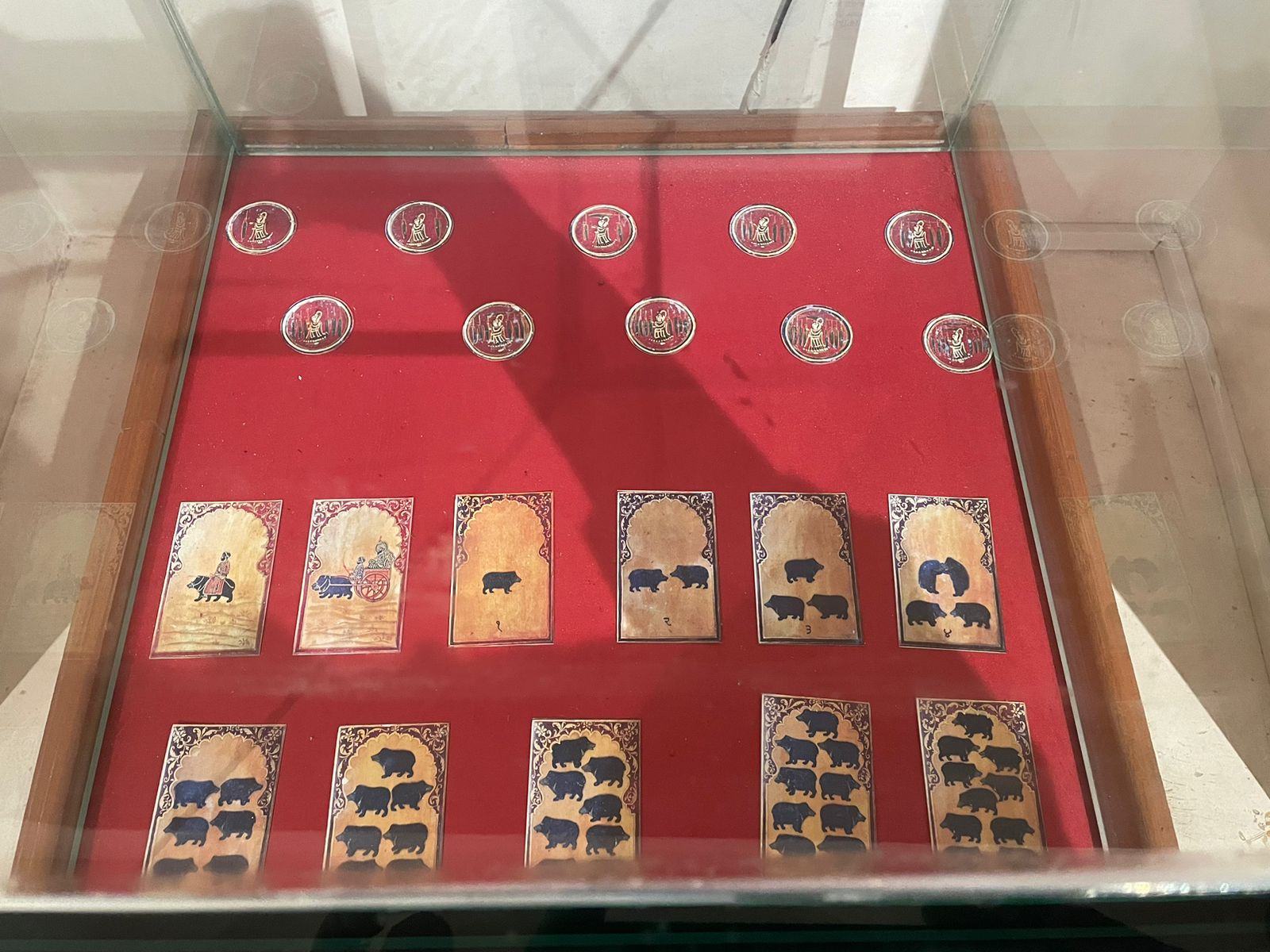
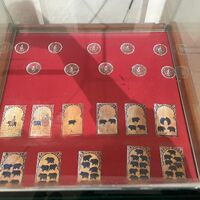
For the next two centuries, Mughal-style Ganjifa remained popular in various regional courts across India. As the game spread, different regions developed their own unique variations and styles. The image here is from Rajasthan's Udaipur Palace and has been kindly shared by Professor Nirmala Menon.
Some of the most well-known regional variations include the Dashavatara Ganjifa from Maharashtra and the Mysore Ganjifa. - Creator (dcterms:creator)
- Souvik Mukherjee
- Source (dcterms:source)
- Udaipur Palace, Rajasthan
- Contributor (dcterms:contributor)
- Nirmala Menon
- Format (dcterms:format)
- Playing cards
- References (dcterms:references)
-
Hopewell, Jeff. Ganjifa - The Traditional Playing Cards of India. IPCS Papers. International Playing-Card Society, 2010.
Kulkarni, R.H. “Ganjifa: Origin and Development - An Art Historical Appraisal.” In Splendours of Ganjifa Art, edited by R.H. Kulkarni, Pramila Lochan, H.A. Anil Kumar, and Tejendra Singh Baoni. Karnataka Chitrakala Parisath, 2019.
Kumar, H.A. Anil. Splendours of Ganjifa Art. Edited by R.H. Kulkarni, Pramila Lochan, H.A. Anil Kumar, and Tejendra Singh Baoni. Karnataka Chitrakala Parishath, 2019.
- Medium (dcterms:medium)
- Paper
- Provenance (dcterms:provenance)
- Not clearly known
- Spatial Coverage (dcterms:spatial)
- Udaipur, Rajasthan
- Variants (dcterms:isVersionOf)
-
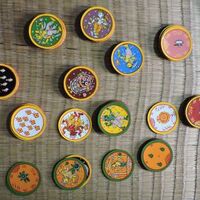 Dashavatar Ganjifa Card, Raghurajpur
-
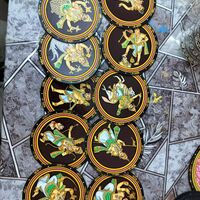 Mysore Chhad Ganjifa
-
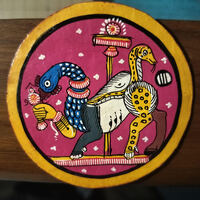 Navagunjara Ganjifa Card, Raghurajpur
-
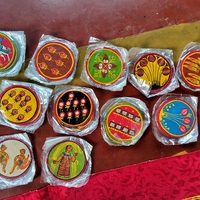 Bishnupur Naksh/Naqsh Cards
-
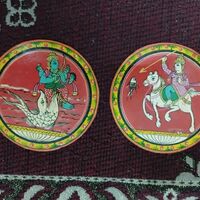 Dashavatar Cards, Sawantwadi
-
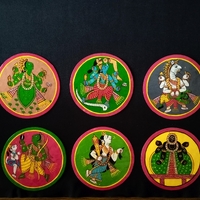 Dashavatar Cards
-
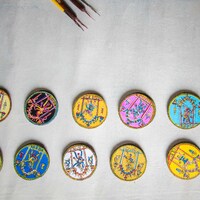 Ramayana Ganjapa from Sonepur
- Tags (dcterms:conformsTo)
- Ganjifa
Linked resources
| Title | Class |
|---|---|
| Mysore Chhad Ganjifa |
Physical Object |
| Navagunjara Ganjifa Card, Raghurajpur |
Physical Object |