-
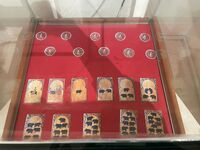 Mughal Ganjifa from Rajasthan
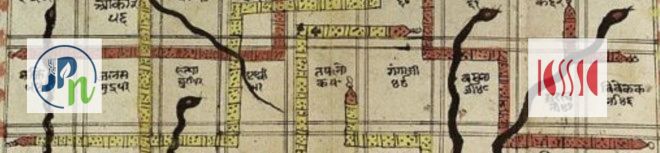
 The card game Ganjifa probably arrived in India during the Mughal era as a popular pastime among the royal court. The game is mentioned in historical writings from that period, including the Baburnama and Humayunnama, memoirs of the first two Mughal emperors as well as the memoir of Gulbadan Begum, the sister of Humayun. Abul Fazl's Ain-i-Akbari, a detailed account of Emperor Akbar's reign names Ganjifa as one of his favorite games.
Early Mughal Ganjifa sets were often circular and made from luxury materials like ivory or tortoise shell. These sets typically included 96 cards, divided into eight suits of 12 cards each. Every suit had a King and a Minister card, along with number cards from one to ten, all beautifully decorated with imperial imagery. The suits were categorized into two groups: the "powerful" suits (bishbar) and the "weak" suits (kambar). A 16th-century poet, Ahli Shirazi, recorded the names of these suits bas: gulam (servant), taj (crown), shamsher (sabre), and tanka (silver coin) in the bishbar cards, and barat (cheque or draft), qimash (material wealth), ashrafi (red or gold coin), and chang (a small harp) in the kambar cards.
In the 16th century, Emperor Akbar introduced a unique version of Ganjifa with 12 suits. Each suit in this game represented a different aspect of his kingdom, from the military and finance to mythology and nature. The suits included a wide range of themes, such as divinities (sura), demons (asura), and serpents (ahi).
For the next two centuries, Mughal-style Ganjifa remained popular in various regional courts across India. As the game spread, different regions developed their own unique variations and styles. The image here is from Rajasthan's Udaipur Palace and has been kindly shared by Professor Nirmala Menon.
Some of the most well-known regional variations include the Dashavatara Ganjifa from Maharashtra and the Mysore Ganjifa.
-
 Interview with Chandrika Padmanabhan, Mysore ganjifa artist
 Detailed interview on Mysore Chhad Ganjifa providing information on the history, the art, the cultural tradition and the survival of the tradition.
-
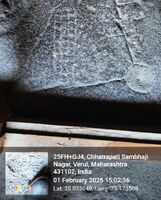 Tablan, Jagannatha Sabha, Ellora
 This etched board of Tablan has been recorded from the Jain Cave complex of Ellora at the entrance of Cave number thirty three or Jagannatha Sabha. Etched games or games inscribed have been documented by scholars and board game researchers from many sites of India, both at religious and secular spaces. From sites like Lothal (Indus Valley) to game pieces found at Mohenjodaro, to reference of scholars at books like Sedentary Games and The Boardgame complied by the Anthropological Survey of India, etchings of game boards have been found on stone slabs of places where people gathered, in temple porches or floors of temples and stupa complex.
This board has three rows and twelve squares on each row etched on the floor of the cave.
The game of Tablan is said to have originated in Mysore or is popularly played in the southern part of India and along the coastal regions. It is a boardgame of two-players, and is considered a race game. It is usually played with four half-cylinder binary dice.
The The Jagannatha Sabha is considered to be the second largest Jain Cave at Ellora dating back to the 9th century AD, according to the inscriptions on its pillars. This cave is popular for its intricate carvings and it is two storied. It consists of twelve pillars and elephant heads towards a porch, all carved from a single rock. The hall has two heavy square pillars in front, four in the middle area, and a pillared interior square principal hall with fluted shafts, all intricately carved with capitals, ridges and brackets. Inside the major idols are of Parshvanatha and Mahavira, the last two tirthankaras in Jainism. This board has been documented at the entrance of the cave facing the pillared prayer hall. This cave was popular to be a part of the Digambara Sect.
-
![Photo of sixteen handed Pachisi / Pagade. [Credits: Souvik Mukherjee]](https://souvikmukherjeeresearch.com/omekas/files/medium/2e4f46ca8c24586c1c77477049edc5c246797050.jpg) Multiple Pachisi Variants, Jaganmohan Palace Mysuru
Multiple Pachisi Variants, Jaganmohan Palace Mysuru There are several variants of Chaupar or Pachisi at the Jaganmohan Palace of Mysore (Mysuru). Some examples are the eight-handed Pachisi, the sixteen-handed Pachisi, and the four handed defensive Pachisi. These and many other games were made by the innovative creation of Maharaja Krishnaraja Wodeyar III(1799-1868), the twenty-second king of Mysore. The rules of these games were written by the king himself in his manuscripts partly in Kannada, and partly in Sanskrit according to R. Vasantha.
The eight-hand Pachisi can be played with two, four, or even eight players. It has a total of one hundred and ninety-two squares or houses on the board. There are thirty-two pawns altogether, divided into eight sets of four, each set in a different color- yellow, green, red, or black. Among these, four sets are plain, while the remaining four sets are marked with vertical lines to distinguish them. This variant can be played with either two octagonal dice or four rectangular dice.
Similarly the sixteen-handed Pachisi can be played by sixteen, eight, or four players. The board consists of three hundred and eighty four houses in total. There are sixty four pawns altogether, divided into four colors- yellow, green, red, and black, with four pawns in each set. Among these, one group of four sets is plain, while another group of four sets is distinguished by vertical lines. A third group of four sets is designed with yellow at the top and bottom and white in the middle, while the fourth group of four sets has the reverse pattern, with white at the top and bottom and yellow in the middle. This variant similarly also requires either two octagonal dice or four rectangular dice to play.
The term Pachisi comes from 'Pachees' or twenty five and according to Vasantha, the king referred this game as 'Pagade Kayi Ata' which had been named after the pawn rather than the number twenty five and these variants were played with two or more stick dice and not cowries. The central 'home' of the pieces or the pawns were called, Mukti Sthala.
-
 Pallanguzhi
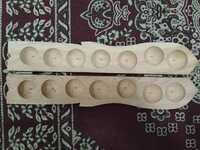
 Pallanguzhi, also called Pallankuzhi is typically known as the game of many pits (pal meaning many and kuzhi meaning pit). The game requires a wooden board with holes on both sides of equal number. There are many kinds of pallankuzhi boards. While the most common one is rectangular with seven pits on each side and at times two extra longer pits. It is a two-player game played by played facing opposite each other. It is played with cowrie shells, precious stones, tamarind seeds or materials locally available to the region. The material used also depended on the socio-economic status of the players along with availability in local regions. The number of stones or cowries used per pit also determined the strategy and the rules of the game. The number of pieces could range from four to twelve or even more.
There are other kinds of boards for example, according to V. Balambal, the Pallanguzhi board of Kanyakumari region is in a triangular shape instead of a rectangle and it is played as a three-player game with five pits belonging to each player. With the number of pits varying the play traditions and the game rules also vary. Usually in Tamil Nadu, there are four kinds of boards. The rectangular with seven pits, a board with six pits with two larger pits to store the cowries or the seeds (closer resemblance to Mancala), the triangular board and another type of board with ten pits on each side and two larger pits at the centre allowing even four players to play with five pits each. As stated from sources, there are examples of the game being played without a board being present. According to Balambal, this game is more popular among women than men. The board at times are pits dug on the ground in order to play or even drawn circles on the ground to serve as a pit. Boards although popularly made of wood, also have other variants of material like metal, ivory or commonly even plastic.
This game is also popular amongst the Muslim community in Southern Tamil Nadu who play this game as a ritual during the fifth day after a marriage ritual with coins. These coins are usually paid by the family of the bride.
-
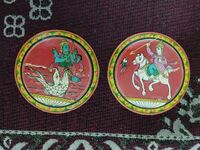 Dashavatar Cards, Sawantwadi
 This image shows a variant of Dashavatar Ganjifa cards sourced from Sawantwadi of Maharashtra. During the 18th and 19th centuries, several regional schools of Ganjifa painting emerged in Sawantwadi. The revival of this craft began when H.H. Rajesaheb Shivramraje Bhonsle, during a visit to the Victoria and Albert Museum in London, noticed a label mentioning Sawantwadi Cards. He and his wife learned the art from the 80-year-old artist Pundalik Chitari, who at that time produced only two sets of Ganjifa per year. Motivated to preserve the tradition, they established Sawantwadi Lacquerwares to promote Ganjifa and lacquer art, with the goal of passing it on to younger generations.
Ganjifa is a product of transculturation in Mughal India or earlier. Ganjifa cards possibly originated in Islamic Persia or Mameluke Turkey and as far as their travel to India is relevant with the earliest sources of Ganjifa cards being mentioned in the Mughal archives by Gulbadan Begum (1523 - 1603), the sister of Emperor Humayun (1508-1556) and later, at length by Abul Fazl (c.a. 1565), the celebrated biographer of the Emperor Akbar (1556-1605) who describes the Ganjifa set at length. The Mughal set consists of the king of Delhi (or the emperor himself) as well as officials from different parts of the administration and other neighbouring states. The Mughal Ganjifa spread to multiple parts of South Asia but has since disappeared from all but a few places in India.
Ganjifa cards also developed into regional variants with the most popular being Dashavatar cards of the ten incarnations of Vishnu into a total card of 120 cards consisting of 10 suits. Each regional variant has their unique variant in play traditions or significance in their trump cards. In Sawantwadi, the ninth avatar is usually Buddha or Krishna whereas in Bengal and Odisha it is typically Jagannath. Hence the ten avatars of Vishnu: Matsya, Kurma, Varaha, Narasimha, Vamana, Parashurama, Rama, Krishna, Buddha, and Kalki consist of one king card, one vizier card and ten numeric cards consisting of one suit. The iconography of the cards also differs depending on the region and their artistic style which makes it significant to the local tradition of the area. The art style of painting the cards are influenced by the Ganjifa painting tradition of Andhra Pradesh. The dimension of the cards are much smaller than that of Bishnupur variant in Brngal or Mysore variant (chhad). The Sawantwadi Ganjifa is an ongoing culture of making cards with locally sourced artisans, supported by the royal family of Sawantwadi. Along with the making, the royal family is also involved in reviving the play traditions of the game.
-
 Download and Play Ganjifa
 Naqsh ruleset provided by Kaushal Gupta in the IPCS journal with some modern adaptations
-
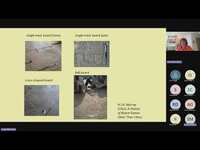 Workshop: Elke Rogersdotter