-
 Lecture by R.G. Singh
-
 Workshop: Niklas Nylund
-
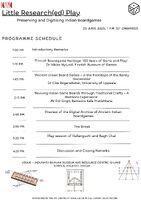 Workshop programme
-
 Interview with Shraddha Bhonsle (Sawantwadi royal family)
 Detailed interview on Sawantwadi Ganjifa providing information on the history, the art, the cultural tradition and the survival of the tradition.
-
 Interview with Dr Arunima Pati 20250217
 Interview with Dr Arunima Pati, eminent expert on Ganjapa / Ganjifa cards.
-
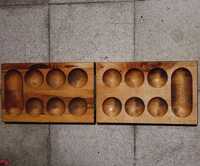 Mancala
 The game of Mancala is considered to be one of the oldest games of the world, while its place of origin and the timeline is debatable. The earliest textual reference as stated by scholars comes from Kitab al-Aghani, or Book of Songs which does not directly mention mancala but refers to a similar game. These rows of cupules have also been excavated in ancient sites like Jordan and many others including megalithic sites in India but their link as to being Mancala is debatable. This game has many variants all across the world and is popular in Africa, Asia, and parts of Eastern Europe. In India, Mancala is known by many names and the rules and variants of the game keep changing based on its region and according to the communities who play them. The number of holes in mancala differ along with the number of rows as well. In some variants the board is hand-drawn on a surface as circles with chalk or even cut holes on the soil to play the game. It is played with local seeds, stones or anything which is easily available as pieces to place inside the pits. The number of pieces per pit also vary from four to even twelve in some variants. This game is popularly a two-player game but some variants also show three players or even one in some case.
-
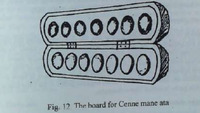 Cenne Mane
 Cenne Mane is played all over Karnataka but it has different names and variants spreading across the region. According to Kulirani and Vijayendra and other scholars, Cenne Mane is itself a variant of the popular game of Mancala. The word chenne is a peculiar word in Tulu language. According to Verupakash et al. it is not used in regular conversation but it is associated with the names of the folk people as chenna, chenni, china, chennu, chennamma, chennappa, chinnappa etc. In Kannada the word chenne- means beautiful and attraction.
India has had many alternate names and variations in rules and strategies of the game. It is often played on a wooden board with depressions. Other times in some regions it is also played by drawing or cutting holes on the ground either on stone or slabs or even temporarily on soil. This game is played for long hours by women more than men and Cenne Mane is also played during the Ashada-Shravan months. It is a two player game, although some variants also mention three players or even one. The intention of winning the game depends on collecting maximum number of seeds or stones or pieces. The pieces are placed in the holes. In case of Cenne Mane, there are four seeds per pit. The game begins in an anti-clockwise direction. This game does not end in one round. There is a case of debts and borrowing that is also followed in some variants.
Cenne Mane is popularly known as Cenne Mane Ata. In the districts of nothern Karnataka it is also called Karu Baruva whereas in southern Karnataka it is known as Buleperga. There are other sub variants that are played like; Jodu Perga, Thara Thimbala, Hegge Thimbala, Mule Ata, Seenya Mukhya, Earns Ata, Arasa Ata and Sithata.
-
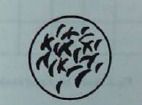 Sankha Khela
 This game was documented by Chhanda Mukhopadhyay and Krishna Basu from Kantabania in Baleshwar district of Orissa from informants aged six to ten years. They are members of the Bauri community and this game was popular amongst them.
This is a two player game. A circle is drawn of about eight to twelve inches radius on the ground with brick pieces or chalk. At the centre of the circle the players assemble broken pieces of glass bangles of different colours to play this game.