-
 Egara Guti
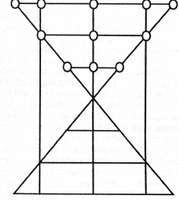
 This game was documented by Hem Chandra Das Gupta from an informant at Bhandara in the Central Provinces. Two players are necessary for the game. There are 23 cross-points and of these 22 are filled up with pieces of two different descriptions, each player having 11 while the central cross-point is kept vacant at the beginning over and capturing the ballet of the adversary lying on the next cross-point if there be an un-occupied cross-point just beyond the latter and in the same line. Not Much information has been given by Das Gupta about the game. He mentioned that this game has resemblance with the game documented in Punjab called Bara Guti but having the central point as vacant. The structure of the board also has some similarities with other forms of alquerque boards like Lau Kata Kati or Kawwa Dorki.
-
 Challis Gutia
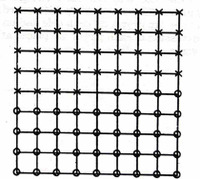
 This game has been documented by Jatindra Mohan Datta in the streets of Ultadanga, Kolkata. The people who knew about the game were inhabitants from Jaunpur, Uttar Pradesh and they stated it used to be played in their village as well. It is a two player game.
One player occupies the points marked with X’s with his 40 pieces —tiny bits of coal as their pieces; his opponent places his 40 pieces —tiny bits of potsherd at the points enclosed by O's. The pieces move one place at a time either vertically or horizontally, if it is vacant: and they capture the opponent's pieces by jumping over the same in a straight line to a vacant point opposite. Successive captures are allowed. The winner is to capture all the pieces of his opponent.
-
 Bara Gutiya
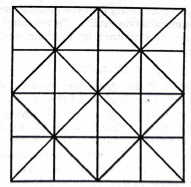
 The game was documented by Charu Chandra Das Gupta from an inhabitant in Kumrahar, Bihar. In this game each player is played with 12 pieces and all cross-points are filled with pieces except the central one which is left vacant. The method of play is similar to that of Ram-tir and Bis-gutiya. It is stated by Das Gupta that this game is a more simplified variant of the two.
-
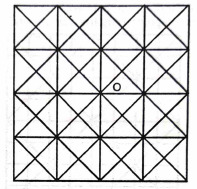 Bis Gutiya
 This game was documented by Charu Chandra Das Gupta in Kumrahar, in Bihar. It is played by two players each having twenty pieces. The central point marked O is left vacant. The method of playing this game is exactly similar to that of the game called Ram-tir also documented in the essay. The main point of interest regarding this game is that in each of the sixteen small square courts there is a cross-point in the centre which is occupied by a piece. On each side there are such eight cross-points on which each player places eight of his twenty pieces.
-
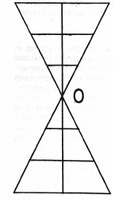 Lau Kata Kati
 This game was documented in an essay by Jantindra Mohan Datta. The games he described were played by locals of Howrah, Hooghly and 24-Parganas. According to Datta this and the other games in the essay are not indigenous in nature. The informant of these games belonged to Panihati. Datta also mentions that similar games were also common in other districts of Asansol, Burdwan, Midnapore, Ranaghat, Santipur, Khulna, and Barisal.
The game of Lau Kata Kati is a two player game. This game is similar to that of Kowwa Dunki and is a version of an Alquerque board. Lau Kata Kati is played with 9 pieces on each side, on a board in the shape of an hourglass. The board is also similar in layout to that of another game Felli from Morocco, but slightly larger, with the nine pieces of each player being arrayed in three rows. There are other similar variants of the structure of the board like Dash Guti, Nao Gutiya and others but the game pieces or the rules may differ from game to game.
-
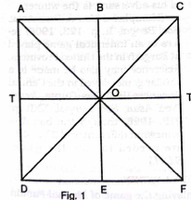 Tant Fant
 This game was documented in an essay by Jantindra Mohan Datta. The games he described were played by locals of Howrah, Hooghly and 24-Parganas. According to Datta this and the other games in the essay are not indigenous in nature. The informant of these games belonged to Panihati. Datta also mentions that similar games were also common in other districts of Asansol, Burdwan, Midnapore, Ranaghat, Santipur, Khulna, and Barisal.
The game of Tant Fant was played by drawing the structure or the diagram of the board on the floor with a piece of charcoal or brick. It is a two player game. At the beginning of the game each player places three distinctive pieces on the three cross-points (ABC or DEF) of their side of the square. In the first move, a piece is shifted to the central line TT. The game is won, when all the three pieces belonging to a player lie in a straight line anywhere (horizontally, vertically, or obliquely) with the exception of the starting line. This game happens to be similar to Bara Guti Pait Pait or Tin Guti Pait Pait in Vikrampore (Dhaka) but unfortunately his description is very meagre. In the game described above no piece of the adversary is to be removed from the board, but in the Vikrampore (Dhaka) game as soon as three pieces are arranged in a straight line, a piece of the opponent is removed from the board. In this way the winner of the game will be one who removes from the board all three pieces of his opponent without losing any one of his piece.
-
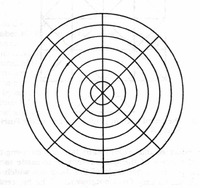 Unidentified Game (Variant of Gol Ekuish)
 This game was documented by Sunder Lal Hora at Kalijhora at present Kalimpong district. The informant of these games was a local man of the area who was of Nepali origin. Credit also has been given to Mr. F.D Raj of Kalimpong who helped confirm the rules and the descriptions of the documented games.
This particular game is untitled or unidentified as the informant could not obtain proper details about it except for the structure of the board. He also states that Mr. F.D. Raj could also not provide the rules of the game.
The structure of the board is exactly similar to Gol-ekuish and if this was another variant the exact rules are unknown. But with the information available in his recorded essay Hora explains that the board consists of seven concentric circles divided by three diameters, thus there are 42 points in which the diameters meet the circles. Two players are required to play the game, one has a large number of ‘goats’ (unfortunately the number could not be understood) and the other plays with only one ‘tiger’. The usual rules of the tiger-play are observed, but the movement can be in all directions and not only along straight lines. In Gol-ekuish each player has 21 ballets which are placed at 21 cross points arranged along three consecutive radii. Thus even with a similar board two or more kinds of lay patterns are possible.
-
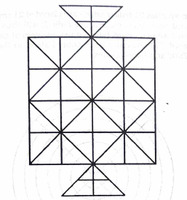 Lam Pusri or Sipahi Kat
 This game was documented by Sunder Lal Hora at Kalijhora at present Kalimpong district. The informant of these games was a local man of the area who was of Nepali origin. Credit also has been given to Mr. F.D Raj of Kalimpong who helped confirm the rules and the descriptions of the documented games.
Lam Pusri is played by two people on a board of 37 points, each player has 18 distinctive pieces which are arranged in such a way that the central cross point is left vacant. This game is similar in every respect to Ahtarah Gutti described by Humphries from Karwi in Uttar Pradesh and Atharagutiala teora described by Das-Gupta in his essay. The rules are also the same as stated by Hora. He also explains that according to his informants, Pusri means tail, and this term is used in the game reference to the triangular pieces at two ends of the diagrams which are likened to tail as they form outgrowths of the big central section of the board. The structure of the board also looks similar to Mughal Pathan documented in Bengal and other places in India.