-
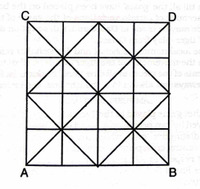 Baghchakkar or Chakrachal
 This game was documented by Sunder Lal Hora at Kalijhora at present Kalimpong district. The informant of these games was a local man of the area who was of Nepali origin. Credit also has been given to Mr. F.D Raj of Kalimpong who helped confirm the rules and the descriptions of the documented games.
This is a variant of Tiger and Goats or Bagh Chal. It is a two player game in an alquerque board. the tiger is represented by four pieces and the goats are represented by twenty. The intention of winning remains similar to other forms of Bagh Chal. For the Tiger, it would be to capture at least five goats and for the goats it would be to encircle the tiger so that it does not have any further moves.
The unique features of this variant is that, the four tigers are placed at the commencement of the game at the extreme four corners and the goats are brought on the board one by one. Secondly once placed, no goat is to be moved from its position till all the goats have been placed on the board.
-
 Lam Turki
 This game was documented by Sunder Lal Hora at Kalijhora at present Kalimpong district. The informant of these games was a local man of the area who was of Nepali origin. Credit also has been given to Mr. F.D Raj of Kalimpong who helped confirm the rules and the descriptions of the documented games.
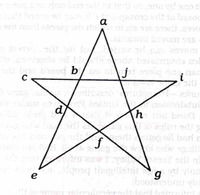
The game is played by one person, so it is a kind of a ‘Solitaire’, but usually a group of people sit together and play the game in turn. It is played on a board of ten cross points arranged as shown in the image. There are nine pieces with which the game is played. The actual play consists of two phases. In the first phase, the person playing has to get all his nine pieces on the board, and then in the second phase, by the usual method of jumping over, has to capture all except one. The pieces can be placed on the board in any way, except that when a piece is placed on a cross point or at a point it cannot be moved elsewhere.
When removing the pieces from the board, they are taken as in draughts by leaping over the piece to be captured to a vacant space in the same straight line. While placing the pieces on the board, the starting should be from any corner point.
Hora also mentions that a similar game has been documented by Humphries called Kowwa Dand in Uttar Pradesh. But the rules of the game were not clear according to Humphries. In the Teesta Valley at that time, Hora described that the game was only played by selective people owing to its difficulty.
He also mentions that 'Lam Turki' means going straight according to the informants which could refer to the characteristics of the movement of the game.
-
 Sher Bakr
 The game that is described in this note is a type of tiger-play prevalent in the district of Shahpur in the Punjab. It is known as Sher Bakr which means lion and goat. The informant of this game was an assistant surgeon of the charitable dispensary of Pail (Shahpur) at the time when Hem Chandra Das Gupta visited the area for his geological fieldwork.
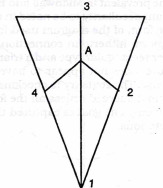
It is a two-player game, one being in charge of one piece, the tiger, and the other in charge of four pieces, the goats. At the beginning of the game the four goat pieces are to be kept at A and the tiger piece at the apex of the triangle, which is at the point marked 1.
The player representing the goat pieces has to move one of his pieces first and then the usual rule is followed according to which a goat piece and the tiger piece can be moved only from one cross-point to another.
But there are some unique points of this game which are worthy of special notice. In all the variants of Bagh Chal or Tigers and Goats recorded, the tiger piece may jump over a cross-point occupied by a goat piece provided the cross-point next to it and in the same straight line is vacant and capture the goat piece. According to the rules of the game as prevalent in Shahpur, the tiger piece may capture the goat piece in this way, while it may also, for the purpose of capturing a goat piece, jump round the angle A either from 2 to 4 or from 4 to 2.
It may also be pointed out that there cannot be more than one goat piece on one cross-point though at the angle A there may be more goat pieces than one. If, however, the tiger piece succeeds in jumping over A and if at that time there are goat pieces more than one only one piece may be captured, recalling in this matter the rules of game recorded in Mianwali, Pakistan.
Another important peculiarity to be noted in connection with this game is the form of the diagram used for playing it. All the diagrams known hitherto in connection with tiger-play are of a square or rectangular type and a triangular diagram. The pieces of the goats are stacked in one place during the beginning of the game which is also one major difference from other variants of tiger and goats.
-
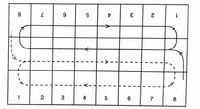 Bheri Bakri
 This game was documented at the region of Uttarkhand, which was once known as the British Garhwal by Hem Chandra Das Gupta during his geological fieldwork. The informants were inhabitants of the area.
The game of bheri-bakri (sheep and goat) is a two person game played with 16 pieces equally divided between the players and 4 pieces of cowries as the dice. The 16 pieces represent the sheep and the goats white being the goats and the sheep is black. By means of the vertical and the horizontal lines the rectangular-diagram used for the play is divided into 24 compartments and of them 8 belong to each player as shown in the image. While the board looks similar to Tablan or Tabul Phale and the use of 4 cowries as dice might be similar, but there are other differences in the way both games are played.
-
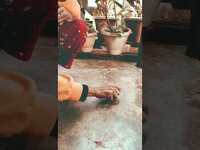 Mawkynting/ Mawkhalai/ Mawsan/Mawdol (five stones)
 Different places have different names for this type of game. Some call it mawkynting some call it mawkhalai some mawsan and sonic mawdot, however the game is the same. This game is very like the Korean stone game, also known as Gonggi (공기).
-
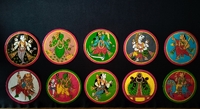 Dashavatar Cards
 The Dashavatar cards of Bishnupur is a product of transculturation of locally made playing cards that came from the Mughal Ganjifa Cards. The Mughal Ganjifa Cards, possibly originated in Islamic Persia or Mameluke Turkey and they travelled to India and soon gained popularity and started having its own regional variants such as the Dashavatar cards which depict the ten incarnations of Lord Vishnu in a set of 120 cards. While the Mughal Ganjifa consisted of 8 suits with the Raja (king card) and the Mantri (vizier card) along with its number cards, this set had 10 suits belonging to each avatar namely, Matsya, Kurma, Varaha, Narasingha, Vaman, Parasuram, Ram, Balaram, Buddha/Jagannath, and lastly Kalki. The Dashavatar cards also had each avatar as a king and vizier card along with numeric cards of 1 to 10.
While the transition of Mughal Ganjifa to its regional variants is still unknown, the makers of the Dashavatar cards in Bishnupur trace back their lineage to the Rajputs in Rajasthan. The artist, Shital Fouzdar belongs to the eighty ninth generation of artists making these hand painted playing cards. The Fouzdar family has been associated with the Malla Rajas of Bishnupur and are popular for making these cards. The image here shows only the 10 raja cards of the avatars. These cards are 8inches in diameter which is larger than the usual 6inches diameter of other regional variants of dashavatar cards such as in Orissa and Maharashtra. Another interesting feature of these cards lies in the differences in their artistic styles, the materials they use, their iconography and even the avatars that they paint. For example in Bishnupur (West Bengal) and Raghurajpur (Orissa) the ninth avatar is Jagannath whereas in other places such as Sawantwadi (Maharashtra) it is Krishna or even Buddha in some cases.
The different variants of the game have their own rules: in some variants, the game starts in the daytime with the earlier avatar suits and at nighttime with the later avatars. When it rains, the game starts with the Matsya (fish) or Kurma (tortoise) suits as these are aquatic animals. In Bishnupur, the scenario is different and the Narasimha suit becomes the opening suit at twilight and the matsya suit opens the game in the daytime. The most powerful card as it is with the mughal ganjifa is the king followed by the mantri or the vizier. In case of dashavatar cards, there are two face cards such as the raja and mantri cards (king and vizier respectively) of the avatars and 10 numeric cards. In these cards, the number is depicted by the counting of symbols of the particular suit (number of fish in case of Matsya). In the first five suits the numeric card 1 is the highest after the raja and mantri card while 10 is the lowest. In case of the last 5 suits the numeric card of 10 becomes the highest while 1 becomes the lowest.
-
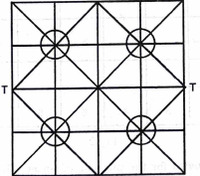 Bagh Batti
 This game was documented at the region of Uttarkhand, which was once known as the British Garhwal by Hem Chandra Das Gupta during his geological fieldwork. The informants were inhabitants of the area.
The game of bagh-batti (bagh or tiger and batti or piece) is a type of tigers and goats or bagh chal played by two people, one of whom is the possessor of two pieces representing two tigers and the other of twenty pieces or battis. There are many variants of Bagh Chal found all across India. It is a hunt game which is also popular in Nepal and sources also show a variant of Tagnor being played in Bhutan. It is an alquerque game and all the variants require two people to play.
The differences lie in the structure of the boards and the number of pieces a tiger represents or goats. In this variant another important difference is that the goats are placed in stacks instead of one in each point which changes the way the game is played. The intention of winning remains similar to other forms of Tiger and Goat games.
-
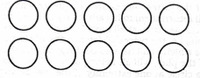 Khutki Boia
 This game was documented by Hem Chandra Das Gupta while he was working on some of his own geological field work. The informants as he stated were Pathan or Pashtun who lived in Mianwali district of Punjab. He explained in his essay that the games he documented from the region were played by everyone in the area including both children and elders, and the games were found at times etched on stone slabs in common spaces. Similar looking boards have been commonly found both in incised patterns in various sites across India inside temples and also in other places.
Khutki Boia is a two-player game. Two rows of five circles are required, each row belonging to one player. According to Das Gupta Khutki Boia literally meant dug circles thus five holes are either dug on the ground or scooped out in slabs of stone i.e. etched or inscribed. At the beginning of the game five pieces are placed in each hole so that each player requires 25 pieces. The rules that are followed are generally like those already described in connection with Mawkar-katya and a few other similar games, the pieces being moved from left to right.