History of Ganjifa
Ganjifa cards derive their name from ganj or 'treasure' or ganjifeh and they are a product of transculturation in Mughal India or earlier. Ganjifa cards possibly originated in Islamic Persia or Mameluke Turkey and as far as their travel to India and their reconfiguration as the Dashavatara cards that show clear Hindu iconography, Jeffrey Hopewell comments:
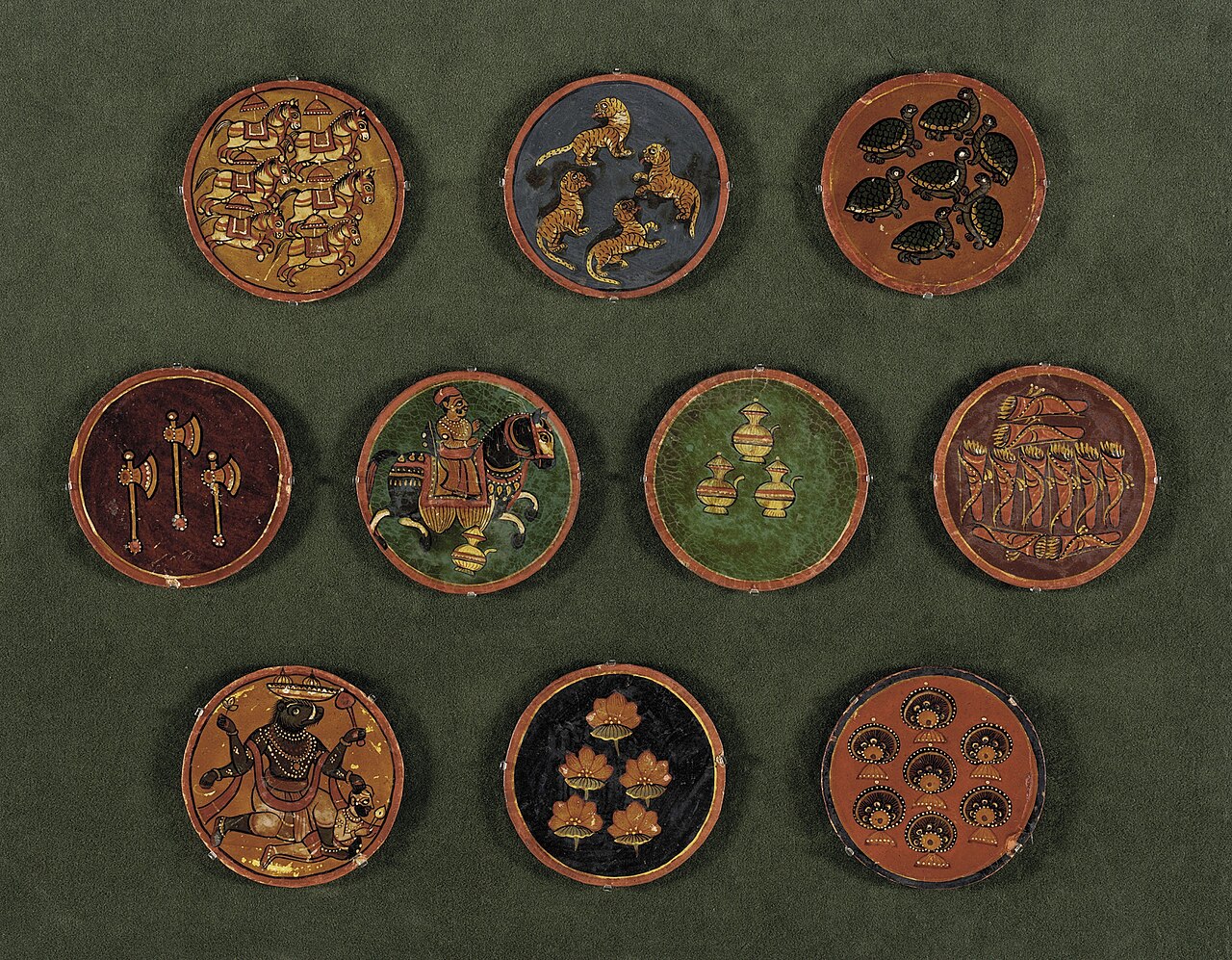
The general assumption is that cards were brought to India by the Mughal Emperors early in the sixteenth century but it is equally possible that they had come with Turkman princes who emigrated to the central part of India known as the Deccan in the late fifteenth century. Once established the cards spread to most regions of India either in the original form with eight suits, known as Mughal ganjifa, or in its slightly later Hindu form with ten suits known as dashavatara ganjifa. (Hopewell 2010: 11)
Ganjifa cards are mentioned in the Mughal archives by Gulbadan Begum, the sister of Emperor Humayun and later, at length by Abul Fazl (c.a. 1565), the celebrated biographer of the Emperor Akbar who describes the ganjifa set at length. The Mughal set consists of the king of Delhi (or the emperor himself) as well as officials from different parts of the administration and other neighbouring states. The Mughal ganjifa spreads to multiple parts of South Asia but has since disappeared from all but a few places in India. As Rudolf van Leyden, an authority on Ganjifa, states ‘one can say with some degree of certainty that foreign (i.e. European) cards had no influence on the development of the eight-suited ganjifa’ (Leyden 10). After the Mughals, the Maratha rulers of India preserved the tradition of the Mughal deck but with their own adaptations. The cards have spread all over India and at one point, they would have been played in Sonepur and Raghurajpur (Odisha), Bishnupur (West Bengal), Odisha, and Mysore as well as those where the transition is not so direct or where the game is no longer played or known. In Sawantwadi, Khem Sawant Bhonsle, a Maratha chief, became a patron of the arts and very likely brought the Mughal ganjifa into his kingdom. Together with the toy-making and other decorative arts, Sawantwadi has become a major hub of ganjifa making. According to Kulkarni, ‘It is in the interest of the local religious beliefs and practices the cards also adopted the local Hindu imagery. Though conceptually they rejected the power of the Mughals, in the case of Ganjifa, it continued to produce Mughal sets side-by-side’ (Kulkarni 2019: 30).
The transition of the cards from the Mughal rule to present times is not as clearly chalked out in the other traditions of ganjifa such as Bishnupur and Raghurajpur, although both claim to have started with royal patronage. Also, the change in the iconography of the Mughal suits of the ganjifa to the more Hindu, both religious and secular sets, is not clearly documented and still an object of research. Nevertheless, both in the Bishnupur and Raghurajpur sets, there are also sets that bear a closer connection to the Mughal ganjifa. Both these traditions of ganjifa have multiple card-suits in addition to the dashavatar cards. The forty-eight card Naksh of Bishnupur and the eight-suited Navagunjara of Raghurajpur (see Pati 70) are such examples. It appears that despite probable independent origins, European cards did at some point coexist with ganjifa cards. In fact, the forty-card, Firangi Ganjifa (loosely ‘European Ganjifa’) is recorded by ganjifa scholar Kaushal Gupta (1979) as being played in Jaipur, Rajasthan. The more compact European card sets would have been easier to play with and the mass-produced and printed cards were obviously much cheaper. Today, as games such as teen patti are identified as iconic, even digitally; the ganjifa set is by contrast more of a rarity and the rules also make play rather cumbersome for modern times. As such, the ganjifa card is becoming more of a handicraft item than an actual game.